

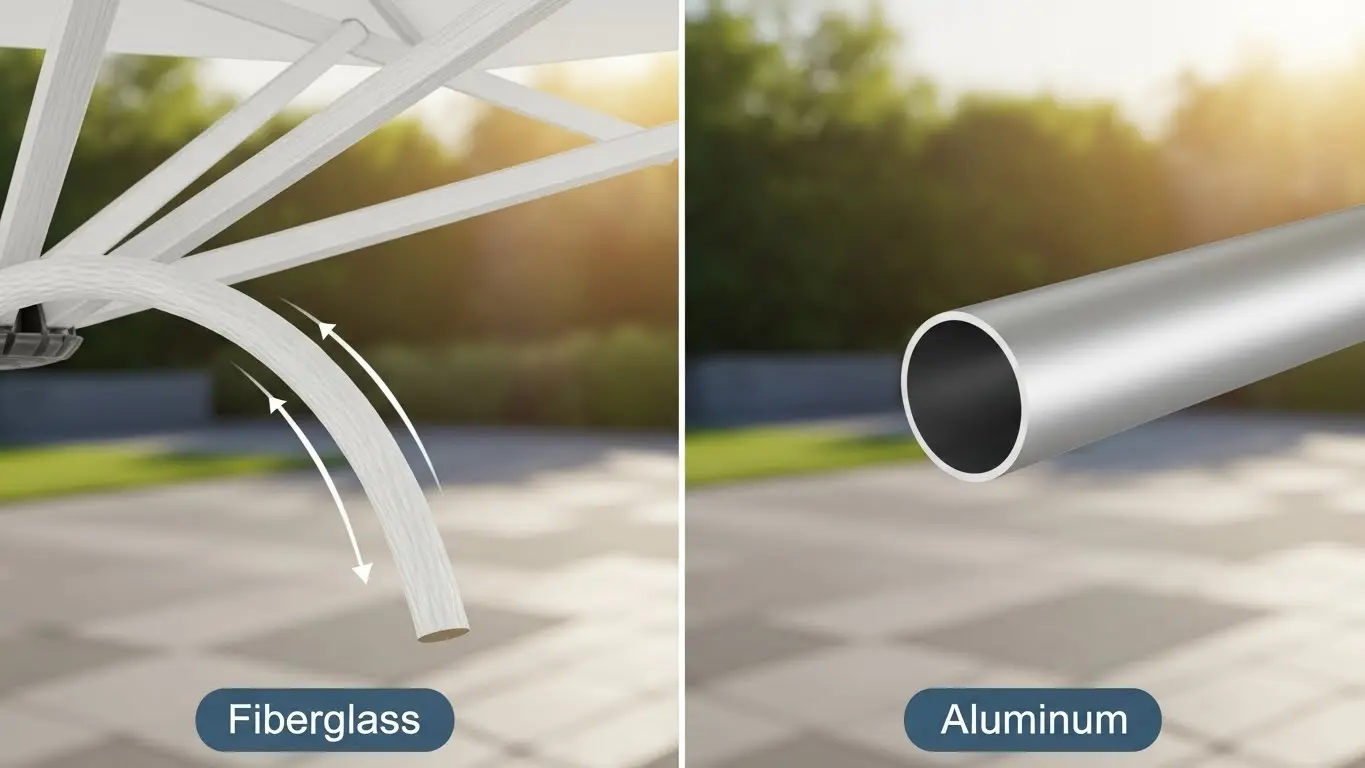
Commercial shade structures in coastal environments face constant stress from wind gusts and salt-driven corrosion. Selecting the right rib technology determines whether frames maintain their shape or suffer from permanent kinking and rust after a single season. We analyze how material density and flexural modulus influence the operational lifespan and safety of high-traffic hospitality furniture.
This analysis compares the mechanical properties of fiberglass and aluminum, highlighting how the 112 lb per cubic foot density of fiberglass offers a lighter, more resilient alternative to aluminum’s 169 lb. We examine the flexural modulus that gives fiberglass its unique shape memory and why maintaining a 12mm rib diameter is essential for reaching the 50,000 Newton tensile capacity needed in commercial settings.
Material Science: Fiberglass vs. Aluminum vs. Steel
Fiberglass serves as the lightest structural option, weighing 112 lb per cubic foot compared to aluminum’s 169 lb and steel’s 490 lb. While all three materials offer comparable tensile strength—ranging from 530 to 590 MPa—fiberglass provides superior fatigue resistance and immunity to chloride-driven corrosion, making it the standard for high-wind coastal environments in 2026.
Weight Ratios and Tensile Strength Comparison
Fiberglass (GFRP) maintains a density of 112 lb per cubic foot, which sits significantly lower than aluminum at 169 lb and steel at 490 lb. Weight per square foot measurements show fiberglass at 1.5 pounds compared to aluminum at 2.5 pounds for equivalent surface areas. Engineering calculations confirm fiberglass weighs approximately half as much as aluminum and one-seventh as much as steel when comparing identical thicknesses.
Tensile strength for GFRP reaches 530 MPa, nearly matching 7075-T6 aluminum at 570 MPa and 304 stainless steel at 590 MPa. This structural efficiency allows fiberglass to support heavy loads without the mass penalties associated with traditional metals, providing a high strength-to-weight ratio essential for contract-grade furniture and infrastructure.
Fatigue Limits and Environmental Durability
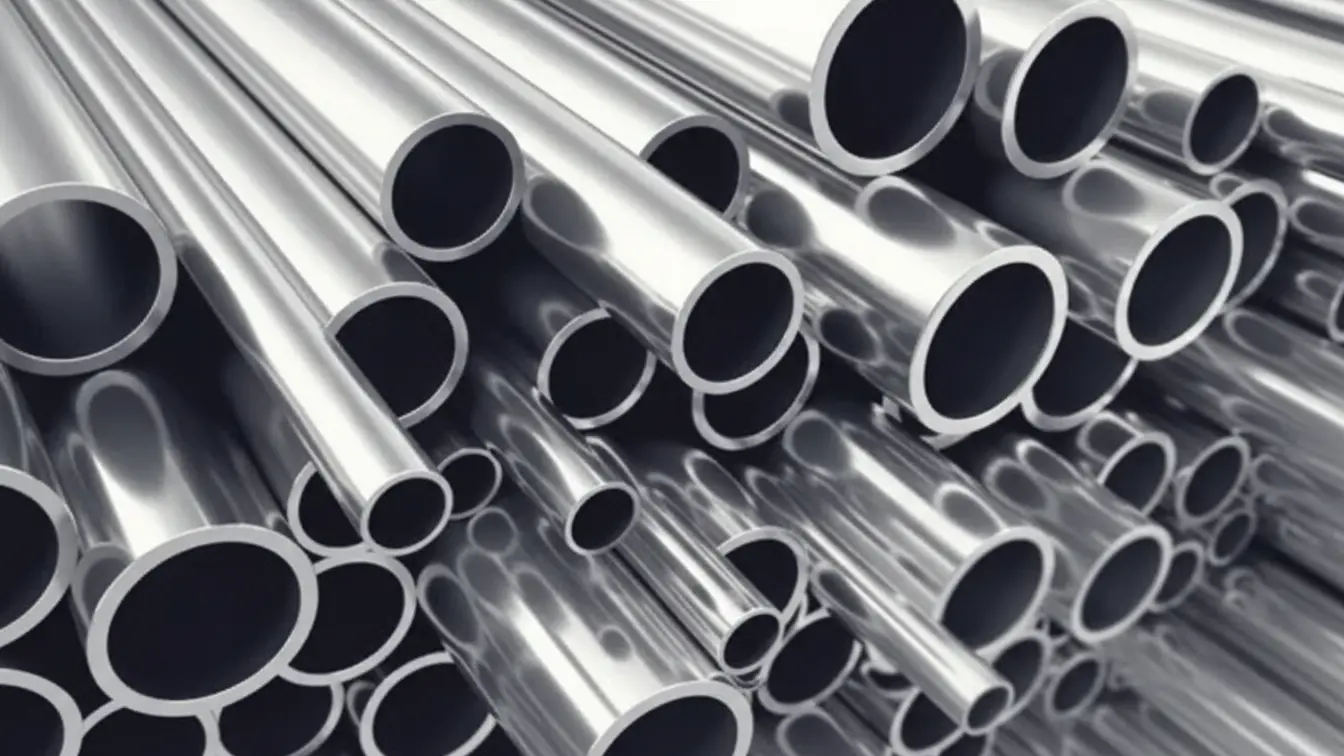
Aluminum lacks a defined fatigue limit and requires engineering for fixed life cycles because the material eventually fails under repetitive stress. Fiberglass and steel demonstrate superior resistance to cyclical load failure, extending the operational lifespan of products subject to constant use. The anisotropic nature of fiberglass allows for optimized strength in the direction of fiber placement, unlike the isotropic properties of steel and aluminum which maintain uniform strength regardless of the load path.
Environmental factors further differentiate these materials. Fiberglass resists pitting corrosion from chlorides and remains stable in alkaline environments, outperforming aluminum in marine and wastewater applications. Thermal thresholds vary significantly; steel melts at 2,800°F and aluminum at 1,220°F, whereas fiberglass reaches its burn point at 500°F, necessitating careful placement in high-heat industrial or fire-critical zones.
The “Memory” Effect: Why Fiberglass Returns to Shape
The memory effect refers to the ability of fiberglass composites to return to their original geometry after bending. This is driven by a stable flexural modulus of approximately 23.9 GPa and strong interfacial adhesion between the glass fibers and the polymer matrix, which prevents the permanent kinking often seen in aluminum or steel frames.
| Material Property | Testing Standard | Performance Value |
|---|---|---|
| Flexural Modulus | ASTM D790 | 23.9 ± 2.3 GPa |
| Flexural Strength | ASTM D790 | 25,000 – 33,400 psi |
| Operational Temperature | UL 746C / 508A | -40°F to 266°F |
| Tensile Strength | ASTM D638 | 14,000 – 22,000 psi |
The Mechanics of Elastic Recovery and Flexural Modulus
Fiberglass ribs function as a polymer-matrix composite (PMC) where glass fiber rovings bond with polyester resins to distribute mechanical stress across the frame. This internal architecture relies on a consistent flexural modulus of 23.9 GPa, ensuring the material remains elastic even under extreme wind loads. While metal tubes reach a yield point and suffer permanent kinking, these composites maintain a linear elastic region that accommodates significant bending angles.
Interfacial adhesion between the glass fibers and the resin matrix prevents structural failure during deformation. This bond allows the rib to absorb kinetic energy from wind gusts and snap back to its original position once the load is removed. Because the flexural modulus stays stable over time, the frame retains its “shape memory” and resists the sagging or warping common in lower-grade materials.
Performance Data and Long-Term Aging Standards
Technical specifications for fiberglass reinforced polyester highlight high impact resistance and dimensional stability. Mechanical testing per ASTM D790 confirms flexural strength between 25,000 and 33,400 psi. Data from long-term storage studies shows that flexural strength only reduces by 18% over 135 months, maintaining a robust 0.98 GPa. This minimal degradation ensures the umbrella ribs continue to provide structural support for years.
These components meet engineering standards like UL 746C and UL 508A, which certify their performance across a temperature range of -40°F to 266°F. Fatigue strength remains at 33% to 50% of the initial values even after a 20-year design life in outdoor environments. These metrics support the use of fiberglass in high-flex applications where repeated movement demands a material that never loses its original profile.

Solid vs. Hollow: The Density Advantage
Solid fiberglass ribs offer superior durability because their high material density prevents the kinking and buckling common in hollow aluminum or steel tubes. By eliminating the internal void, these ribs absorb and redistribute wind energy, maintaining structural integrity in 2026 high-traffic hospitality environments.
Structural Integrity and Energy Absorption
Solid core construction eliminates the internal air pocket where hollow metal ribs typically fail under compression. This material density supports uniform stress distribution, which allows the rib to flex without permanent deformation. Additionally, the higher mass-to-volume ratio provides a lower center of gravity for the umbrella canopy when deployed, increasing stability in open-air settings.
Load-Bearing Limits and Flexural Modulus
Solid 12mm fiberglass ribs maintain a higher flexural modulus than standard 1.2mm wall-thickness aluminum tubes. This design significantly increases breakage resistance by avoiding the pinch point buckling frequently seen in tubular steel. Because the material is naturally corrosion-proof, the interior of the rib stays structurally sound over years of use, unlike hollow tubes that often rust from the inside out due to trapped moisture.
Premium Commercial Patio Umbrellas: Factory-Direct & Fully Customizable

Connecting to the Hub: Ball-Joint vs. Fixed
Hub connections determine how umbrella ribs respond to wind. Fixed joints provide rigid stability for consistent canopy shapes, while ball joints offer angular articulation to absorb stress. For 2026 commercial standards, high-performance ball-joint systems must withstand pull-out forces exceeding 650 lbs to prevent structural failure in wind-exposed hospitality settings.
Mechanical Dynamics of Articulation and Alignment
Ball joints facilitate angular articulation between 30° and 45°, allowing ribs to shift under gust loads to reduce localized stress. This movement protects the structural integrity of the frame during sudden weather changes by dispersing energy that would otherwise cause snapping. Fixed hub connections maintain precise rib alignment for formal architectural aesthetics but lack the axial flexibility found in plunging joints. While fixed connections ensure a symmetrical canopy profile, they transfer more wind energy directly to the central hub.
Plunging joint variants combine articulation with axial movement to compensate for dynamic length changes during umbrella deployment. This dual-action movement reduces friction and mechanical wear on the rib ends. Rigid connections rely on material density rather than movement to resist deformation in high-traffic commercial zones. These systems provide a sturdy feel for permanent installations where movement is not a primary requirement.
Load Resistance and Structural Tolerance Standards
Commercial-grade ball studs require pull-out resistance between 650 lbs and 1,200 lbs to ensure canopy retention during storms. Engineering these components with specific taper angles of 30° to 45° optimizes the overlap between the ball and socket, creating a secure interface for long-term operation. Welded hollow joints utilize a wall-thickness-to-diameter ratio of 1/30 to 1/45 to prevent local buckling under compressive loads. This ratio ensures the joint remains lightweight without sacrificing the ability to withstand crushing forces in exposed environments.
Bolted ball joints featuring milled facets on solid cast steel reduce overall frame weight while maintaining high shear strength. These assemblies often utilize high-strength bolts to secure the ribs against the hub without the risk of slipping. Critical rod-to-joint gaps must remain under 20mm in steel-reinforced assemblies to prevent mechanical failure at the hub interface. Maintaining these tight tolerances ensures the umbrella functions smoothly throughout thousands of opening and closing cycles.
Corrosion Resistance: Fiberglass Never Rusts
Fiberglass reinforced plastic (FRP) is inherently non-metallic, meaning it cannot oxidize or rust like steel and aluminum. By using premium vinyl ester resins, these ribs achieve NEMA 4X ratings and survive over 8,000 hours of continuous salt spray testing with zero structural degradation, making them ideal for high-salinity coastal resorts.
| Material Technology | Salt Spray Testing (ASTM B-117) | Durability & Rating |
|---|---|---|
| FRP (Premium Vinyl Ester) | 8,000+ Hours (Zero Corrosion) | NEMA 4X / 25-Year Lifespan |
| FRP (Isophthalic Polyester) | Standard Acid/Base Resistance | Coastal & Industrial Grade |
| Polyester Powder Coating (Metal) | 4,000 Hours (Threshold) | Limited by Surface Scratches |
Molecular Stability and Resin Barriers
Non-conductive composite structures eliminate the risk of electrolytic corrosion and pitting commonly found in coastal metal umbrellas. Premium vinyl ester resins, such as Derakane 510-A, create a robust chemical barrier resistant to both acidic environments and strong bases. These resins wrap the glass fibers in a protective envelope that prevents chemical degradation even in dense humidity.
Synthetic veils ensure a resin-rich surface that maintains 90% of the manufacturer’s specified Barcol hardness, protecting the structural laminate integrity over decades. Homogeneous material construction means even deep scratches do not expose a rustable core. Unlike powder-coated aluminum, where a single nick allows oxidation to spread beneath the paint, fiberglass remains stable throughout its entire cross-section.

ASTM B-117 Performance and Salt-Air Longevity
ASTM B-117 Salt Spray Testing confirms zero corrosion after 8,000 hours of exposure. This performance more than doubles the 4,000-hour threshold often cited for high-end polyester powder coatings. The material meets NEMA Type 4X standards, validating its performance in the harshest corrosive outdoor atmospheres where salt air quickly destroys traditional hardware.
Low water absorption rates of 0.15% to 0.25% (ASTM D570) prevent the internal fiber swelling that leads to structural cracks in coastal environments. Engineering data projects a lifespan of 25 years (over 200,000 hours) for beach-front applications. This longevity removes the need for periodic re-galvanization or expensive metal replacements, providing a stable solution for high-exposure properties.
Weight Considerations: Stability in Motion
Proper stability depends on the ratio between rib weight and frame strength. While heavier materials like steel provide gravity-based stability, they increase top-heaviness and risk of kinking. Lightweight fiberglass ribs, often 30-50% lighter than metal counterparts, improve the center of gravity and use flexibility to dissipate wind energy safely.
The Relationship Between Mass and Wind Deflection
Rib mass influences the pendulum effect of the umbrella. Excessive weight at the perimeter increases the force exerted on the center pole during heavy gusts. Fiberglass ribs, which have a density of approximately 1.8 to 2.0 g/cm³, provide a lighter alternative to 6061 aluminum at 2.7 g/cm³ or steel at 7.8 g/cm³.
Reducing rib weight lowers the center of gravity for the entire structure. This shift decreases the required weight of the base to meet 2026 safety compliance standards. Engineers prioritize kinetic flexibility over static mass to ensure the canopy returns to a centered position after high-velocity wind events.
Material Density Ratios and Coastal Performance
Fiberglass ribs with a diameter of 12mm or more maintain high strength-to-weight ratios. This construction prevents the structural kinking often seen in heavier, thin-walled metal ribs. Technical testing indicates that lighter fiberglass ribs reduce the stress on the hub and runner by up to 25% compared to solid metal alternatives.
Contract-grade specifications for 2026 emphasize effective weight. This measurement balances the physical mass of the rib with its capacity to withstand lateral pressure without permanent deformation. Weight considerations for coastal hospitality projects favor non-metallic composites because they eliminate internal corrosion, which adds brittle weight to the frame over time.
Replacement Costs: Fiberglass Longevity
Fiberglass components provide high durability through layered construction, but repair costs fluctuate based on damage depth. Surface scratches cost approximately $500 to fix, whereas structural delamination or core failure can exceed $3,000. By 2026, data indicates that while fiberglass offers longevity, aluminum alternatives often retain 8–12% more value over five years due to simpler repair processes.
Material Composition and Service Life Factors
Rigid fiberglass hulls use a layered construction involving gelcoat, mat, and resin cores. This design provides high rigidity but leaves the material prone to shattering or delamination under high-impact stress. Unlike metal hulls that deform, fiberglass layers can separate, which compromises structural integrity and requires labor-intensive grinding and re-lamination to restore.
Marine-grade fiberglass components often incorporate wood or foam cores to enhance buoyancy and strength. If moisture penetrates the outer gelcoat layer, the inner core begins to rot, which causes repair costs to escalate rapidly. In high-use environments, fiberglass requires periodic maintenance to prevent UV degradation and osmosis, differing from the lower-maintenance profile of T6 aluminum.
Aluminum hulls and ribs typically dent rather than shatter, providing a more predictable lifecycle for commercial fleet operators. While fiberglass provides significant service life, aluminum alternatives often retain 8–12% more value over a five-year period because the repair process remains simpler and more cost-effective for high-impact scenarios.
Repair Economics and Restoration Expenses
Professional labor rates for fiberglass restoration currently range from $70 to $110 per hour, including material overhead. Minor surface repairs using woven fabric and epoxy resin typically cost $500 or less. Severe gouges and structural splits require professional remediation, with costs scaling between $1,500 and $3,000 for expert service.
Major structural failures can reach costs of $10,000 when uninsured, which often makes replacement more viable than repair for older units. A full restoration of a 15-foot fiberglass-based Rigid Inflatable Boat (RIB) averages $22,000 to $23,000. This amount represents approximately 45% of the price of a new 2026 model vessel.
DIY material kits for minor patching range from $150 to $300. Specialized skills are necessary to ensure structural bond integrity, as improper repairs can lead to moisture ingress and core failure. Professional oversight remains the standard for critical structural components to ensure long-term durability and safety.
Why We Use 12mm+ Diameter Ribs
Selecting a 12mm minimum diameter creates a structural inflection point where tensile capacity reaches approximately 50,000 Newtons. This specification ensures the ribs maintain the necessary relative area for mechanical interlock and provides the stiffness required to withstand significant wind loads in commercial hospitality settings.
Tensile Capacity and Structural Stability Thresholds
A single 12mm rib carries a tensile load between 47,000 and 57,000 Newtons before reaching its yield point. This threshold allows the structure to meet the 0.055 minimum relative rib area ratio required for efficient load transfer in heavy-duty applications. Engineering components to this diameter class provides the necessary moment of inertia to prevent buckling under the high-shear environments typical of coastal resort installations. This thickness effectively bridges the gap between lightweight residential components and industrial-grade structural members.
Geometric Requirements and Manufacturing Tolerances
Transverse rib geometry follows a strict 0.7 ratio relative to the nominal diameter to maintain a side surface angle of at least 45 degrees. Precision machining for these components maintains tolerances within ±20 micrometers on mating surfaces and ±10 micrometers for locating features. Modern 5-axis CNC systems optimize the production of 12mm+ ribs to ensure consistent performance across large-scale B2B furniture rollouts. Standardized diameters like 12mm, 16mm, and 20mm allow for predictable mechanical interlock and compatibility with contract-grade hub assemblies.
Final Thoughts
Coastal environments demand materials that resist salt air and high winds. Fiberglass offers a better weight-to-strength ratio than aluminum or steel for these specific settings. It flexes to absorb wind energy and survives years of exposure without rusting. Aluminum remains a practical choice for temporary or mobile setups where impact resistance and simpler repair processes are the priority.
Long-term durability depends on how a frame manages stress and moisture. Solid 12mm fiberglass ribs prevent the structural kinking and internal corrosion that often cause hollow metal tubes to fail. While repair costs for composite materials vary, the extended lifespan in high-traffic hospitality zones reduces the need for frequent full replacements. Choosing a rib material based on the specific wind and salt conditions of a property helps maintain a safe and stable outdoor space.
Frequently Asked Questions
Are fiberglass ribs superior to aluminum for commercial hospitality use?
Aluminum ribs offer high impact resistance and lightweight performance for mobile applications, but fiberglass works best for coastal projects. Fiberglass provides absolute corrosion resistance in salt-air environments and uses its natural flexibility to shed wind loads that might dent or deform aluminum frames.
Do fiberglass umbrella ribs break in high winds?
Fiberglass ribs flex elastically under pressure rather than snapping. This flexibility allows the frame to absorb heavy gusts and return to its original shape. This durability results in a functional lifespan four to five times longer than traditional steel or wood rib systems.
What is the strongest material for high-tension umbrella ribs?
Steel provides the highest level of structural stiffness and remains the strongest material for achieving maximum rigidity. It serves as the standard for golf umbrellas requiring tight canopy tension. While fiberglass offers durability through flexion, steel ribs with diameters ranging from 5.8mm to 7.0mm provide the most rigid frame architecture.
How do technicians repair a damaged fiberglass umbrella rib?
If a rib fractures, technicians replace the individual component by disassembling the hub and removing the stainless steel pins. Matching the replacement rib to the original pultrusion diameter—typically between 7.67mm and 19.05mm—ensures the canopy expands evenly and maintains structural balance.



 English
  Spanish
  French
  German
  Portuguese