



Every cubic meter of a shipping container has a cost, but many businesses unintentionally pay for empty space or unnecessary weight. Simple oversights, like shipping low-value heavy materials or choosing the wrong container type, can inflate landed costs and erode profit margins before your products even reach the warehouse.
This guide outlines practical strategies for container logistics. We cover how choosing a 40HQ container can reduce per-unit freight costs by 15–35% for bulky goods, analyze the trade-offs between floor loading and palletizing, and explain how to use leftover space for high-margin accessories to maximize every dollar spent on shipping.
Industry Manufacturers List
Quick Comparison: Top Picks
| Manufacturer | Location | Core Strength | Verdict |
|---|---|---|---|
| Double-Base Plastic Stackable Containers | Industry Wide | Flat double-base pallets/containers with reinforced ribbed base, designed for heavy loads, automation-ready handling, and secure vertical stacking on standardized pallets.[1] | Best for automated systems and heavy-duty conveyor use where base stability and quiet operation are paramount. |
| Straight-Wall Stackable Totes and Bins | Industry Wide | Heavy-duty straight-wall stackable totes and bins for pallet and AS/RS use, optimized for secure vertical stacking and maximum internal volume per footprint.[10] | Ideal for maximizing internal storage space and achieving high-density stacking in automated fulfillment centers. |
| Rotary (Swivel) Stacking and Nesting Containers | Industry Wide | Nestable/stackable rotary containers with special bases and sidewalls that enable both secure stacking and deep nesting depending on orientation.[8] | The go-to solution for closed-loop logistics, significantly cutting costs on return shipping and empty storage. |
| Modular Reusable Stackable Container Systems | Industry Wide | Standard-format plastic logistics containers (e.g., RAKO/EUROTEC‑type) with multiple base, sidewall, and interior options, all designed to inter-stack on common pallets.[1] | Excellent for creating stable, mixed-SKU pallet loads that conform to standardized international shipping dimensions. |
| Stackable IBC Totes with Integrated Pallet Frames | Industry Wide | Caged composite IBCs with integrated steel frames and pallets, designed for safe multi-layer stacking of heavy liquid and bulk material loads.[2] | The top choice for safely storing and transporting heavy liquids and bulk materials with maximum vertical density. |
| Portable Stackable Pallet Racks (Stacking Racks) | Industry Wide | Stackable pallet rack bases with insertable posts or end frames designed for up to five-high stacking and knock-down storage when not in use.[5] | Offers unparalleled storage flexibility, allowing warehouses to dynamically create and remove racking to adapt to changing inventory levels. |
| Stackable Shipping Containers for Vertical Yard Utilization | Global Standard | 20‑ft and 40‑ft ISO shipping containers with corner castings and structural frames engineered for multi-layer vertical stacking in ports and yards.[3] | The global standard for maximizing ground-level storage capacity in ports and depots by leveraging vertical space. |
Double-Base Plastic Stackable Containers
Double-base stackable plastic containers use two welded bottom plates to create a very flat, extremely strong base that resists deflection under heavy loads. This enables quiet running on conveyors, reliable performance in automated systems, and safe high stacking on Euro/ISO pallets to maximize cube utilization in containers and warehouses.
Their core products include flat double-base containers with reinforced ribbed bases, specifically designed for heavy loads. These containers are automation-ready and built for secure vertical stacking on standardized pallets, serving demanding environments in intralogistics, automotive, and retail distribution centers.
At a Glance:
- 📍 Location: Industry Wide
- 🏭 Core Strength: Flat double-base pallets/containers with reinforced ribbed base, designed for heavy loads, automation-ready handling, and secure vertical stacking on standardized pallets.
- 🌍 Key Markets: Intralogistics, automotive, pharmaceuticals, retail distribution centers, and any warehouse using conveyors/ASRS where high stack heights and stable bases are critical.
Why We Picked Them:
| ✅ The Wins | ⚠️ Trade-offs |
|---|---|
|
|
Straight-Wall Stackable Totes and Bins
Straight-wall stackable containers are engineered with vertical sidewalls and tight tolerances, so the external footprint matches the internal volume. This design maximizes the usable cube per tote.
Their precise geometry allows for secure, high-density stacking on pallets and inside automated storage systems. This helps improve packing ratios in trailers and ocean containers, boosting logistical efficiency.
At a Glance:
- 📍 Location: Industry Wide
- 🏭 Core Strength: Heavy-duty straight-wall stackable totes and bins for pallet and AS/RS use, optimized for secure vertical stacking and maximum internal volume per footprint.
- 🌍 Key Markets: Automated warehouses, e‑commerce fulfillment, manufacturing kitting, and any operation focused on maximizing storage density and container fill efficiency.
Why We Picked Them:
| ✅ The Wins | ⚠️ Trade-offs |
|---|---|
|
|
Rotary (Swivel) Stacking and Nesting Containers
Rotary stacking containers use a special tapered design that lets them stack when oriented one way and nest when rotated 180°. This simple function greatly reduces the volume needed for empty returns.
The dual-function geometry supports high, stable stacks during use while dramatically cutting backhaul and storage space for empties. This improves overall CBM efficiency, especially in closed-loop systems like automotive and retail tote pools where reducing the cube of empty containers is a priority.
At a Glance:
- 📍 Location: Industry Wide
- 🏭 Core Strength: Nestable/stackable rotary containers with special bases and sidewalls that enable both secure stacking and deep nesting depending on orientation.
- 🌍 Key Markets: Closed-loop distribution, automotive and retail tote pools, and any shuttle or returnable packaging system where empty-container cube reduction is important.
Why We Picked Them:
| ✅ The Wins | ⚠️ Trade-offs |
|---|---|
|
|
Modular Reusable Stackable Container Systems
Modular reusable stackable containers are available in standardized footprints and heights that can be mixed and matched while still forming uniform pallet and load modules. This modularity lets different SKUs be combined into tightly packed, stable stacks that match pallet and container dimensions, improving load factor and reducing shipping CBM per unit.
The main products are standard-format plastic logistics containers (like RAKO/EUROTEC‑types) with multiple base, sidewall, and interior options. All are designed to inter-stack on common pallets, serving global supply chains in automotive, pharmaceuticals, and retail that depend on standardized returnable packaging.
At a Glance:
- 📍 Location: Industry Wide
- 🏭 Core Strength: Standard-format plastic logistics containers (e.g., RAKO/EUROTEC‑type) with multiple base, sidewall, and interior options, all designed to inter-stack on common pallets.
- 🌍 Key Markets: Global supply chains using Euro or ISO pallets, including automotive, intralogistics, pharmaceuticals, and retail distribution that depend on standardized returnable packaging.
Why We Picked Them:
| ✅ The Wins | ⚠️ Trade-offs |
|---|---|
|
|
Stackable IBC Totes with Integrated Pallet Frames
Composite IBC totes with rigid steel cages and pallet bases are engineered for vertical stacking whether full or empty. This design allows multiple liquid or bulk loads to occupy a single floor footprint. Their cubic shape and stackability improve volumetric efficiency in warehouses, trucks, and containers compared to traditional drums.
This stacking capability increases CBM utilization, making them a smart choice for storing and transporting dense fluids and materials efficiently.
At a Glance:
- 📍 Location: Industry Wide
- 🏭 Core Strength: Caged composite IBCs with integrated steel frames and pallets, designed for safe multi-layer stacking of heavy liquid and bulk material loads.
- 🌍 Key Markets: Chemicals, food ingredients, construction materials, and industrial fluids where dense products require safe, high-density vertical storage and transport.
Why We Picked Them:
| ✅ The Wins | ⚠️ Trade-offs |
|---|---|
|
|
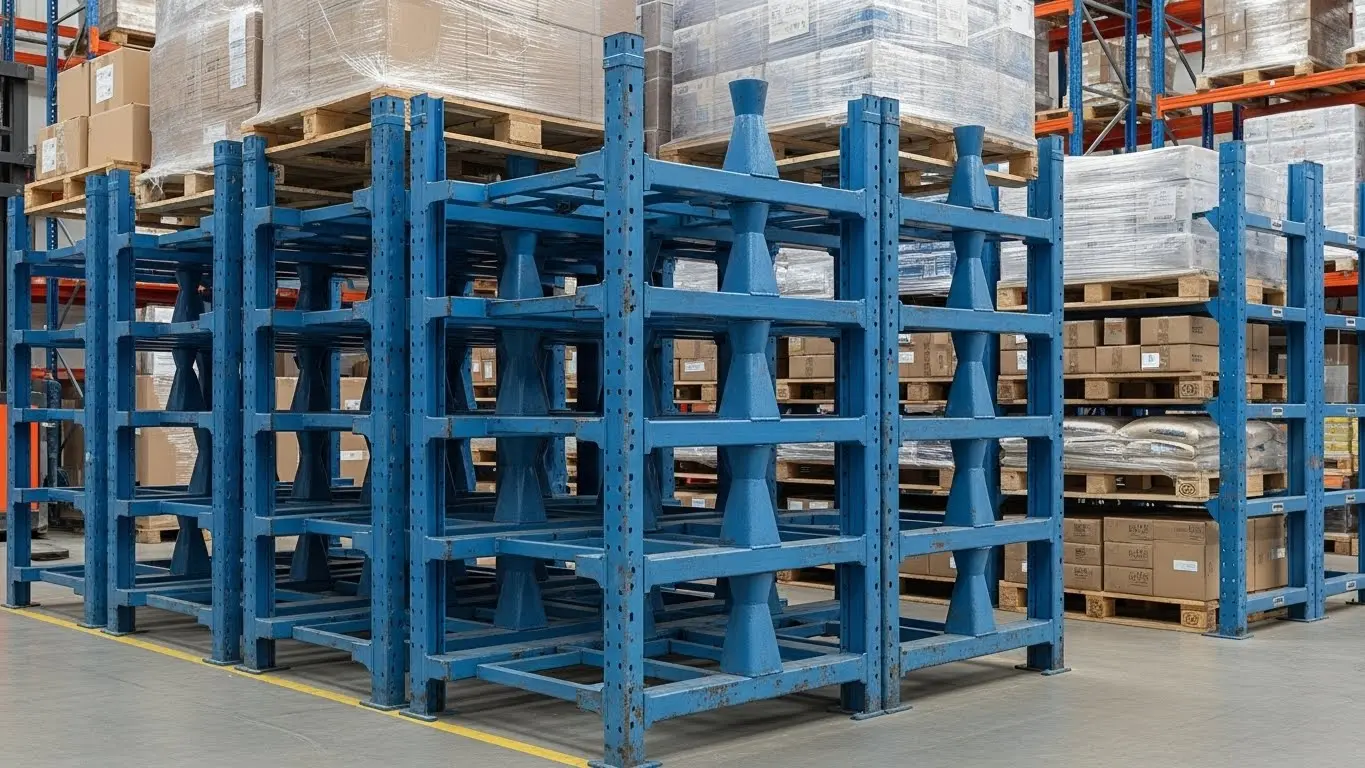
Portable Stackable Pallet Racks (Stacking Racks)
Portable stackable pallet racks are built with a simple base and removable posts. This design lets you stack loaded racks up to five units high. They are a movable alternative to fixed racking, giving warehouses the ability to shrink or grow storage areas based on current inventory.
This flexibility helps improve both floor space and cubic meter (CBM) utilization, which is especially useful for handling seasonal changes or different product mixes. When not needed, the racks can be knocked down for compact storage, freeing up valuable warehouse space.
At a Glance:
- 📍 Location: Industry Wide
- 🏭 Core Strength: Stackable pallet rack bases with insertable posts or end frames designed for up to five-high stacking and knock-down storage when not in use.
- 🌍 Key Markets: General warehousing, third-party logistics, seasonal storage operations, and bulk item shippers seeking flexible, high-density floor stacking solutions.
Why We Picked Them:
| ✅ The Wins | ⚠️ Trade-offs |
|---|---|
|
|
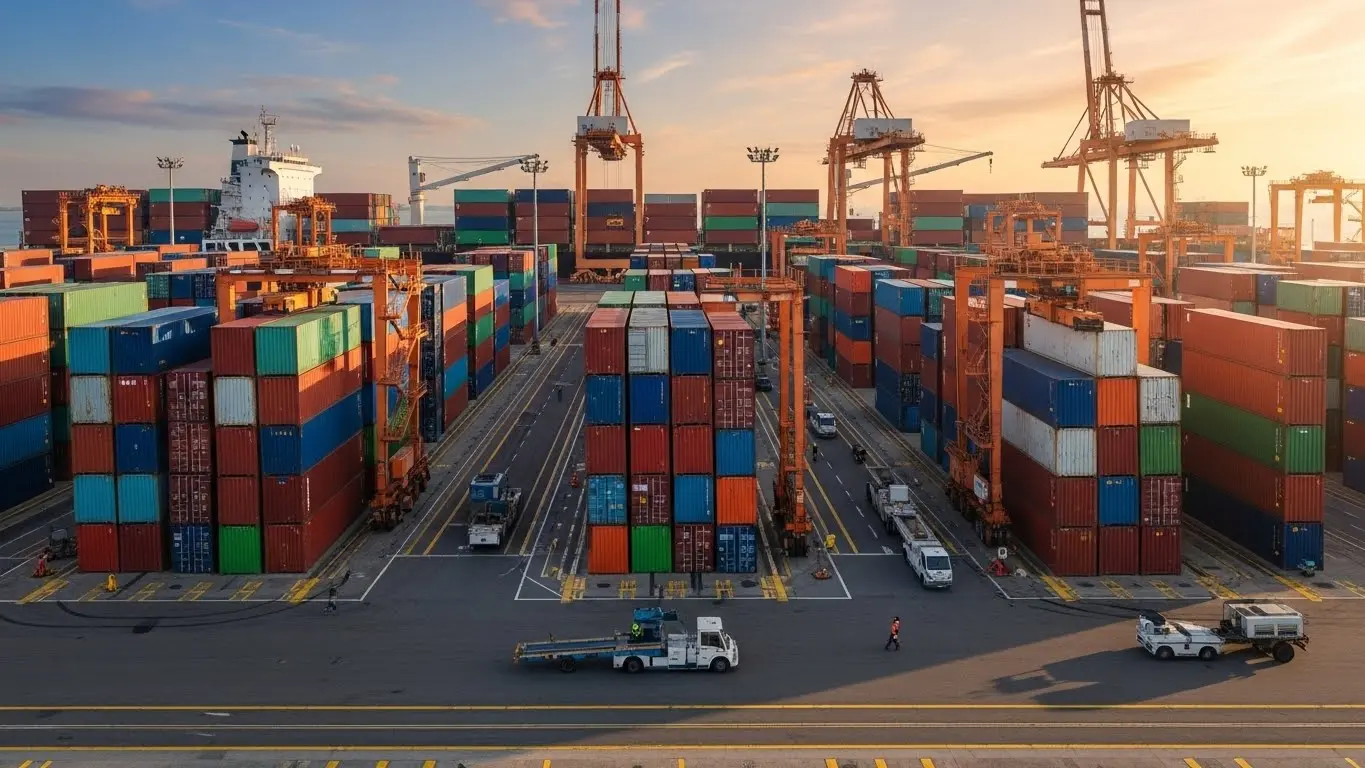
Stackable Shipping Containers for Vertical Yard Utilization
Standard ISO shipping containers are built for stacking. They can be stacked up to nine units high when full or twelve high when empty in normal conditions.
Using this stacking ability in storage yards makes the most of limited space. It also helps keep containers organized for easier loading into 40HQ or other transport configurations.
At a Glance:
- 📍 Location: Global Standard
- 🏭 Core Strength: 20‑ft and 40‑ft ISO shipping containers with corner castings and structural frames engineered for multi-layer vertical stacking in ports and yards.
- 🌍 Key Markets: Port terminals, container depots, construction and industrial sites using containerized storage, and logistics hubs managing large container inventories.
Why We Picked Them:
| ✅ The Wins | ⚠️ Trade-offs |
|---|---|
|
|
The “Dead Weight” Problem: Concrete Bases
Full concrete slab foundations often represent unnecessary “dead weight” for shipping containers. They add significant non-revenue mass to shipments, which increases transport and handling costs without providing extra payload capacity. Since a container’s frame is engineered to transfer loads through its four corner posts, a full slab is frequently over-specified for static uses where smaller, more efficient options like corner piers or pads are sufficient.
Why Full Slabs Create Non-Revenue Shipping Weight
Using a full concrete slab under a shipping container adds substantial non-revenue weight and volume. This extra mass increases transport and handling costs but offers no additional payload capacity. For most static applications, a full slab is structurally unnecessary. The container’s frame is specifically engineered to support its load through the four corner posts, making more targeted support systems a practical alternative.
Calculating Actual Load vs. Over-Specified Concrete
A 40ft container can support a maximum gross mass of around 30,480 kg. In many storage or conversion scenarios, the actual load is far lower, which means only minimal footing is needed. Standard soil bearing capacities, typically between 1,500 and 3,000 pounds per square foot (psf), show that only a small contact area is required to safely distribute the load. This makes efficient alternatives like corner piers or pads a better choice than an over-specified and heavy full slab.
20GP vs. 40HQ: Cost Per Unit Analysis
Choosing between a 20GP and 40HQ container depends on cargo type and volume. A 40HQ offers over double the volume for less than double the cost, reducing per-unit shipping expenses by 15–35% for light, bulky goods. A 20GP is more cost-effective for smaller shipments (under 35 m³) or dense, heavy cargo that reaches its weight limit before filling the container’s volume.
| Comparison Point | 40HQ Container (High Cube) | 20GP Container (General Purpose) |
|---|---|---|
| Cubic Volume | ~76 m³ (over twice the 20GP) | ~33 m³ |
| Ideal Cargo Type | Light, bulky products where volume is the main constraint (e.g., furniture, plastics). | Dense, heavy goods that reach the weight limit quickly, or small-volume shipments. |
| Cost Efficiency | Reduces per-unit freight costs by 15–35% when fully utilized by volume. | More cost-effective for shipments under 35 m³ and provides a lower cost per kilogram for heavy cargo. |
| Weight Limit | ~26 tonnes (payload) | ~26 tonnes (payload) |
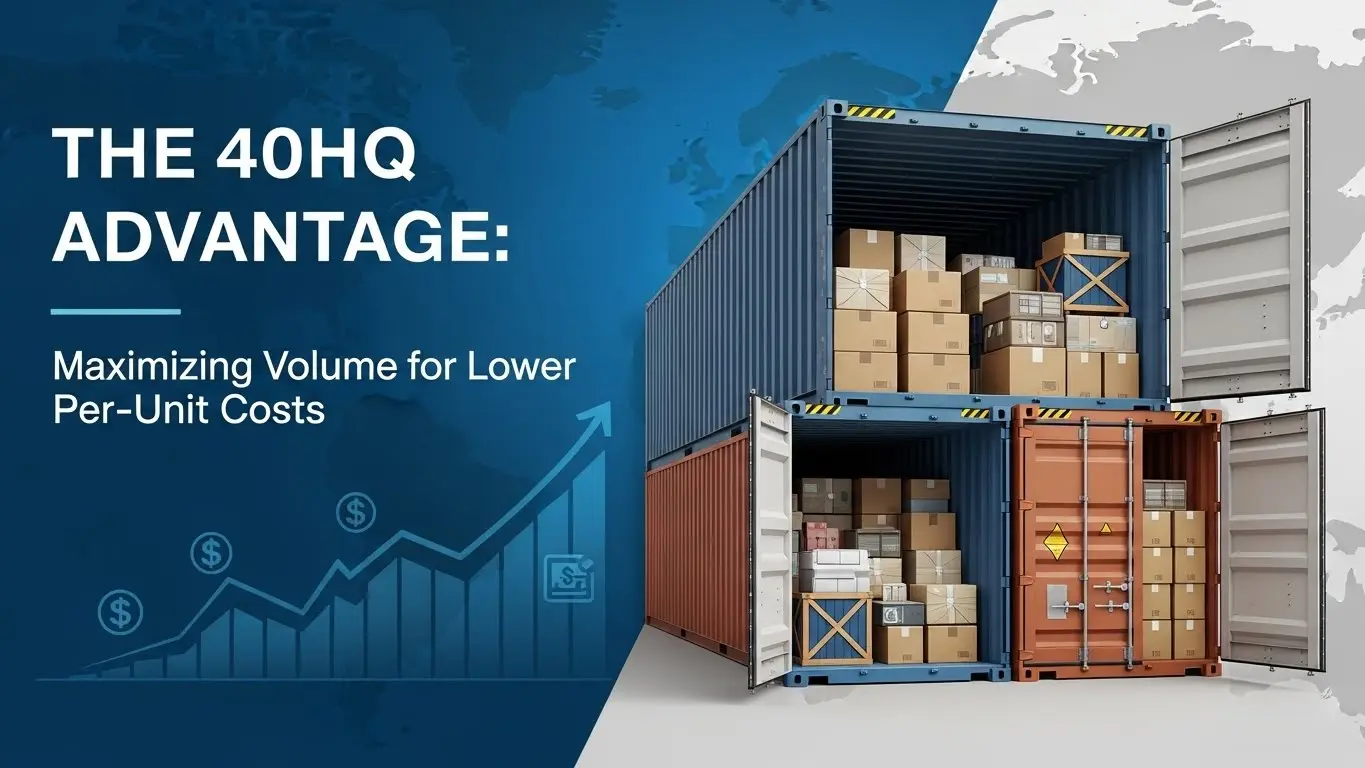
The 40HQ Advantage: Maximizing Volume for Lower Per-Unit Costs
A 40HQ container offers a significant volume advantage, providing approximately 76 cubic meters (m³) of space compared to the 33 m³ in a 20GP. This increase in capacity comes at a freight cost that is less than double that of the smaller container, creating an immediate efficiency gain. For shippers with light, bulky products like outdoor furniture, this means you can load 2.2 to 2.4 times more units into a single container, which directly lowers the shipping cost allocated to each item. When a 40HQ is filled to its volume capacity, the freight cost per unit can drop by 15–35% compared to using 20GP containers for the same amount of cargo.
The 20GP Scenario: When Smaller Shipments or Heavy Cargo Win
A 20GP container remains the more economical choice in specific situations. If your total shipment volume is less than 35 m³, using a 20GP prevents you from paying for the unused space in a larger 40HQ. The 20GP is also ideal for very dense and heavy cargo. Both container types have a similar maximum weight limit of around 26 tonnes, which is often reached long before the container is full by volume. In these weight-limited scenarios, the extra cubic capacity of a 40HQ offers no benefit, and the 20GP typically results in a lower overall freight cost and a better cost-per-kilogram rate.
Source Custom, Commercial-Grade Umbrellas Direct from the Factory

Palletizing vs. Floor Loading: Trade-offs
Choosing between floor loading and palletizing involves a direct trade-off. Floor loading maximizes container space to lower freight costs per unit, but palletizing provides faster unloading, better product protection, and safer handling at the expense of reduced cargo capacity.
Container Capacity vs. Unloading Speed
Floor loading maximizes the internal volume of a container, allowing shippers to fit roughly 650–750 cartons into a 40’HQ by using up to 64 CBM of space. Palletizing reduces this usable capacity by about 14–15%, fitting only 450–550 cartons. The primary advantage of pallets is speed, as a forklift can unload goods quickly. A floor-loaded container can take up to five times longer to unload manually.
Product Protection and Damage Risk
Palletized goods are secured on a stable base, which significantly reduces the risk of cargo shifting and getting damaged during transit. Floor-loaded cartons have a higher chance of toppling over or being crushed, unless they are packed and secured with extreme care to prevent movement.
Freight Cost vs. Labor and Handling Cost
Floor loading typically results in a lower freight cost per unit because more items fit inside a single container. Palletizing adds the material cost of the pallets but can lower the total landed cost. It achieves this by reducing manual labor expenses and minimizing potential damage-related losses at the destination warehouse.
Filling the Gaps: Adding Spare Parts/Accessories
You pay for the entire volume of a shipping container, but most shipments leave empty gaps. Filling these gaps with lightweight spare parts or accessories is a smart way to lower your cost-per-unit. This approach spreads the fixed shipping cost across more items, turning unused space into an opportunity to ship high-margin products without a separate booking.
Why Empty Container Space is a Hidden Cost
A standard 40HQ container offers about 76 cubic meters (CBM) of total volume. In practice, most shipments only use between 60 to 68 CBM due to stacking inefficiencies and the shape of the cargo. This means you are paying freight charges for empty, unused space.
When you add lightweight spare parts or accessories into these gaps, you spread the fixed cost of shipping across a larger number of items. This directly reduces the transportation cost allocated to each unit, making your primary products more profitable.
This tactic effectively converts wasted space into a valuable shipping opportunity. You can move high-margin accessories or essential spare parts alongside your main cargo, avoiding the cost and complexity of a separate, smaller shipment.
Strategies for Maximizing Container Volume
First, calculate the volume of your primary cargo to determine how much space is left. For instance, if a shipment of furniture occupies 55 CBM in a 40HQ container, you have up to 21 CBM of available space that can be filled with other goods.
Make full use of the container’s vertical space by stacking lighter boxes on top of heavier, palletized goods. Always check that the total weight remains below the container’s maximum payload limit, which for a 40HQ is typically around 26,780 kg.
Look for smaller gaps and voids around and between your pallets. These spaces are perfect for tucking in non-bulky items such as cushions, furniture covers, or hardware kits. Filling these voids helps create a denser, more stable load while maximizing your freight spend.
Packaging Standards: Drop-Test Approved Cartons
Key global and US packaging standards, such as ISTA 1A/2A and ASTM D5276, define drop-test protocols to ensure cartons can withstand shipping impacts. Specific regulations like 49 CFR 178.603 for hazardous materials and EN 22368-1 for toy safety also mandate these tests to qualify packaging for transport.
Key Global and US Drop-Test Protocols
ISTA 1A/2A is a widely used international standard for packages under 150 lbs (68 kg). It specifies 10 drops from heights that vary based on the package’s weight, simulating common handling conditions.
ASTM D5276 defines procedures in the United States for testing the impact resistance of shipping containers that weigh 110 lbs (50 kg) or less. This standard provides a consistent framework for evaluating how well a carton protects its contents from drops.
Industry-Specific Carton Regulations
49 CFR 178.603 is a mandatory US federal regulation that requires drop tests to qualify any packaging used for transporting hazardous materials. Compliance is necessary to ensure safety and prevent leaks or spills during shipment.
EN 22368-1 is a European standard specifically for toy safety. It helps ensure that packaging protects children’s products from damage caused by drops and other forms of rough handling during transit and in retail environments.
Marks and Labels: Ensuring Customs Compliance
Properly marking shipping containers with specific identification, safety, and cargo-related labels is essential for customs compliance. These markings include unique ISO 6346 IDs, CSC safety plates, weight data, and hazardous material placards. Inaccurate or missing labels can lead to significant shipment delays, fines, and inspections.
Container Identification, Safety, and Weight Markings
Key markings for customs and safety start with a unique container ID that follows the ISO 6346 standard, which includes an owner code and serial number for global tracking. Every container must also display a mandatory CSC (Convention for Safe Containers) safety plate, which certifies its structural integrity and specifies its maximum gross weight and stacking limits. Additionally, clearly stenciled weight data, including Tare, Net, and Maximum Gross Weight (MGW), is required for load planning and regulatory checks.
Hazardous Materials and Dimensional Markings
Containers carrying specialized cargo need additional markings. Those with hazardous materials must have placards and labels compliant with IMO, DOT, and UN standards to identify specific hazard classes like flammable liquids. Containers with non-standard dimensions need caution markings, such as the yellow ‘Warning High Cube’ decal, to prevent routing accidents. Regulations also mandate the correct placement of UN identification numbers for dangerous goods, as specified in rules like U.S. 49 CFR Part 172.
Commercial and Cargo-Specific Labels
Commercial and cargo-specific labels streamline logistics and protect workers. Barcode shipping labels, like the GS1 SSCC-18, are applied to pallets or containers to enable automated supply chain tracking. When contents pose a risk to handlers, workplace safety labels are also necessary. These must comply with standards such as OSHA’s Hazard Communication Standard to inform workers of potential chemical exposures.
Consolidation Services: Combining Orders
Consolidation services reduce shipping expenses by combining multiple smaller orders into a single full container. This allows shippers to share container space, spreading fixed costs like freight and handling across more products, which lowers the overall cost per unit compared to individual LCL shipments.
How Multi-Buyer Consolidation Reduces Costs
Multi-buyer consolidation works by grouping several small orders from different buyers or suppliers into one full-container-load (FCL). This shared container model lets shippers split fixed charges, including ocean freight, documentation fees, and port handling. By distributing these costs over a larger volume of goods, the freight expense for each individual unit becomes much lower than it would be for separate Less-than-Container-Load (LCL) shipments.
Planning Shipments Around 40HQ Container Capacity
Effective planning centers on maximizing the space in a 40-foot high cube (40HQ) container. While a 40HQ has a theoretical volume of about 76 cubic meters (CBM), the actual loadable space is between 60 and 68 CBM. Consolidation services strategically combine orders to fill this practical volume, minimizing wasted space. This approach is most cost-effective when the total volume of the combined orders gets close to the capacity of a standard 40ft container, which is around 55 to 58 CBM.
Coordination, Timing, and Trade-Offs
The consolidation process requires careful coordination. A central warehouse, known as a Container Freight Station (CFS), is needed to receive, check, and load goods from all the suppliers involved. One trade-off is that lead times can increase, as cargo might need to wait at the CFS until enough orders are collected to fill the container. While this method reduces the per-unit freight cost, it also adds extra handling steps at the destination port to sort and deliver each individual order.
Frequently Asked Questions
How many patio umbrellas fit in a 40HQ container?
The number of patio umbrellas that can fit in a 40HQ container varies significantly, typically from 212 to 860 units. This capacity depends on the umbrella’s model, size, and packaging design. For example, compact cantilever umbrellas might reach 860 units, while larger, bulkier double-head umbrellas may only fit around 212. For an accurate estimate, always request a detailed loading plan from your supplier based on your specific order.
Is it better to floor load or palletize umbrellas?
Palletizing is usually the better choice for patio umbrellas. Pallets provide crucial protection against crushing and damage, ensure stability, and allow for much faster and safer handling at warehouses. While floor loading can increase container capacity by 8-15%, it significantly raises the risk of damage, making it suitable only when minimizing per-unit freight cost is the primary goal and the product packaging is extremely robust.
Should I import concrete bases from China?
In most cases, importing concrete bases from China is not economical. Concrete is extremely heavy and has a low value, meaning the sea freight cost often exceeds the value of the product itself. The high shipping expense makes it more practical and cost-effective to source heavy bases locally near your final market.
What is the maximum cargo weight for a 20ft container?
A standard 20ft container has a maximum cargo weight (payload) of approximately 28,200 kg (about 62,000 lbs). The total gross weight, which includes the cargo and the container itself, must not exceed 30,480 kg (67,200 lbs).
Final Thoughts
Maximizing freight value comes down to a series of smart, calculated decisions. Choosing a 40HQ for bulky goods, palletizing for product safety, and filling empty gaps with accessories are all practical steps that lower your per-unit shipping costs. Every cubic meter inside a container is a paid-for asset, and a strategic approach ensures you get the most out of it.
Ultimately, these logistical details do more than just trim freight expenses. A well-planned shipment minimizes product damage, prevents customs delays, and creates a more predictable supply chain. Working with your suppliers to get loading plans, packaging standards, and labeling right protects your investment from the factory all the way to your warehouse.