


B2B procurement teams and product engineers face significant financial risks when textile components fail in harsh outdoor or industrial environments. A single seam failure often triggers expensive warranty claims and damages brand reputation, making the choice between specialized materials and standard alternatives a critical decision for long-term ROI. For many high-end applications, the difference between a three-year lifecycle and a lifetime warranty depends entirely on the technical specifications of the thread and seam construction.
This guide examines the performance metrics required for durable manufacturing, detailing how integrated tie-down systems support a 3,150 lb design load capacity and how multi-layer heat-activated tapes achieve a 20,000 mm H₂O waterproof rating. We compare the cost-benefit ratio of investing in PTFE threads, which show 0% strength loss under UV exposure, against bonded polyester options that typically degrade within 18 months in high-UV climates. By analyzing these variables, manufacturers can select the appropriate reinforcement techniques and quality control standards for their specific project lifecycles.
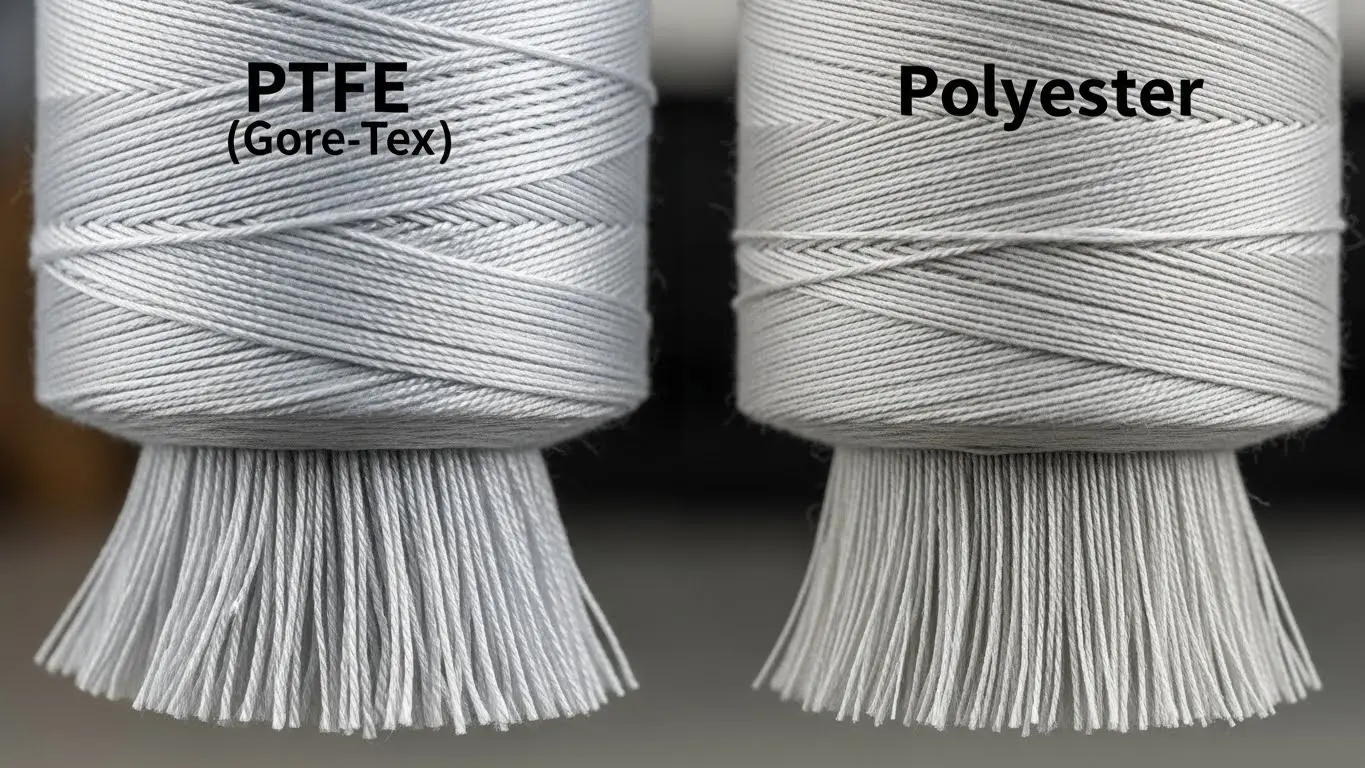
Thread Selection: PTFE (Gore-Tex) vs. Polyester Thread
PTFE thread offers permanent UV resistance and chemical immunity for high-end marine and industrial applications, while bonded polyester provides superior initial tensile strength at a lower price point for projects with a 2-to-3-year lifecycle.
| Performance Metric | PTFE (Tenara/Gore-Tex) | Bonded Polyester |
|---|---|---|
| UV Durability | Indefinite; 0% strength loss | Significant degradation after 18 months |
| Initial Tenacity | 2.5–4.0 gpd (Lower) | 7.0–9.0 gpd (Higher) |
| Chemical Resistance | Inert to bleach, acids, and salt | Vulnerable to harsh cleaning agents |
| Projected Cost | 5x to 10x higher investment | Standard market pricing |
PTFE Thread Performance in Harsh Environments
PTFE threads, including brands like Gore Tenara, maintain their original tensile strength regardless of UV exposure levels in 2026 outdoor environments. This material is completely chemically inert, ensuring that the thread resists degradation from bleach, bird droppings, acid rain, and extreme temperatures reaching 500°F. Because the fiber is waterproof and non-flammable, manufacturers typically provide lifetime warranties for PTFE thread used in professional marine and architectural awning applications.
Bonded Polyester for Standard Outdoor Use
Bonded polyester thread provides nearly triple the initial tenacity of PTFE before sunlight exposure begins the fiber degradation process. Modern dyes and nanotechnology treatments have improved the functional life of polyester, extending it to approximately 18 months in high-UV tropical climates. However, polyester requires specific maintenance protocols using only mild soaps, as harsh chemical cleaners quickly weaken the fiber structure and lead to premature seam failure.
Operational Cost and Application Differences
Selecting between these materials depends largely on the project lifecycle and budget. PTFE thread requires a significantly higher initial investment, costing 5 to 10 times more than standard bonded polyester options. High-end hospitality resorts favor PTFE to avoid the recurring labor costs associated with re-stitching seams every few years. In contrast, polyester remains the standard choice for cost-sensitive retail programs and short-term commercial event structures where long-term durability is not the primary performance metric.

Seam Types: Flat Felled vs. Overlock
Flat-felled seams utilize a double-stitched, folded-edge technique to create high-strength, low-profile joints for high-stress areas, while overlock seams offer a faster, single-step edge-finishing process suitable for internal joins and flexibility.
Construction Mechanics of Flat Felled and Overlock Seams
Flat-felled seams involve folding raw fabric edges and applying double rows of stitching to create a flat, reinforced joint with a neat finish on both sides. This construction method ensures that no raw edges remain exposed, significantly improving the longevity of the seam under tension and preventing fraying in heavy-duty applications.
Overlock seams use a single-step process to trim excess fabric allowance and encase the edge in thread for basic fray resistance. This method is common in internal joins where speed is a priority and the edge does not require the heavy reinforcement provided by a folded seam.
The low-profile nature of flat-felled stitching provides a premium look and reduces bulk, which is ideal for visible seams in high-end outdoor products. By minimizing the seam height, manufacturers prevent abrasion and ensure a clean aesthetic on both the interior and exterior of the product.

Durability and Production Suitability for Heavyweight Materials
Flat-felled seams offer superior structural integrity for high-stress zones, resisting tearing forces in areas like seats and yokes even across 12 layers of fabric. The dual rows of stitching provide a safety margin against mechanical failure, making them the standard for structural durability in workwear and tactical gear.
Factories utilize overlock seams for heavyweight denim or canvas inseams to maintain flexibility and reduce material bulk in high-movement areas. In some heavy-duty applications, the thickness created by double-folding high-ounce fabrics can impede movement or create pressure points, making the overlock finish a more practical choice for mobility.
Time-intensive flat-felled construction requires specialized feed-off-arm machinery, while overlock methods prioritize faster production speed and lower manufacturing costs. Engineers must choose between the labor-intensive strength of the felled seam and the economic efficiency of the overlock pass depending on the specific performance requirements of the garment section.
Strategic use of both seam types allows manufacturers to balance aesthetic quality with practical assembly for durable outdoor furniture covers and contract-grade gear. Combining these techniques ensures that high-load stress points receive maximum reinforcement while maintaining an efficient and cost-effective production workflow.
Reinforced Pockets: Where the Rib Meets the Fabric
Reinforcing pockets at the junction of rigid ribbing and flexible fabric prevents structural failure by distributing stress through industrial bartacks and specialized stitch patterns. Utilizing high-tenacity PTFE threads and stabilizing interfacing ensures these high-wear compartments withstand repetitive tension and industrial laundering without tearing.
Stress Point Stabilization at the Rib-Fabric Junction
Mechanical failure frequently occurs where rigid ribbing meets flexible fabric. These materials have mismatched tension and stretch rates, which creates a concentrated stress point during movement. Without proper stabilization, the interface between the two different fabric weights becomes the primary site for structural degradation.
Unreinforced pocket openings carry a high risk of thread breakage and fabric tearing. Repetitive movement or aggressive washing cycles pull on the seams, eventually ripping the base material. These failures are common in designs that rely on standard single-row stitching without secondary support.
Anchoring pockets correctly prevents them from twisting or shifting under load. When users apply pressure while sitting or reaching into the compartment, the reinforcement absorbs the energy. This keeps the pocket aligned and prevents the fabric from distorting over time.
Industrial Reinforcement Techniques and Stitch Patterns
Standard industrial construction requires bartacks or triple backtacks at the top and bottom of pocket openings. These dense stitch clusters distribute the load across a larger surface area than a standard seam. This technique effectively moves the stress away from the raw edge of the fabric to a reinforced zone.
Specific stitch configurations like triangular or J-stitch bartacks provide superior structural integrity. These complex patterns offer more points of contact between the thread and the textile fibers compared to a single-row stitch. High-performance workwear relies on these configurations to prevent pocket detachment under heavy use.
Interfacing patches or clear plastic tape stabilize bias edges to prevent seam stretching. This is particularly vital in knit components where the fabric easily deforms. The tape acts as a non-stretch backbone, ensuring the pocket opening retains its original dimensions regardless of fabric tension.
Heavy-duty applications may utilize metal rivets or burrs as an alternative to thread-based reinforcement. B2B furniture projects and tactical gear often use these hardware components to secure high-stress junctions. Rivets provide a permanent mechanical bond that exceeds the tensile strength of even the most durable sewing threads.
Technical Metrics for Commercial Durability
Contract-grade outdoor gear utilizes high-tenacity PTFE or Tenara threads to resist chemical degradation and abrasion. These threads maintain their integrity in extreme environments where standard polyester would fail within months. Their UV resistance makes them the standard for marine and industrial upholstery.
Seam specifications require shanks and elastic to lap at least 3/8 inch for maximum security. Using two distinct rows of stitching ensures that even if one row fails, the structural integrity of the pocket remains intact. This redundancy is a hallmark of commercial-grade textile engineering.
Finished pocket bags must be overlocked and lie flat against the main body. They must not extend below the hem line to maintain both functional and aesthetic standards. A flat-lying pocket bag prevents bulkiness and reduces the risk of the bag snagging on external objects during use.
Quality assessments for 2026 prioritize a maximum defect equivalent of 2.5 for seam strength. This metric evaluates the reliability of pocket attachments under standardized pull tests. Meeting this standard ensures that the garment or furniture piece survives the rigors of commercial lifecycle expectations.
Scale Your Business with Premium, Factory-Direct Shade Solutions

Vent Construction: Hemming for Airflow
Hemming for airflow creates airtight seals and prevents edge fraying in ventilation systems by folding and securing fabric or sheet metal edges. Standard practices utilize 1.00 mm galvanized sheet metal, PTFE threads like Tenara for high tensile strength, and reinforcement clips spaced every 300 mm to maintain structural integrity under air speeds reaching 7 to 10 m/s.
Reinforcement Standards for Airtight Seals
Structural integrity in ductwork depends on double-fold hems with a minimum width of 25 mm. These folds prevent edge fraying and stop stitching failure when the system experiences high airflow stress. Technicians secure fabric and metal edges using galvanized clips or welds spaced no more than 300 mm apart to maintain the seal. Additionally, reinforcing vent pockets with specialized sealants allows the assembly to handle 50 Pa test pressure without depressurization-induced rips.
Velocity Limits and Material Specifications
Material selection shifts based on airflow demands, with 1.00 mm galvanized sheet metal required for high-pressure systems where air speeds exceed 10 m/s. Hemming designs must scale with these speeds, utilizing specific configurations for 3 m/s quiet zones and up to 7 m/s for industrial applications. Installing 25 mm thick compressed rock wool insulation further protects hemmed joints from condensation and environmental wear in humid conditions.
High-Performance Thread and Stress Testing
Long-term durability in fabric vents requires PTFE threads like Tenara, which offer tensile strength exceeding 50 lbs and high resistance to UV or chemical degradation. Quality control teams verify seam strength by conducting stress tests at 1.5 times the intended operating velocity. To further protect the construction, sound absorbers installed near hemmed edges minimize mechanical vibrations that could lead to premature stitching wear.
Valance Stitching: Binding vs. Hemmed Edge
Valance construction relies on two primary finishing techniques: binding and hemming. Binding encloses the fabric edge in a separate tape to prevent fraying and provide structural stability, while hemming involves folding the fabric for a minimal, low-profile aesthetic. Technical selection depends on fabric weight, UV exposure levels, and mechanical stress at rod pockets or headers.
Binding for High-Stability and Decorative Finishes
Binding encloses raw edges within a bias tape or binding strip to create a clean finish on both sides. This method offers high stability and prevents fraying or stretching, particularly on curved hems and heavy drapery. Binding provides resistance to ripping under tension, making it a functional choice for reversible valances and high-wear areas.
Hemmed Edges for Minimal and Lightweight Construction
Hemmed edges use single or double-folded fabric stitched close to the edge for a neat, low-bulk appearance. Blind hem techniques create nearly invisible stitches on the front, maintaining clean lines for lightweight valances. While less robust than binding, double-fold hems provide sufficient security for standard decorative window treatments without adding unnecessary weight to the header.
Technical Reinforcement and Thread Selection for Longevity
Contract-grade valances require UV and abrasion-resistant threads, such as PTFE or Tenara, to prevent seam failure in sunny environments. Reinforcing rod pockets and headers with double stitching or interfacing tape prevents fabric tearing at primary stress points. Upgrading from standard running stitches to professional blind hems or binding helps the product meet rigorous quality standards for commercial hospitality use.
Tie-Down Straps: Integrated vs. Loose
Integrated tie-down straps are factory-fabricated systems permanently attached to structural frames to ensure consistent tension, while loose steel straps offer field-cut versatility and higher ultimate strength for on-site timber framing and tension restraint.
Factory-Integrated Tensioning Systems
Integrated straps function as factory-fabricated systems permanently connected to the structure to ensure consistent tension. These systems utilize pre-attached anchor points that usually sit within 24 inches of the ends to maintain ANSI A119.1 compliance. By installing these components during the manufacturing phase, engineers ensure that the tensioning points align perfectly with the primary structural members.
These systems eliminate the need for field splicing, reducing the risk of installation errors in 2026 structural projects. Standard configurations support a 3,150 lb design load capacity, which provides reliable wind zone security for manufactured housing and modular units. This factory-controlled approach guarantees that every strap meets the specific engineering tolerances required for the building’s design life.
Loose Steel Straps and Site Application
Field-cut systems utilize rolls of galvanized steel, typically 1-1/4 inches wide and 0.035 inches thick. Installers pull these straps tight and secure them around rafters or frames using 4-5 bolt turns or heavy-duty crimps. This flexibility allows crews to adapt the strapping to unique site conditions or non-standard structural geometries where factory points may not be available.
Proper splicing is critical for these systems, requiring a 12-inch overlap with two separate seals to maintain structural integrity. Loose straps offer an ultimate strength exceeding 4,725 lbs, making them suitable for versatile tension restraint in timber framing. When used with radius clips to prevent edge cutting, these straps provide high-capacity uplift resistance in custom construction environments.

Material Standards and Corrosion Resistance
Straps must conform to HUD and ASTM D3953-97 specifications to ensure long-term structural safety. Galvanized coatings like G60 and G120 provide essential protection against oxidation in outdoor environments. The thickness of the zinc coating directly impacts the lifespan of the tie-down system, particularly in regions with high humidity or proximity to salt air.
High-corrosion sites require specific materials such as QQ-S-781f Type 1 Class B Grade 1 steel. To ensure the metal survives high-stress uplift events, a minimum net section of 21mm² per AS1684 is required. This metric ensures that the cross-sectional area of the steel remains sufficient to handle the calculated design loads even after accounting for fastener holes or minor surface wear.
Waterproofing Seams: Tape Sealing Options
Effective seam waterproofing relies on heat-activated or pressure-sensitive tapes that seal needle holes in synthetic laminates. Professional standards utilize multi-layer tapes to achieve waterproof ratings of 20,000 mm H₂O while maintaining 80% of the base fabric’s original tensile strength.
Multi-Layer Heat-Activated Tapes
Two-layer seam tapes serve the majority of mass-market outdoor production. These adhesives specifically seal needle holes in PU, PVC, and TPU laminates, preventing moisture ingress at the stitch line. The application process requires precise thermal regulation to ensure the adhesive penetrates the fabric weave without compromising the laminate layer.
Three-layer tapes provide reinforced strength for extreme weather gear and industrial apparel. These variants maintain at least 80% of the base fabric durability, offering a significant advantage in high-abrasion environments. The additional fabric backing on the tape protects the waterproof membrane from mechanical wear during active use.
Heat activation is necessary to reach professional waterproof ratings of 20,000 mm H₂O. When applied correctly, these tapes achieve a peel strength greater than 10 N/25 mm on synthetic coated materials. This mechanical bond ensures the seam remains intact even when subjected to the internal pressure of heavy precipitation or immersion.
Substrate-Specific Sealing Methods
PU seam tapes target fabrics featuring polyurethane coatings. These tapes create a permanent bond on flat seams through thermal application, effectively fusing the tape to the coating. This method is standard for synthetic outdoor textiles where a consistent, low-profile waterproof barrier is required across long seam runs.
Pressure-sensitive tapes offer a cold-application alternative for specific high-performance materials. Film-backed fabrics like Dyneema Composite Fabric (DCF) often cannot withstand the high heat required for traditional iron-on tapes. Self-adhesive films provide a reliable seal for these substrates, though they are typically reserved for seams under lower mechanical stress.
Sealing selections depend on the specific stress requirements of the seam. Iron-on types generally offer higher mechanical resistance and longevity than self-adhesive films. Engineers analyze the expected load on the seam—such as the tension on a tent ridge or the flex in a jacket elbow—to determine if a thermal bond or a pressure-sensitive film is appropriate.
Industrial Ratings and Repair Protocols
The West Bridgeford T-2000X iron-on tape provides an industry standard for permanent sealing. This tape is compatible with Gore-Tex, urethane-coated fabrics, and specialized materials like spinnaker cloth. Its versatility makes it a preferred choice for both factory-level production and high-end technical repairs where bond integrity is non-negotiable.
Fabric-reinforced sealing tapes demonstrate superior performance in industrial laundering tests, holding approximately 40 lbs per inch of width. This capacity significantly outperforms liquid glues and basic adhesive patches. The reinforcement prevents the tape from stretching or creeping when exposed to high temperatures and mechanical agitation during cleaning cycles.
Professional repair standards utilize parchment paper and precise temperature control during the bonding process. This barrier prevents the iron from sticking to the tape while ensuring the heat transfers evenly. Strict adherence to temperature windows allows the adhesive to reach its melting point and flow into the fabric fibers without melting the underlying synthetic yarns.
Quality Control: The Light Table Inspection
Light table inspection identifies structural defects in construction fabrics and linens by utilizing a translucent, back-lit surface. This method exposes flaws such as stitching rips, weak seams, and impurities that are often invisible under standard overhead lighting conditions.
The Role of Backlighting in Defect Identification
Light table inspection uses a translucent, illuminated surface to backlight materials like outdoor fabrics and linens. This method reveals flaws invisible under normal lighting, such as stitching rips, weak seams, and impurities in the weave. Technicians place the material flat on the surface and adjust the brightness to medium for general checks or higher for detail-oriented tasks. Maintaining a clean workspace remains a priority, and teams use lint-free cloths to ensure no debris obscures the inspection area.
Illumination Standards and Precision Metrics
Precision quality control requires shadow-free illumination between 1000 and 1500 lux to identify subtle thread breaks. Safety protocols follow OSHA mandates, ensuring light fixtures stay at least seven feet above surfaces or use shatterproof shields. Modern inspection setups in 2026 utilize energy-efficient LED models for better longevity and adjustable brightness levels. Teams follow the 20-20-20 rule during high-intensity inspections to prevent eye strain and maintain accuracy throughout the shift.
Validating Structural Integrity and Thread Consistency
Backlighting highlights inconsistencies in PTFE thread, ensuring the durability required for contract-grade outdoor gear. The process verifies pocket adhesion and reinforcement points on heavy-duty items like tents and commercial tarps. Specialized tables with lift capacities exceeding 1000 lbs allow for the inspection of large-scale architectural membranes and panels. Technicians use magnification tools like loupes to check thread integrity at critical stress points and seams to prevent field failures.
Frequently Asked Questions
What is the most durable thread for outdoor furniture sewing?
Polyester thread remains the standard for outdoor gear like cushions and awnings because it resists UV rays, mildew, and abrasion. For high-exposure environments or 2026 marine projects, PTFE thread offers a lifetime solution that maintains its integrity against salt, chemicals, and extreme weather without degrading.
Why do umbrella pockets often rip at the ribs?
Rips occur when wind and mechanical stress concentrate at the rib attachment points. Using reinforced stitching, high-density pongee fabrics, and fiberglass ribs helps distribute this tension. Manufacturers prevent failure by adding patches or seam taping to these specific high-stress zones.
When should you use double-stitched seams?
Double stitching adds a second parallel row of straight stitches to reinforce the primary seam. This technique is best for high-tension areas where you need extra durability and protection against fraying, providing a stronger bond than a single row of stitching.
How do flat-felled seams improve construction quality?
Flat-felled seams fully enclose raw fabric edges by folding and topstitching the material flat. This creates a very strong, locked bond that prevents raveling and is ideal for heavy-duty outdoor applications where the seam must withstand constant pulling and weather exposure.
Final Thoughts
Selecting the right combination of thread, seam construction, and reinforcement methods determines the actual lifespan of outdoor gear. While PTFE thread and flat-felled seams require a higher initial investment, they prevent the frequent failures and repairs common with bonded polyester and standard overlock finishes. Focusing on high-stress points, such as pocket junctions and vent hems, allows for a design that handles repetitive tension and airflow without structural degradation.
Consistent quality control through light table inspections and standardized pull tests ensures that finished pieces meet commercial expectations. By integrating these technical standards—from UV-resistant Tenara threads to multi-layer seam tapes—manufacturers build gear that survives harsh environments and heavy mechanical use. Precision in these assembly details ultimately separates durable, professional-grade equipment from short-term retail products.



 English
  Spanish
  French
  German
  Portuguese