


Hospitality managers and beach operators face significant liability risks when shade structures fail during sudden coastal gusts. While many retail-grade models collapse at speeds as low as 20 mph, commercial environments require rigorous factory testing to prevent equipment from becoming airborne hazards. Moving beyond basic marketing claims, empirical validation ensures that anchors and frames can withstand real-world pressures without structural failure.
This article analyzes the engineering behind 80 km/h (50 mph) wind tunnel protocols, which generate approximately 210 lbs of uplift force—nearly triple the 75 lb resistance required by the ASTM F3681 safety baseline. We explore how marine-grade materials like T6 aluminum handle salt-induced oxidation, the mechanics of rib deflection in high-resolution bend tests, and the specific documentation needed to verify safety for insurance providers.
The 50mph (80km/h) Standard: Open-State Testing
Factory testing at 50 mph (80 km/h) validates umbrella stability beyond the standard ASTM F3681 requirement of 30 mph. This open-state protocol ensures the canopy and anchor system resist the significant uplift forces generated in coastal environments, preventing the umbrella from becoming an airborne hazard.
| Wind Speed (mph) | Estimated Uplift Force | Testing Classification |
|---|---|---|
| 30 mph (48 km/h) | 75 lb (340 N) | ASTM F3681 Safety Baseline |
| 44 mph (70 km/h) | ~160 lb (710 N) | High-Performance Commercial Limit |
| 50 mph (80 km/h) | ~210 lb (935 N) | Enhanced Factory Validation |
Engineering Resilience Beyond ASTM F3681 Baselines
ASTM F3681 establishes a safety baseline requiring systems to resist detachment at a minimum wind speed of 30 mph (48 km/h) for 30 minutes. Testing at 50 mph (80 km/h) addresses the needs of high-traffic commercial zones where sudden coastal gusts exceed standard consumer thresholds. The open-state simulation tests the integrity of the ribs and central pole under constant tension to ensure no structural deformation occurs. Manufacturers use these metrics to differentiate contract-grade umbrellas from lightweight consumer models that often fail at 20-30 mph.
Wind Tunnel Dynamics and Mechanical Lift Requirements
Umbrellas with a 7.5 ft diameter generate approximately 75 lb (340 N) of upward force at 30 mph, which increases exponentially as speeds reach 50 mph. Testing protocols utilize mechanical pull tests at the bottom pole to simulate the suction effect created by wind passing over the canopy. A 50 mph standard typically requires sand anchors with a minimum capacity of 125 lb to counteract the 2.8x increase in drag force compared to the 30 mph baseline. Factory validation involves monitoring the failure points of the locking mechanism and the anchor’s grip strength in various sand densities.
ASTM F3681 Protocols: Independent Verification
ASTM F3681 protocols replace marketing claims with empirical engineering standards, requiring beach umbrella anchors to withstand 30 mph winds. For a 7.5-foot umbrella, the system must provide at least 75 pounds of resistance force, verified through independent wind-tunnel testing to ensure public safety and commercial compliance.
| Performance Metric | Requirement | Compliance Scope |
|---|---|---|
| Wind Resistance Threshold | 30 MPH | All anchor devices |
| Minimum Anchoring Force | 75 Pounds | 7.5-foot diameter umbrellas |
| Verification Standard | ASTM F3681-24/25 | Mandatory for compliance claims |
Safety Thresholds for Anchoring Resistance
The ASTM F3681 standard establishes a rigid engineering framework to prevent beach umbrellas from detaching and causing injury. Anchoring devices must maintain stability in wind speeds reaching 30 miles per hour, a threshold that aligns with common seaside weather patterns. For a standard 7.5-foot diameter umbrella, the system requires a minimum anchoring resistance of 75 pounds. These quantified performance requirements translate technical safety analysis from the U.S. Consumer Product Safety Commission into enforceable manufacturing goals.
Engineering thresholds ensure that an umbrella remains secured even when subjected to the lift and drag forces typical of coastal environments. By establishing a 75-pound resistance floor, the protocol addresses the physics of wind-blown objects, effectively mitigating the risk of umbrellas becoming airborne hazards. This data-driven approach removes the ambiguity of “windproof” labels, providing a measurable safety baseline for consumers and manufacturers alike.

Wind-Tunnel Testing and Compliance Validation
Independent third parties conduct wind-tunnel tests to provide objective validation of manufacturer claims. These test methodologies evaluate the entire umbrella and anchor system together, determining how the components interact under extreme stress. Under the 2026 manufacturing guidelines, products cannot claim compliance unless they meet every specific requirement in the protocol. This rigorous testing environment simulates real-world conditions to ensure that the hardware performs as intended during high-wind events.
Verification documents serve as empirical evidence for commercial beach operators and insurance evaluations. These records distinguish between compliant safety systems and non-compliant products, allowing professional managers to verify the equipment used on their shorelines. By requiring third-party testing, the ASTM F3681 protocol eliminates gray areas in marketing, ensuring that safety claims remain grounded in documented physical performance rather than theoretical assertions.
Video Evidence: Watching the “Bend Test” Live
Live testing videos provide proof of an umbrella’s ability to withstand mechanical stress. By recording rib deflection and the 75-pound resistance required by ASTM F3681-25, factories demonstrate that the frame can bend without breaking and return to its original shape after high-wind exposure.
Visualizing Rib Deflection and Material Recovery
Engineers observe the maximum degrees of rib curvature before failure to establish safe operating limits for fiberglass and T6 aluminum frames. This visual data confirms the elasticity and flexibility of the materials under load. By documenting these limits, manufacturers ensure the umbrella components withstand sudden forces without sustaining permanent damage.
Analyzing structural memory through video allows teams to verify that the umbrella canopy returns to its taut position after enduring gust-simulated loads. This recovery process proves that the frame maintains its shape and tension over repeated use. High-resolution recording captures whether materials sag or weaken after exposure to peak mechanical pressure.
Technical footage records the behavior of the hub and runner under peak tension. We verify that commercial-grade components do not crack or seize during operation, even when pushed to their mechanical limits. This documentation ensures that the internal components of the umbrella remain functional and safe for public use in high-traffic environments.
Verification of ASTM F3681-25 Mechanical Benchmarks
Video documentation captures the 75-pound upward force resistance test required for stable anchoring of market umbrellas in public hospitality spaces. This test confirms that the anchoring device holds the structure securely against vertical displacement. Recording the pull test provides an objective record that the product meets the safety mandates for 2026.
Testing facilities overlay real-time data on test footage to confirm stability at the 30 mph sustained wind baseline defined in current protocols. This synchronized data provides proof of performance during the exact moment of wind impact. The footage serves as a transparent verification for safety inspectors and commercial procurement teams regarding wind resistance capabilities.
Stress tests validate that canopies within the 45-square-foot limit maintain structural integrity without inversion. By monitoring the canopy under mechanical load, we confirm that the rib geometry and material strength prevent the structure from flipping. This stability is essential for maintaining safety and preventing equipment failure during sudden weather transitions.
Premium Commercial Umbrellas: Engineered for Durability, Priced for Growth

Destructive Testing: Finding the Breaking Point
Destructive testing identifies the precise point of failure for umbrella anchors through mechanical pull tests and high-velocity wind simulations. Under current safety standards, systems must resist 75 lbs of upward force or maintain stability in 30 mph winds for 30 minutes, preventing the equipment from becoming a hazardous projectile.
ASTM F3681 Failure Thresholds and Safety Benchmarks
Engineers apply 75 lbs of upward force to the bottom pole during mechanical pull tests to replicate the lift generated by 30 mph winds. These rigorous benchmarks ensure the anchor remains submerged and locked in the sand without detachment. By focusing on quantifiable resistance, these standards eliminate subjective stability claims and directly target the risk of airborne injuries.
Current safety requirements apply to umbrellas with diameters up to 7.5 feet and canopy areas under 45 square feet. This specific scope allows regulators to standardize testing protocols for the most common equipment sizes. Compliance ensures that even under peak force, the system stays integrated, preventing it from transforming into a hazardous projectile.
Stress Limits and Wind Tunnel Performance Data
Wind tunnel data reveals significant performance gaps between standard and heavy-duty equipment. While generic models often fail at speeds between 20 and 30 mph, premium systems secure the umbrella up to 44 mph. High-capacity bases utilizing 125 lbs of sand ballast provide the necessary counterweight to handle beach gusts, which frequently exceed average wind speeds by 40%.
Reinforced 16-inch bases paired with 8-foot umbrellas maintain their structural integrity until reaching 38 mph. Post-test inspections pinpoint critical vulnerabilities in anchor threading and frame joints under extreme stress. These findings allow engineers to strengthen components and align designs with upcoming 2026 safety regulations.
Salt Spray + Wind: Testing for Coastal Reality
Coastal testing evaluates how umbrellas handle the dual stress of high-velocity winds and corrosive salt air. Modern 2026 safety protocols require anchors to withstand 75 pounds of upward lift, while frames must use marine-grade materials like T6 aluminum to prevent structural failure caused by salt-induced oxidation.
Marine-Grade Corrosion Resistance for Salt Environments
Coastal air contains high chloride concentrations that accelerate oxidation on standard metal frames within weeks of exposure. To combat this, manufacturers utilize T6-grade aluminum frames treated with specialized powder coatings. These coatings act as a primary barrier against salt fog infiltration, preserving the structural integrity of the umbrella during long-term seasonal use.
Hardware components such as tilt mechanisms and joint screws require 304 or 316 stainless steel. These materials prevent the seizing common in high-humidity beach zones where salt crystals accumulate in moving parts. Engineering teams use factory salt spray tests to simulate years of coastal exposure, ensuring that every structural joint remains mobile and free of rust throughout the product’s lifespan.
Anchor Stability and Lift Resistance Standards
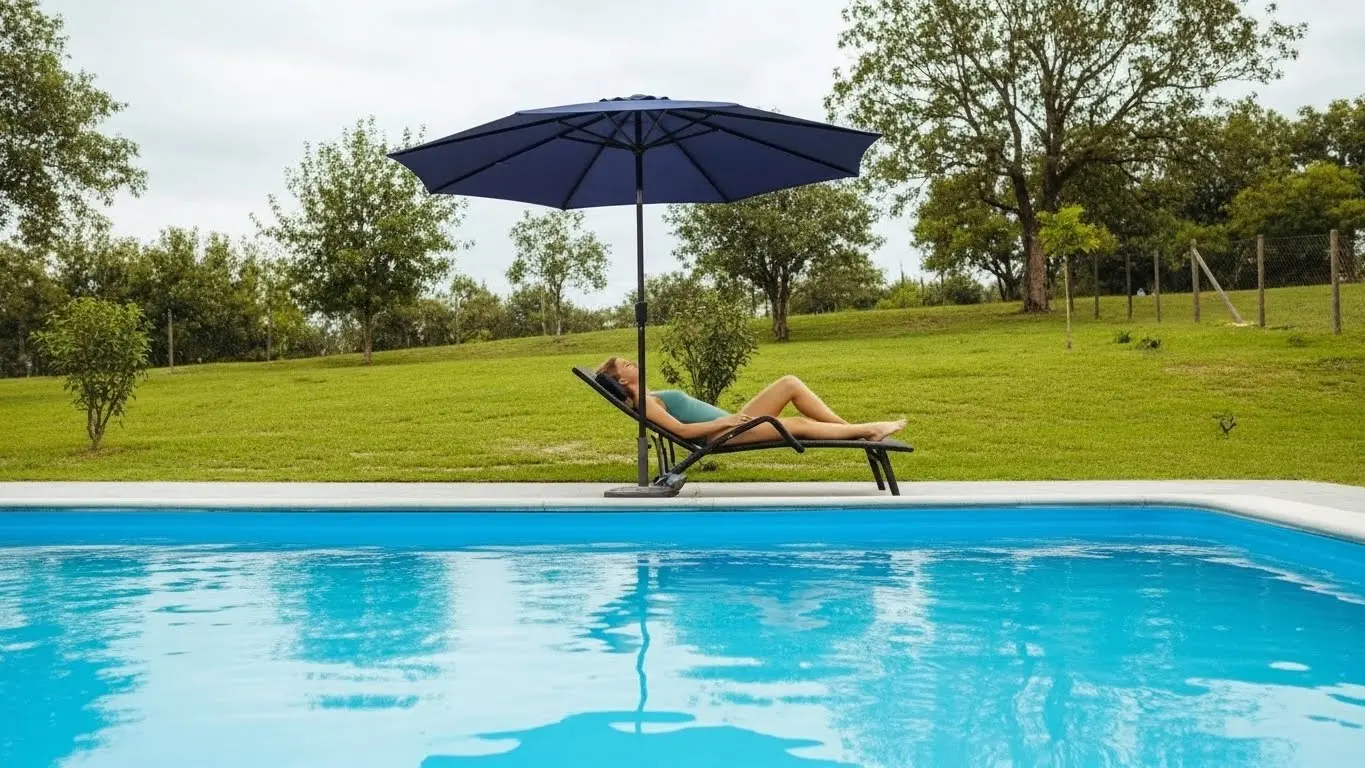
The ASTM F3681 protocols establish clear safety benchmarks for beach equipment. A standard 7.5-foot umbrella must resist at least 75 pounds of upward force to remain secured in the sand. This specific measurement accounts for the physics of lift, where wind passing over the canopy creates a vacuum effect similar to an airplane wing. Without a compliant anchor, the umbrella can become an airborne hazard.
Wind tunnel validation involves maintaining stability for 30 minutes at constant speeds of 30 MPH. Because coastal wind gusts typically peak 40% higher than average inland speeds, heavy-duty sand anchors are essential for safety. These reinforced systems are calibrated to handle the dynamic lift generated by the canopy’s surface area during sudden pressure changes, reducing the risk of the over 3,000 annual injuries caused by flying beach umbrellas.
Competitor Benchmarking: How Cheap Umbrellas Fail
Budget umbrellas typically fail because they lack the 75-pound upward resistance needed to stay anchored. While ASTM F3681-compliant systems endure 30 MPH winds for 30 minutes, most retail-grade alternatives collapse at 20 MPH, presenting significant safety risks due to their non-certified, lightweight anchoring components.
The 75-Pound Resistance Gap in Anchor Engineering
The safety of a beach umbrella depends on its ability to stay grounded under sudden gusts. ASTM F3681 specifies that an anchor must withstand a minimum of 75 pounds of upward force, a metric established to simulate the lift generated by 30 MPH winds. This threshold serves as the primary line of defense against umbrellas becoming dangerous projectiles on crowded beaches.
Engineering audits reveal a stark contrast between professional systems and mass-market alternatives. Many retail-grade anchors rely on thin plastic threading or shallow screw designs that shear or pull free under less than 40 pounds of lift. These components lack the mechanical integrity required to meet the safety baseline, often failing long before they reach the critical resistance point.
Meeting the 2026 safety standards requires anchoring systems that utilize high-capacity sand bases. These professional-grade bases often hold up to 125 pounds of sand, creating a massive ballast that exceeds the 75-pound requirement. This extra capacity provides a significant safety margin, ensuring the system remains stationary even when sand conditions are less than ideal.
Failure Thresholds: 20 MPH Collapse vs. 30 MPH Compliance
Testing at the A2 Wind Tunnel in North Carolina shows a performance gap between certified and non-certified products. While the ASTM baseline demands stability in 30 MPH winds for at least 30 minutes, many budget umbrellas fail at just 20 MPH. These failures often involve the structural collapse of the canopy ribs or the complete ejection of the anchor from the sand.
Premium systems engineered for compliance demonstrate significantly higher durability. Tests show these units frequently hold steady through the 30 MPH requirement and show no mechanical failure until wind speeds reach 44 MPH. This performance nearly doubles the capabilities of standard retail models, providing a reliable solution for coastal environments prone to high winds.
Because ASTM F3681 remains a voluntary standard, many manufacturers skip wind tunnel validation to keep production costs low. This leaves consumers with products that appear functional but lack verified safety reports. Buyers seeking maximum protection should prioritize systems with third-party certification, as these products have undergone the rigorous mechanical pull and wind tunnel tests necessary to ensure stability.
The Difference Between “Wind Resistant” and “Wind Proof”
The 2026 industry standard defines windproof as having air permeability of 1.0 CFM or lower, which effectively blocks all air passage and convective heat loss. Wind-resistant materials allow between 5 and 60 CFM, blocking roughly 80–95% of wind to balance protection with breathability in moderate conditions.
Air Permeability Thresholds and CFM Ratings
True windproof performance requires an air permeability rating of 1.0 CFM (cubic feet per minute) or less. This measurement aligns with established 2026 industry benchmarks and technical specifications for extreme environments. Fabrics meeting this threshold prevent air from passing through the material, which stops convective heat loss during high-velocity exposure. A rating of 0 CFM represents a total barrier, ensuring no wind penetration occurs even under intense pressure.
Wind-resistant materials typically measure between 5 and 60 CFM. A higher number indicates greater air penetration and reduced protection. While a 0 CFM rating indicates a total barrier, softshells and other wind-resistant fabrics allow some air passage to improve breathability. These textiles typically block 80–95% of incoming wind, making them suitable for active use where managing internal moisture is as important as blocking the elements.

Performance Benchmarks for Commercial Grade Equipment
Standard testing protocols evaluate material integrity against wind pressure of 30 mph (48 km/h). This provides a consistent baseline for commercial grade equipment comparisons. Wind-resistant softshells offer enough shielding for 10–15 mph breezes, making them appropriate for sheltered hospitality zones or moderate outdoor work environments where high-intensity movement requires heat dissipation. In these settings, absolute windproofness might lead to overheating.
Hardshell membranes with integrated waterproofing inherently achieve windproof status. The physical structure of the waterproof laminate prevents air passage regardless of wind speed. For procurement teams, selecting the right material depends on the specific environment. High-altitude or coastal installations often require 0–1.0 CFM materials to maintain thermal efficiency, while inland or sheltered locations benefit from the airflow provided by wind-resistant alternatives.
Testing Certification Documents for Insurance
Insurance providers require objective proof of wind resistance to manage liability risks. Official test reports following ASTM F3681 protocols provide the necessary documentation to verify that beach umbrellas meet safety thresholds. These certificates protect resorts from claims and help secure better coverage by proving equipment stays secure in high winds.
Standardized Compliance for Liability Coverage
Insurance companies require objective proof of stability before extending public liability coverage to resorts and beach clubs. Using equipment that lacks verified performance data creates an unquantifiable risk for the insurer. When properties provide ASTM F3681-24 documentation, they offer a recognized safety benchmark that helps lower insurance premiums for hospitality businesses by quantifying the safety limits of their outdoor equipment.
Verified test reports show that operators follow Consumer Product Safety Commission (CPSC) safety guidelines. This adherence helps prevent accidents involving airborne umbrellas, which CPSC engineers identified as a significant hazard in high-traffic coastal areas where wind gusts are often 40% higher than inland. By maintaining these records, businesses demonstrate proactive risk management and protect themselves against negligence claims during a liability event.
Essential Test Reports and Safety Metrics
Certification documents for insurance approval must confirm that the anchor system passed specific mechanical stress tests. One primary metric involves a vertical pull test where the anchor resists a 75 lb upward force without detaching from the ground. This test simulates the uplift force generated by 30 MPH winds on a standard 7.5 ft diameter umbrella, providing a baseline for physical security in public spaces.
Safety reports also include data from wind tunnel exposures. To meet the ASTM standard, the umbrella and anchor system must remain secure during a 30-minute test at constant 30 MPH speeds for canopy sizes under 45 square feet. Risk managers use these third-party lab results to approve equipment installations for high-traffic coastal zones. Standardized evidence of wind resistance carries significantly more weight during the underwriting process than anecdotal manufacturer claims.
Final Thoughts
Selecting an umbrella for coastal or high-traffic environments requires looking past marketing labels. Real-world safety depends on verified engineering that meets or exceeds the ASTM F3681 standard. While the 30 mph baseline provides a starting point, commercial-grade systems tested to 50 mph offer the necessary durability for unpredictable seaside weather. These higher standards ensure that frames remain intact and anchors stay secure when wind forces escalate.
Investing in certified equipment helps mitigate liability and protects public safety. Documentation from wind tunnel tests and salt spray simulations serves as proof that a product can handle corrosive environments and high-velocity gusts. Choosing marine-grade materials like T6 aluminum and stainless steel hardware prevents structural failure over time. Prioritizing documented performance over vague claims allows operators to maintain a safer environment for guests and staff.
Frequently Asked Questions
How do manufacturers test wind-resistant umbrellas?
Testing follows standardized protocols like ASTM F3681. For umbrellas under 7.5 feet, manufacturers conduct horizontal pull tests using 75 pounds of force. Larger units go through wind tunnel simulations to evaluate how the structure handles various wind directions and sustained pressure.
What wind speeds can a heavy-duty commercial umbrella handle?
Standard commercial models usually manage wind speeds between 35 and 55 mph. Premium designs engineered for extreme weather can resist gusts up to 90 mph, provided they use the correct anchoring systems and weighted bases.
Are there truly windproof patio umbrellas?
No umbrella can be completely windproof in all weather conditions. Quality designs focus on wind resistance. Compliant products stay stable in winds up to 30 mph and withstand 75 pounds of upward force, but they can still fail if speeds exceed their structural limits.
Which certifications prove an umbrella is safe for high winds?
You can verify performance by checking for ASTM F3681 or F3512-21 compliance. Independent safety marks from TUV or ISO standards also provide proof that the product has passed mechanical durability and material strength tests.



 English
  Spanish
  French
  German
  Portuguese