

Sourcing Giant Umbrellas involves a critical distinction that directly impacts liability. Misclassifying a 3.5m promotional model as a commercial-grade structure leads to structural failure in moderate winds, exposing your business to significant property damage and warranty claims.
This analysis provides the engineering benchmarks to separate true commercial structures from seasonal alternatives. We compare mast wall thickness against specified wind resistance ratings, like Grade 3, to prevent costly sourcing errors and protect your investment.
What Qualifies as a “Giant” Umbrella? (4m, 5m, and 6m Diameters)
Giant umbrellas are commercial-grade, 4m+ in diameter with reinforced frames. Promotional models are smaller (under 3.5m) and built for lighter, seasonal use.
The Commercial Standard for Giant Umbrellas
In the industry, the “giant” category begins at a 4-meter diameter. An umbrella of this size provides at least 16 square meters of shade, making it suitable for commercial spaces. But size isn’t the only factor.
True qualification comes down to construction. These umbrellas are engineered for high-traffic environments like restaurants, hotels, and event venues. They feature reinforced frames, heavy-duty masts, and mechanical opening systems designed for permanent or semi-permanent installation, not occasional backyard use.
How Promotional Umbrellas (Up to 3.5m) Compare
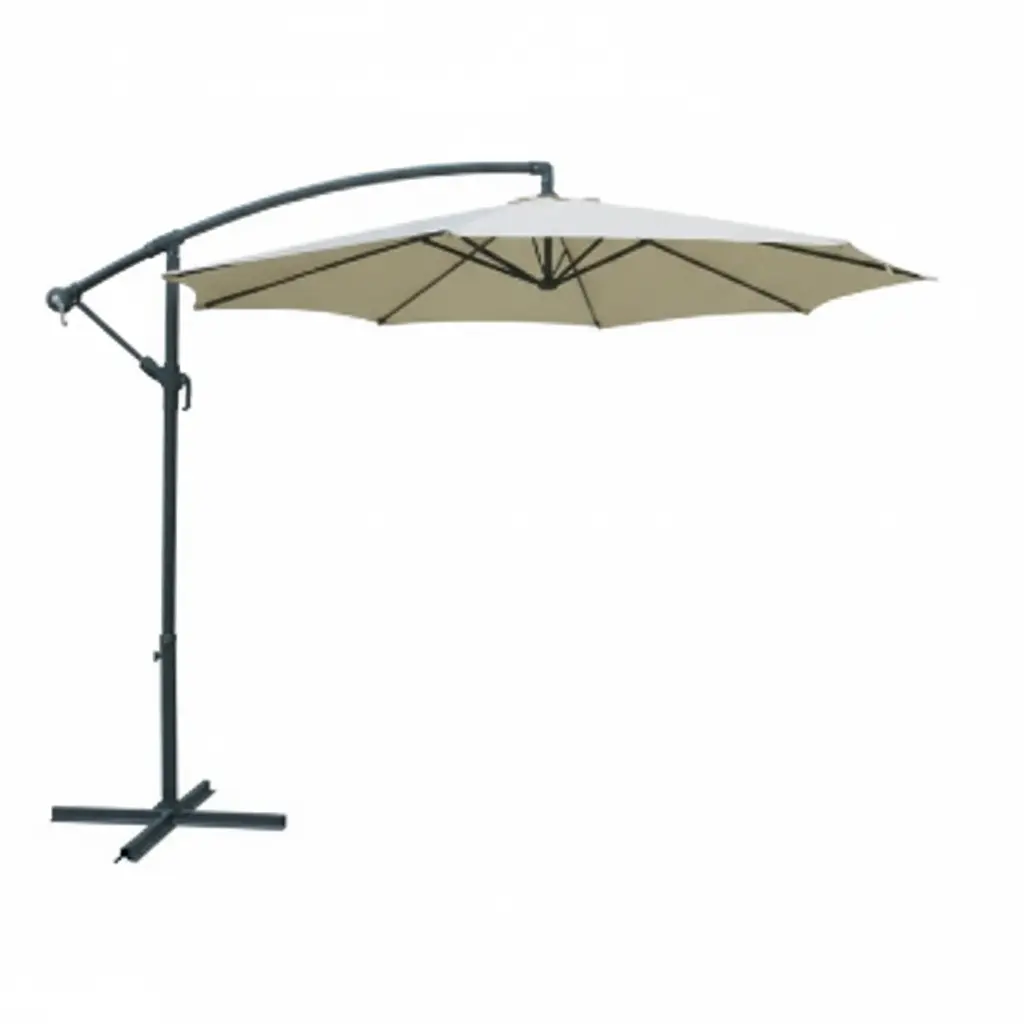
It’s important to distinguish giant umbrellas from our promotional-grade models. Our largest hanging umbrella, the PTZHU-003, has a 3.5m canopy but is built for a different application: seasonal promotions and entry-level retail where cost is the primary driver.
These models use cost-effective materials like Phosphated Steel Frames and 160g/m² Polyester fabric. They are engineered for light conditions and have a specified wind resistance limit of Grade 3 (12-19 km/h). For safety and product longevity, they must be closed when not in use or during breezy conditions.

Structural Upgrades: Why Is 3-4mm Wall Thickness Critical?
A 3-4mm mast wall thickness provides the lateral strength to resist bending under high wind loads. It also maintains the rigidity required to keep the canopy taut.
Boosting Lateral Strength to Resist Wind Load
The main job of an umbrella mast is to stand up straight. During a weather event, wind exerts powerful lateral (sideways) forces that try to bend it. Thicker walls directly increase the mast’s ability to resist these forces and prevent it from deforming or failing.
A 3mm mast wall thickness is a common benchmark in commercial-grade umbrellas because it delivers a significant boost in lateral strength. This allows the structure to handle the sustained wind loads found in exposed restaurant patios or public venues, not just a gentle breeze.
Maintaining Canopy Tension with a Rigid Frame
A taut canopy isn’t just for looks; it’s a core functional requirement. The entire frame must be rigid enough to hold the fabric under tension. Even a slight flex in a mast or a rib immediately translates into a loss of tension, causing the canopy to sag.
This is why you’ll see other components specified with thicker walls, like canopy ribs built with 2mm thick profiles. A rigid frame prevents flex, keeps the fabric tight, and ensures the umbrella can properly shed water and resist wind damage instead of flapping loosely.
Get Durable, Factory-Direct Commercial Umbrellas

Why Is a Telescoping Mast Essential for Giant Umbrellas?
A telescoping mast is critical for giant umbrellas because it lifts the canopy upwards as it closes, allowing it to clear tables and chairs underneath without rearrangement.
Closing Over Furniture Without Rearranging
The core function of a telescoping mast is mechanical simplicity. As you close the umbrella, the mast lifts the entire canopy assembly vertically. This action raises the arms and fabric high enough to clear any tables, chairs, or planters placed underneath. It solves the biggest logistical headache of large canopies in fixed layouts: you no longer need staff to shuffle furniture every time the umbrella is opened or closed. The mechanism handles the clearance automatically.
Maximizing Operational Convenience in Commercial Settings
For any high-traffic commercial venue like a restaurant or hotel terrace, this feature is non-negotiable. It provides huge convenience for staff who may need to close umbrellas quickly due to sudden wind or at the end of the day. The feature allows businesses to utilize every square foot of their valuable outdoor space, as furniture arrangements can remain consistent and dense. Ultimately, it ensures shade can be provided or removed without ever disrupting seated customers.

Wind Load Challenges: How Does Physics Change with Large Canopies?
Large canopies act like sails, creating extreme uplift and pressure. They demand contract-grade engineering and safety certifications like EN581 to manage wind loads and prevent structural failure.
The Aerodynamics of Pressure and Uplift
When wind hits a large canopy, it doesn’t apply force evenly. The structure experiences an asymmetrical pressure distribution across its surface. This means some areas are pushed down while others are pulled up, all at the same time.
The wind generates both downward pressure on the top of the canopy and powerful uplift forces, or suction, from underneath. This uplift is often stronger than the downward pressure, turning the entire canopy into a wing. The most extreme stress concentrates at the leading and trailing edges, which is where structural failures often begin.
Engineering for Stability: The EN581 Safety Standard
To handle these amplified wind loads, true giant umbrellas require contract-grade engineering. Products built for commercial settings are often certified to standards like EN581, which tests for strength, stability, and safety against the forces they will face outdoors. This isn’t just about using thicker poles; it involves the entire structural design.
This is where buyers need to be careful. The promotional-grade umbrellas we manufacture are designed for a completely different purpose. They are built for seasonal value and high-volume container loading, not for high-wind performance. Our products have a wind resistance rating of Grade 3 or less (around 12-19 km/h). They must be closed when not in use or in even a gentle breeze to prevent damage. They do not meet EN581 and are not engineered for the aerodynamic challenges of a permanent commercial installation.
Base Requirements: Why Are Bolt-Down Anchors Mandatory for Giants?
Giant umbrellas catch immense wind forces that overwhelm weighted bases. Bolt-down anchors are mandatory to physically secure the mast to a foundation, preventing dangerous tipping or lift-off.
The Physics of Wind Load on Large Canopies
A large canopy, anything 4 meters or wider, acts like a sail. It doesn’t just block wind; it catches it, creating tremendous leverage against the base. The force isn’t linear. As the surface area and height increase, the tipping and lifting forces on the anchor point multiply exponentially. This creates a high risk of failure in even moderate gusts.
Standard portable bases, even those weighing hundreds of pounds, are simply not heavy enough. They rely on sheer mass, but the physics of wind load creates uplift that can easily overcome that weight. A strong gust can get under the canopy and turn the entire umbrella into a dangerous projectile. Portable bases cannot provide the resistance needed to counter these forces reliably.
Permanent Anchoring for Commercial Safety
Bolt-down systems solve this problem by creating a direct, mechanical connection to a structural foundation. The umbrella mast is physically fastened to a concrete slab, a reinforced deck footing, or another solid structure. This isn’t about weight; it’s about a fixed, rigid connection that eliminates any chance of the base sliding, tipping, or lifting.
For any commercial application—restaurants, hotels, public plazas—this is the only responsible method. Permanent anchoring is a non-negotiable safety requirement. It ensures the installation remains stable in changing weather, protecting property and, more importantly, people. Anything less introduces an unacceptable level of risk in a professional or public setting.
Installation Logistics: Will You Need a Forklift for Setup?
For giant commercial umbrellas 4m or larger, a forklift is often required. The main mast and heavy bolt-down anchor system easily exceed safe manual lifting limits, making machinery essential.
Identifying the Heaviest Components
The need for a forklift comes down to two key parts: the main mast and the base. On a true giant umbrella, the telescoping mast is a thick, heavy-gauge metal tube housing complex mechanisms. The real weight, however, is in the base, which is often a substantial steel plate for bolting down or a massive concrete block. These components can weigh hundreds of pounds, making manual lifting unsafe and impractical. While the canopy and arm assembly is large, its weight is secondary to the sheer mass of the foundational parts.
Planning for Site Access and Machinery
Logistics must be sorted out well before the umbrella arrives. You need to confirm the installation site has clear, wide access for both the delivery truck and the forklift. Tight corners, low overhangs, or soft ground can stop a project cold. Don’t assume your crew can handle it; schedule a certified installation team that is properly equipped and insured to operate the necessary machinery. Proper planning prevents delays and ensures the setup is done safely and correctly the first time.
Cost vs. Coverage: Is One Giant Umbrella Better Than Four Small Ones?
One giant umbrella frees up ground space but is fixed. Multiple small units offer flexibility and portability for seasonal use, but they also create more clutter.
The Core Trade-Off: Unobstructed Space vs. Repositional Flexibility
The main decision comes down to how you use your space. A single large parasol uses just one central mast. This leaves much more open area on a terrace for tables and chairs, creating a clean, uncluttered look. It’s a set-it-and-forget-it solution for permanent layouts.
Four smaller umbrellas create the opposite effect. You get four poles taking up floor space. But these units are lightweight and easy to move. You can reposition them to track the sun, adapt to different event layouts, or bring them inside at the end of the day. This flexibility is valuable when your space needs to serve multiple purposes.
Why Multiple Small Umbrellas Excel for Promotional Campaigns
For volume retailers or event organizers, the math favors multiple small units. Our “Promotional Grade” umbrellas, like the PTMU-001 market model, are engineered for high-volume container loading. This design focus drives down the per-unit cost, making them ideal for seasonal “Special Buys” or large-scale marketing campaigns.
We offer silk screen logo printing, turning these affordable umbrellas into a widespread and highly visible marketing tool. For beer brands, festivals, or cafes, blanketing an area with dozens of branded umbrellas delivers a much bigger impact than one or two giant, unbranded units could ever achieve.

How Do Giant Canopies Maximize Your Branding Impact?
Giant canopies function as massive, high-visibility billboards. Their surface is prime real estate for custom logos, creating an unmissable focal point that captures attention and reinforces brand recognition.
Creating an Unmissable Visual Landmark
A giant canopy is more than a shade structure; it’s a physical landmark. In a crowded event or a busy outdoor space, its sheer size naturally draws the eye and serves as an elevated focal point. This isn’t theoretical—it’s about commanding a physical presence that small-scale signage just can’t match.
The structure effectively becomes a hybrid billboard and storefront. It establishes a sense of authority and credibility before a customer even steps underneath. You’re not just another booth; you’re the destination people navigate toward.
Applying Brand Identity with Custom Printing
The real marketing value comes from turning that fabric into a branding asset. We use Silk Screen printing to apply logos, slogans, and specific brand colors directly onto the canopy fabric. This is a core service for our promotional and event clients, like beer brands or corporate sponsors.
This process ensures their brand looks identical at every trade show, festival, or patio location, building immediate recognition. The goal is consistency. When a customer sees that specific color and logo combination from across a venue, they know exactly who it is.
Frequently Asked Questions
What is the largest size for a patio umbrella?
Standard residential umbrellas typically max out at 10-12 feet in diameter. For larger needs, commercial-grade giant umbrellas are available in sizes ranging from 13 to 20 feet or more. These larger models require heavy-duty bases or permanent mounting for safe operation.
How much wind can a giant umbrella handle?
Wind resistance varies by design. Most commercial giant umbrellas are engineered to withstand sustained winds of 30 to 55 mph. Specialized, high-performance models with reinforced frames and secure installations can be certified for wind gusts up to 63 mph.
Do giant umbrellas need special installation?
Yes, their size and weight necessitate specialized installation. Permanent methods, like in-ground concrete sleeves or bolted base plates, offer the highest level of safety. Portable weighted bases are also an option but must be correctly matched to the umbrella’s size for stability.
Are 15-foot commercial umbrellas readily available?
Yes, 15-foot umbrellas are a standard size in the commercial market and are widely available through various manufacturers and retailers. They are specifically designed for large spaces like restaurant patios, resorts, and event venues.
Final Thoughts
The choice isn’t between cheap and expensive; it’s between a temporary asset and a permanent fixture. Using a promotional-grade umbrella with a Grade 3 wind limit in a permanent commercial setting invites structural failure and liability. Matching the engineering to the application is the only way to protect your investment and reputation.
Our expertise is in high-volume, promotional-grade umbrellas engineered for seasonal value. Request our catalog to see models optimized for maximum container loading. Contact our team to discuss custom logo printing for your next campaign.




 English
  Spanish
  French
  German
  Portuguese