

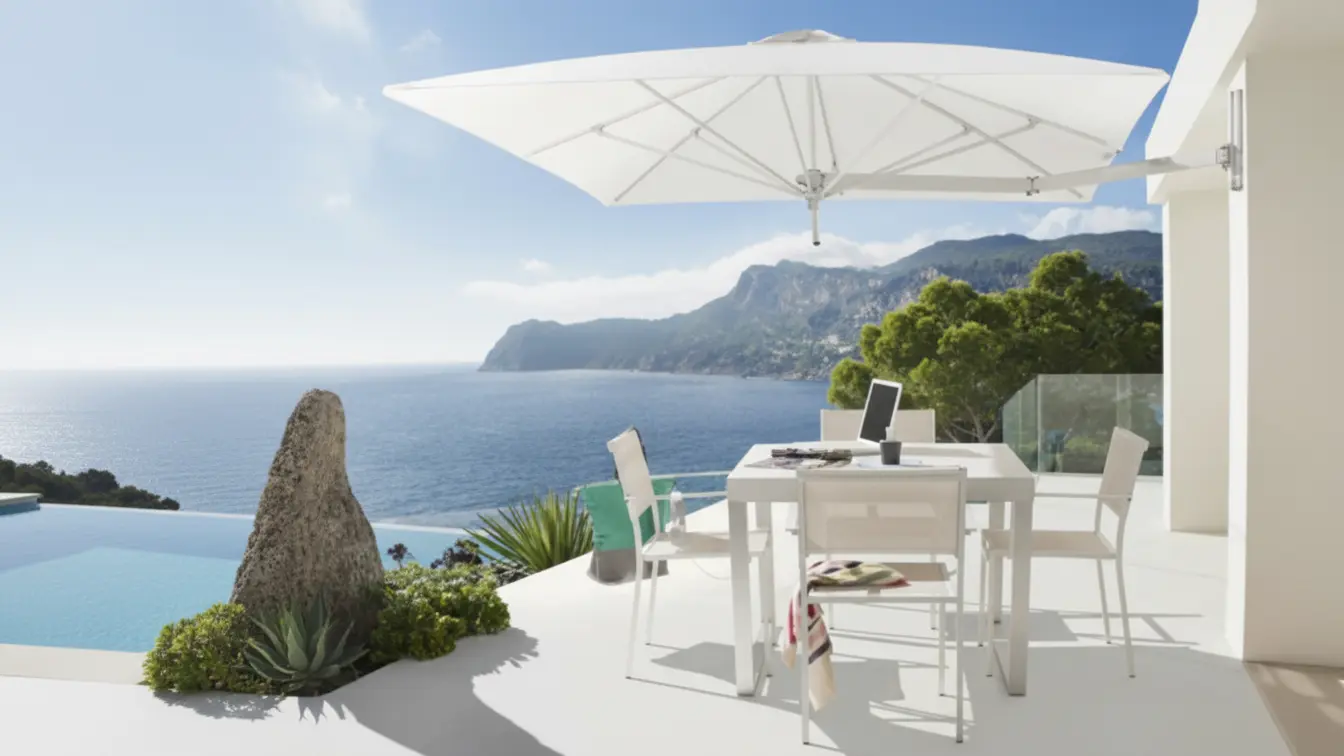
Homeowners with limited deck space often struggle to add shade without giving up valuable floor area. Choosing the best deck umbrella means balancing coverage, aesthetics, and mounting options that work with small layouts and varying wind conditions.
This guide covers top space-saving umbrella brands, mounting methods that remove bulky bases, and material durability considerations, helping homeowners pick the ideal shade solution for long-lasting comfort on compact wooden decks.
Top Space-Saving Deck Umbrellas to Consider
Selecting the right deck umbrella is vital for efficient use of limited outdoor space. This list spotlights top brands offering compact, practical umbrellas ideal for small decks, highlighting key features, ease of use, and durability to help you choose the best fit.
1. Patiofurnituresco (China)
Patiofurnituresco specializes in contract-grade outdoor furniture with 16 years of manufacturing experience. Based in Taizhou, China, it serves clients in over 30 countries, offering customizable patio umbrellas designed for commercial and high-traffic spaces.
Its direct-from-factory business model supports low MOQs and fast lead times, helping startups and e-commerce brands access certified quality (UL4041, EN581) at competitive pricing.
- 🌏 Main Markets: Startups, Private Label Brands, E-Commerce
- 🪑 Main Products: Contract-grade umbrellas, heavy-duty outdoor seating, outdoor structures
| ✅ What We Love | ⚠️ Things to Consider |
|
|
2. Sunnyglade (United States)
Sunnyglade produces affordable, space-efficient umbrellas ideal for residential decks. The 7.5 FT and 9 FT models include crank lift and push-button tilt for effortless adjustment. Their powder-coated aluminum poles and heavy-duty polyester canopy offer reliable durability.
- 🏠 Main Markets: Budget-conscious homeowners
- 🪄 Main Products: Market and cantilever umbrellas, portable options
| ✅ What We Love | ❌ Things to Consider |
|
|
3. Bluu (United States)
Bluu focuses on premium offset cantilever umbrellas that maximize shading without occupying deck center space. The 10-foot design offers full rotation and a near-90° tilt capability, providing wide, adjustable coverage for various sun positions.
- 🎯 Main Markets: Homeowners valuing aesthetics and performance
- ☂️ Main Products: Offset umbrellas, bases, replacement canopies
| ✅ What We Love | ❌ Things to Consider |
|
|
4. Pure Garden (United States)
Pure Garden delivers lightweight cantilever umbrellas weighing around 30 lbs, ideal for easy repositioning and seasonal storage. The bolt-together base supports flexible weighting options and multi-angle tilt for wide coverage.
- 💼 Main Markets: Budget buyers and rental operators
- ☀️ Main Products: Offset umbrellas, bases, canopy covers
- 🌐 Website:PureGardenCo.com
| ✅ What We Love | ⚠️ Things to Consider |
|
|
5. Abba Patio (United States)
Abba Patio’s 7.5-foot market umbrellas are compact and built to withstand strong winds. The fabric attachment system uses grommets and screws to prevent tearing, making it one of the most durable small market-style designs.
- 🏡 Main Markets: Homeowners needing durable, low-maintenance solutions
- 🛠️ Main Products: Market umbrellas, bases, shade accessories
- 🌐 Website:AbbaPatio.com
| ✅ What We Love | ❌ Things to Consider |
|
|
6. Tangkula (United States)
Tangkula’s 10-foot offset umbrellas balance function and value. They feature hand-crank lifting and five tilt positions with 360° rotation for full sun management. The cross-base is included, though extra weighting improves wind stability.
- 🏖️ Main Markets: Mid-range buyers seeking value and function
- 🌐 Website:Tangkula.com
| ✅ What We Love | ⚠️ Things to Consider |
|
|
7. Tempera (United States)
Tempera specializes in table-integrated umbrellas for small decks. The 9-foot umbrella features heavy-duty polyester fabric and a compact pole designed to mount through outdoor tables for space savings.
- 🌴 Main Markets: Mid-to-premium homeowners
| ✅ What We Love | ❌ Things to Consider |
|
|
8. SERWALL (United States)
SERWALL stands out for portability. Its 7.5-foot umbrella uses a removable sand anchor system for use on decks, lawns, or beaches. The design offers 99% UV protection and adjustable tilt for flexible sun coverage.
- 💡 Main Markets: Homeowners needing adaptable shade on small decks
| ✅ What We Love | ⚠️ Things to Consider |
|
|
In our experience, compact umbrellas like those from Patiofurnituresco and Tempera deliver strong performance for small deck spaces, balancing design, durability, and practical use. Homeowners can prioritize tilt range, base flexibility, or direct-from-manufacturer value depending on their space and budget needs.
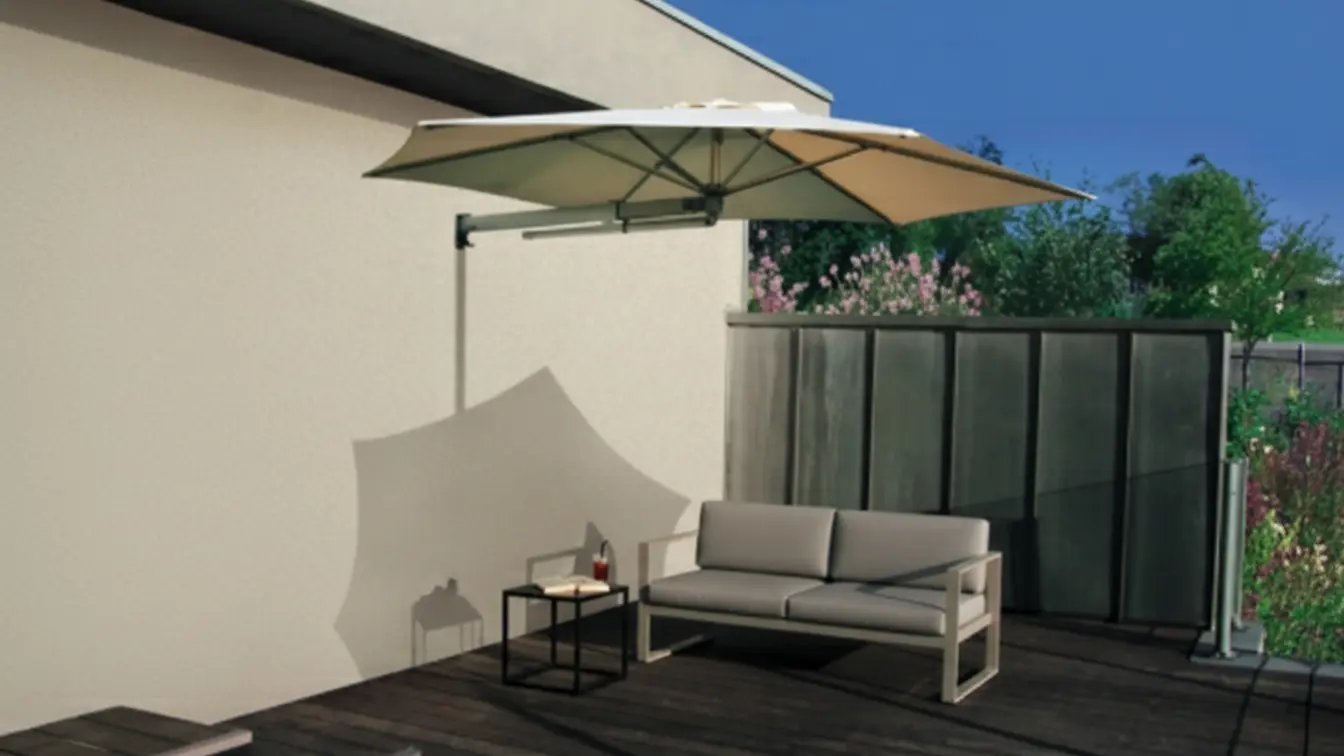
Mounting Options That Eliminate Bulky Bases
Modern deck umbrellas can be mounted using post anchors, deck blocks, fascia mounts, and raised base plates to eliminate bulky freestanding bases. Post anchors driven into the ground with a jackhammer offer the most secure and space-efficient solution for decks up to 8 feet high, while deck blocks serve as a simple no-dig option for lower decks under 6 feet.
For homeowners looking to install the best deck umbrella without giving up valuable floor space, modern mounting systems offer several reliable alternatives to traditional heavy bases. These techniques secure umbrellas directly to the deck or surrounding foundation, improving stability and aesthetics at once.
Overview of Mounting Options
Several mounting methods can remove the need for bulky, freestanding bases while maintaining strong wind and load performance. Each solution has unique requirements and benefits depending on deck height and construction material.
- ✅ Post Anchors: Driven into soil using jackhammers, they ensure high stability and are suitable for decks up to 8 feet.
- ✅ Deck Blocks: Rest on the surface with no excavation required, perfect for decks below 6 feet.
- ✅ Fascia Mounts: Bolted directly to deck ledger boards, providing strong structural integration without disrupting the ground.
- ✅ Raised Base Plates: Surface-mounted plates ideal for vinyl or membrane decks to maintain waterproofing integrity.
Key Comparison of Mounting Options
This table compares the most common mounting types for stability, load, and ease of installation, helping homeowners select the right approach for their deck’s conditions.
| Mounting Type | Installation Method | Max Deck Height Supported | Ground Prep | Stability | Cost Efficiency |
|---|---|---|---|---|---|
| Post Anchors | Jackhammer-driven | 8 ft | Minimal compaction | ✅ High | 💰 Moderate |
| Deck Blocks | Rest on leveled ground | 6 ft | Only leveling | ⚠️ Moderate | ✅ Low |
| Fascia Mounts | Bolted to ledger | Variable | None | ✅ High | 💰 Moderate |
| Raised Base Plates | Surface-mounted | Variable | None | ⚠️ Moderate | 💰 Moderate–High |
Critical Installation Considerations
Proper installation is key to safety and compliance with modern building codes when mounting deck umbrellas without large bases.
- ⚠️ Post Anchors: Require at least 30 seconds of jackhammer driving after hitting the foundation plate to compact soil and distribute load.
- ⚠️ Fascia Mounts: Must align with deck joist spacing and fully supportive ledger connections that meet dimensional and gap standards.
- ⚠️ Wind Resistance: Under the 2021 IRC, decks over 6 ft may need two 1,500 lb lateral holdowns within 24 inches of each end.
- ⚠️ Raised Base Plates: Should maintain waterproof seals on vinyl or membrane decks and undergo inspection at least once per year.
Why Post Anchors Are the Premium Solution
In our experience, post anchors deliver the highest stability and most space-efficient setup for the best deck umbrella installations. They connect the shade structure directly to compacted soil, eliminating heavy and unsightly surface bases.
- ✅ The anchored foundation plate resists lateral movement during strong wind events.
- ✅ Compatible with tall decks—up to 8 feet high—supporting umbrellas with expanded reach.
- ✅ Though a jackhammer is required, the method meets building codes when paired with structural holdowns.
- 🚀 Ideal for long-term performance where both aesthetics and safety are priorities.
Alternative Mounting Methods for Finished Decks
Homeowners with completed decks can still enjoy strong and discreet umbrella setups by using non-invasive mounting techniques. These options are particularly useful for retrofit projects where digging isn’t possible.
- ✅ Fascia Mounts: Bolt to the deck ledger for excellent load transfer and stability without soil disturbance.
- ✅ Raised Base Plates: Sit flush on deck surfaces and maintain membrane protection, ideal for waterproof decks.
- 💡 Tip: Always evaluate the umbrella load path and lateral resistance to ensure reliable anchoring under wind pressure.
How to Choose the Right Umbrella for Your Deck
For wooden deck homeowners seeking shade without bulky bases, cantilever umbrellas offer unobstructed space and flexible positioning, making them optimal for medium to large decks. Market umbrellas suit smaller decks and areas with high winds, especially if a central pole can be integrated through a dining table.
Choosing the best deck umbrella depends on your deck size, sun exposure, and how much space you want to keep open. Both market and cantilever umbrellas have unique strengths suited for different setups and weather conditions.
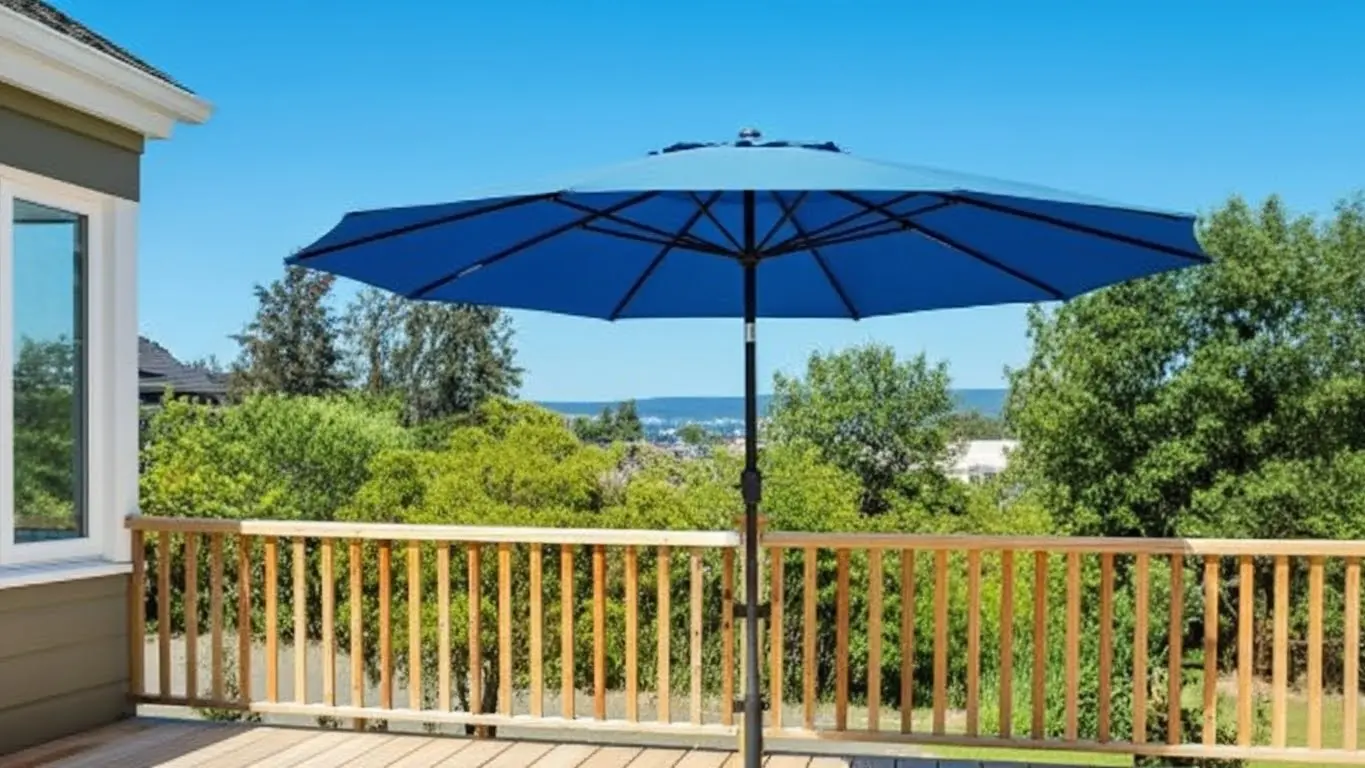
Comparing Market and Cantilever Umbrellas
This comparison shows how both designs differ in structure, stability, and usability.
| Feature | Market Umbrella | Cantilever Umbrella |
| Pole Position | Central pole (through-table mount) | Offset side pole for open center space |
| Recommended Deck Size | Small to medium (5–8 ft) | Medium to large (8+ ft) |
| Shade Coverage | 6–9 ft diameter | 9–13 ft diameter |
| Wind Stability | ✅ More stable in high winds | ⚠️ Needs 70+ lb weighted base |
| Usable Space | ❌ Central pole limits table space | ✅ Fully open under-canopy area |
| Mobility & Adjustability | Tilt function only | Full 360° rotation for flexible shade |
Optimizing Shade and Space for Wooden Decks
Decks with limited footprints can benefit from smart umbrella placement. Cantilever umbrellas position the pole to the side, keeping the deck’s central area clear for chairs or loungers. This setup works best when space is needed for movement or entertaining.
Market umbrellas, by contrast, place the pole through a table hole, creating a compact and wind-resistant arrangement but with less floor flexibility.
For the best coverage, extend your umbrella size about 2–2.5 ft beyond the area you want shaded. For instance, a 5 ft wide section of deck typically needs a 9 ft umbrella to keep seating consistently covered.
Considering Wind Conditions and Durability
When wind is a frequent issue, market umbrellas often perform better due to their symmetrical design and central support. They stay steadier in breezy conditions common to elevated decks.
Cantilever umbrellas need a heavier base—typically over 70 lb—and careful angling to stay secure. Both types benefit from high-performance materials like UV-resistant fabrics (such as Sunbrella) and corrosion-proof aluminum or treated wood frames.
Reinforced arms and canopies are recommended for larger cantilever models to maintain long-term structural integrity.
Adjustability and User Convenience
Ease of adjustment can determine how often homeowners use their deck shade. Market umbrellas usually feature a simple tilt mechanism, letting you angle the canopy as the sun shifts.
Cantilever umbrellas offer a more dynamic setup. With 360° rotation, you can easily reposition the shade without moving the base, keeping one control handle at arm’s reach for daily usability. These features enhance comfort, especially during midday when sun angles change quickly.
Practical Recommendations for Deck Owners
- ✅ Choose a market umbrella if your deck is under 8 ft wide or exposed to strong winds.
- ✅ Opt for a cantilever umbrella for larger decks where open space and flexible shading matter most.
- ⚠️ Always consider base weight—cantilever models need heavier supports for safety.
- 💡 If you use a dining set, a market umbrella through the table center is usually the most stable and space-efficient choice.
In our experience, matching the umbrella style to your deck’s layout and wind conditions ensures you get both comfort and durability from your investment. Whether you prefer the steady simplicity of a market umbrella or the open versatility of a cantilever design, selecting the right one makes outdoor living more enjoyable year-round.
Elevate Your Outdoor Spaces with Factory-Direct Custom Umbrellas
Partner with Patiofurnituresco to access durable, innovation-driven patio umbrellas engineered for commercial success and low-risk market entry. Customize your order with expert OEM/ODM services backed by 16 years of manufacturing excellence and global certifications.

Benefits of Cantilever vs. Center Pole Umbrellas
Cantilever umbrellas offer unobstructed shade with no central pole interference, ideal for maximizing deck space and flexibility. Center pole umbrellas provide better stability, wind resistance, and affordability, suited for fixed tables and cost-conscious users.
Choosing the best deck umbrella depends on your space layout, furniture setup, and local wind conditions. Each umbrella type brings strengths suited to different deck designs and usage preferences.
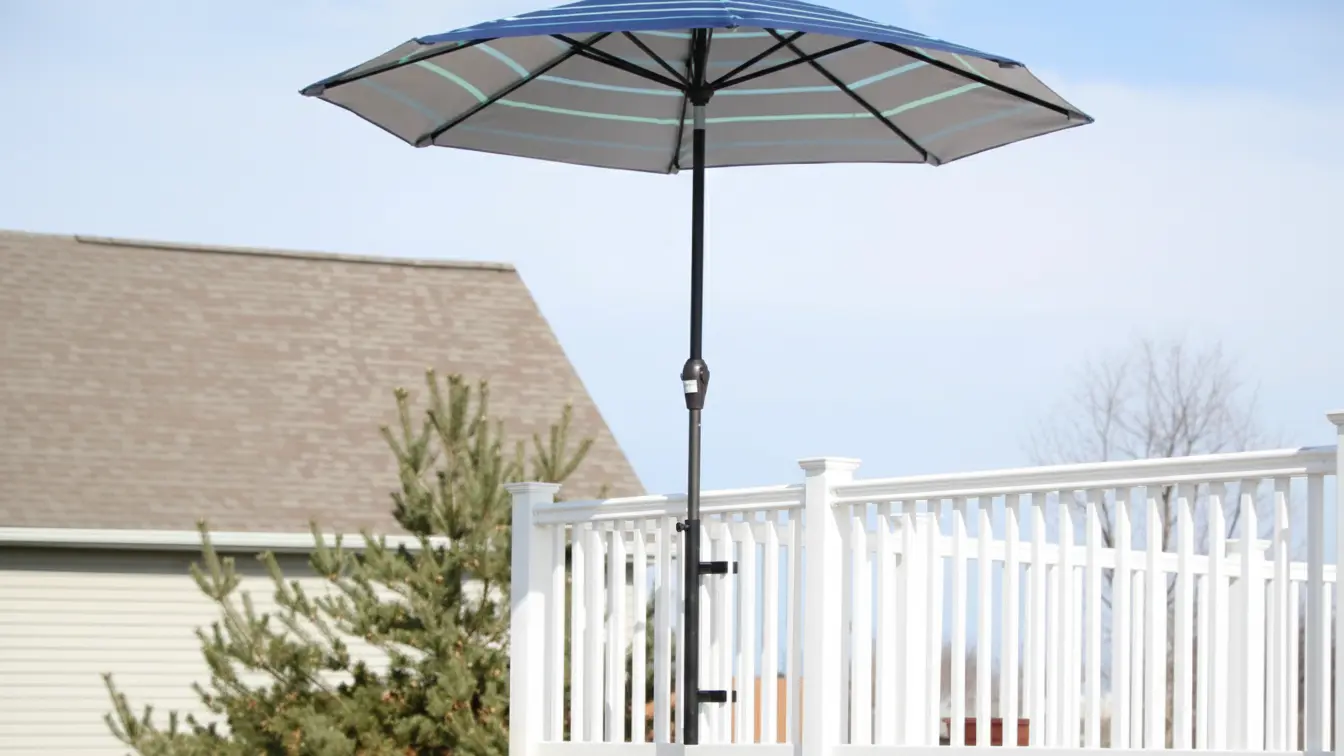
Key Comparison Table of Cantilever and Center Pole Umbrellas
| Feature | Cantilever Umbrella ✅ | Center Pole Umbrella ✅ |
|---|---|---|
| Pole Position | Offset (outside canopy) | Central (through canopy) |
| Canopy Width | 8–13 feet coverage | Typically smaller |
| Base Weight Required | 400+ pounds base | Lighter bases (often fits into table) |
| Shade Coverage | Unobstructed underneath | Obstructed by central pole |
| Rotation Capability | 360° rotating base | Limited or fixed |
| Tilt/Adjustment | Full tilt and rotate | Limited tilt options |
| Wind Resistance | ⚠️ Lower (requires heavy base) | Higher (lower profile) |
| UV Protection | UPF 50+ blocking 97% UV rays | UPF 50+ blocking 97% UV rays |
| Typical Use Case | Pools, patios, flexible seating | Cafés, restaurants, fixed tables |
| Price Point | Higher 💲💲💲 | Lower 💲 |
| Maintenance | Mechanical checks needed ⚙️ | Focus on fabric care 🧺 |
| Space Footprint | Larger (needs clearance) | Compact design |
Practical Insights for Wooden Decks and Outdoor Settings
Cantilever umbrellas free up valuable deck space because their support pole sits outside the shaded area. This design suits small to medium wooden decks where table holes are unavailable or undesired. With a rotating base and multiple tilt angles, it’s easy to move shade coverage throughout the day.
Center pole umbrellas usually mount through a table or into a separate weighted base. While this adds some layout limitation, it creates excellent balance and wind stability. Their compact footprint suits fixed setups like outdoor dining sets or café tables.
In windy conditions, center pole umbrellas often outperform cantilever models due to their centered load and lower height. Cantilever umbrellas can stay steady with a 400–500 lb base or permanent deck anchoring. For homeowners protecting wood surfaces, cantilever models also avoid drilling through tabletops, maintaining the aesthetic and integrity of the wooden deck.
Maintenance and Durability Comparison
Both umbrella types typically use high-grade acrylic fabric with UPF 50+ protection, blocking up to 97% of UV rays. Maintaining the canopy fabric ensures it stays vibrant and protective over years of use.
- 💡 Cantilever umbrellas: check rotating joints and tilt mechanisms regularly for smooth movement.
- 💡 Center pole umbrellas: simple upkeep—focus on cleaning fabric and inspecting mounting fixtures.
- 🚀 Consistent maintenance extends service life and preserves long-term deck aesthetics.
Materials and Durability for Outdoor Deck Umbrellas
Solution-dyed acrylic fabrics like Sunbrella® offer the highest durability for outdoor deck umbrellas, lasting 5–10 years with excellent UV and water resistance. Olefin serves as a cost-effective mid-tier option with a 3–5 year lifespan and strong mildew resistance. Budget polyester options typically last 1–2 years but come at a lower price point.
When selecting the best deck umbrella for a wooden or composite deck, understanding fabric materials is crucial. Each type of textile affects UV resistance, longevity, and maintenance effort. Below is a breakdown of key umbrella fabric options for different deck environments.
Comparison of Umbrella Materials: Key Performance Metrics
| Material | UV Protection | Color Fastness (hours) | Average Lifespan | Water/Mildew Resistance | Price Tier |
|---|---|---|---|---|---|
| ✅ Solution-Dyed Acrylic (Sunbrella®) | Excellent – 98%+ UV block | 2000+ | 5–10 years | ✅ Excellent | 💰 High |
| ✅ Olefin (Polypropylene) | Very Good – UPF 80 | 700–1500 | 3–5 years | ✅ Good | 💰 Mid |
| ⚙️ Solution-Dyed Polyester (Terylast) | Good – 98% UV | Varies | 1–3 years | ✅ Moderate | 💰 Budget+ |
| ❌ Standard Polyester | Moderate protection | — | 1–2 years | ❌ Limited | 💰 Low |
| 🎨 Canvas | Moderate | 300–600 | 2–4 years | ⚠️ Needs care | 💰 Mid |
Material Selection Considerations for Deck Umbrellas
Deck umbrellas must withstand continuous exposure to sun, wind, and moisture. The proximity to wooden surfaces also raises concerns about mildew and discoloration.
- ✅ Solution-dyed acrylic lasts longest since pigments are embedded directly in the fibers. It resists mold, mildew, and fading while remaining breathable — ideal for permanent deck installations.
- ✅ Olefin balances durability and affordability. It dries quickly and resists stains, protecting wood decks even with some mild fading over time.
- ⚙️ Polyester fabrics cost less and work well for shaded or seasonal decks, though they fade faster when exposed to strong sunlight.
- 🎨 Canvas delivers a traditional, rustic appearance but needs regular maintenance due to moderate moisture resistance.
Common Misconceptions About Deck Umbrella Fabrics
- ⚠️ Not all polyester fabrics are equal. Solution-dyed polyester lasts far longer than standard polyester and usually includes better fade warranties.
- 💡 Premium acrylic isn’t always necessary. Olefin offers about 80% of acrylic’s performance at roughly half the cost.
- ⚠️ Water resistance does not mean mildew-proof. Quick-drying capability is crucial, especially over wood decks where humidity lingers.
- 💡 Fade resistance should always match deck exposure — full-sun environments require high UV ratings for color retention.
Recommended Materials for Different Deck Scenarios
- 🌞 Full sun, permanent decks: Solution-dyed acrylic (Sunbrella®) for superior UV and mildew protection lasting 5–10 years.
- 🏡 Moderate sun, residential decks: Olefin offers solid durability and quick drying for 3–5 years of service.
- 🌤️ Shaded or seasonal decks: Solution-dyed polyester variants deliver reasonable fade resistance at lower cost.
- 💰 Budget or occasional use: Standard polyester fits short-term setups where price matters more than longevity.
- 🎨 Aesthetic or vintage style: Canvas fabric provides natural charm with higher upkeep requirements.
Installation Tips for Limited Space Decks
Installing decks in limited spaces requires careful planning around spatial constraints, precise measurements, and space-saving structural techniques such as platform decks, multi-level designs, and built-in seating. Maximizing vertical space and choosing lighter materials enhance usability and the perception of openness.
Building a deck in a small outdoor area is all about smart structure and design discipline. Each inch matters, so the process should balance aesthetics, functionality, and durability. The following sections outline best practices to help homeowners and builders create high-impact decks even in restricted spaces.
Pre-Installation Assessment and Precise Measurement
Start with a precise site assessment before any cutting or framing begins. Record exact dimensions, note the ground slope, and take multiple measurements to capture irregularities. This information helps you avoid misalignments later during construction.
- 📏 Document exact dimensions of the available area, including ground slope.
- 🌳 Identify existing structures like trees, fences, and utilities that affect layout.
- 💡 Establish foundational data to optimize use of every square foot.
In our experience, detailed assessment can reduce design revisions by more than 30% and help maintain accurate alignment throughout installation.
Strategic Layout and Functional Zoning
Limited space doesn’t mean limited functionality. Even a small deck can include designated areas for relaxing, dining, or light gardening when planned correctly.
- 🪑 Create distinct zones for seating, dining, and greenery.
- 🎨 Use splice boards or subtle visual borders to separate areas without partitions.
- 🚶 Design the pathways and furniture flow to keep the deck open and uncluttered.
A clear zoning concept encourages efficient use of space and contributes to a seamless visual experience.
Choosing Structural Designs for Limited Spaces
The structure you choose determines how adaptable your deck will be. Compact structures can deliver both comfort and functionality when fitted to the site conditions.
- 🛠️ Platform decks offer a low profile and quick installation without deep foundations.
- 📈 Multi-level decks adapt to sloped terrain and organize activities vertically.
- ⭕ Curved designs trim unused corners and improve flow for social areas.
Each structural approach provides flexibility in shape and scale, and choosing the right type improves both functionality and overall appearance.
Material Selection and Visual Enhancement Techniques
Smart material choices improve longevity while visually expanding the sense of space. Composite decking or treated wood helps resist weather stress in tight environments.
- 🪵 Use composite decking for durable, low-maintenance performance.
- 🌤️ Select lighter tones like gray or tan to make the area appear larger.
- 🎯 Balance aesthetic appeal with long-term daily wear in limited-use areas.
Lighter finishes tend to reflect sunlight better, visually enhancing perception of openness without structural changes.
Built-In Features, Storage, and Vertical Space Utilization
Adding built-in features minimizes clutter and turns structural elements into storage solutions.
- 🪑 Incorporate built-in seating with under-bench storage to maximize surface area.
- 🌿 Use hanging plants, lattice fences, floating tables, and wall-mounted lighting to add utility vertically.
- 🧺 Choose multi-functional furniture that adapts to compact zones easily.
Vertical storage and built-in seating combine comfort with organization, improving deck versatility by nearly 40% in most small layouts.
Lighting Solutions to Enhance Ambiance and Space Perception
Good lighting creates warmth while freeing up valuable floor area. It can also define zones and improve safety during evening use.
- 💡 Install wall-mounted or solar-powered LED fixtures to save floor space.
- ✨ Use string lights or compact lanterns to bring cozy, decorative charm.
- 🌙 Integrate ambient lighting that complements built-in furniture and pathways.
Energy-efficient lighting systems enhance both ambiance and function without adding to physical bulk.
Addressing Common Misconceptions About Small Decks
Many homeowners think small decks will always feel tight or impractical, but that’s far from true when design principles are applied correctly.
- ✅ Thoughtful zoning and vertical utility eliminate the “cramped” feel.
- 💰 Cost-effective updates refinish or reconfigure decks without full renovations.
- 🧩 Built-ins and modular furniture bring adaptability without rigidity.
By combining these ideas, small decks can offer the same experience as larger spaces while maintaining comfort and style.
Installation Workflow Checklist
This checklist summarizes the entire workflow to ensure an efficient deck project in limited spaces.
- 📐 Assess & Measure: Record accurate site dimensions and slope details.
- 🎯 Define Purpose: Decide if the deck will focus on dining, lounging, or greenery.
- 🧱 Select Deck Type: Choose platform, multi-level, or curved design.
- 🪵 Choose Materials: Select durable, light-colored composites or treated wood.
- 🪑 Plan Zoning: Mark areas with subtle visual borders for better flow.
- 📦 Incorporate Built-Ins & Storage: Use benches and integrated storage.
- 🌿 Use Vertical Space: Add trellises, planters, and hanging décor.
- 💡 Install Space-Saving Lighting: Prefer wall-mounted or solar LEDs.
- ⚠️ Ensure Safety & Compliance: Follow local building codes.
- 🎨 Add Final Touches: Use decor and cushions to bring character.
When every stage is executed precisely, even the smallest deck can function as a full-scale outdoor living space—especially when paired with compact accessories like a shade-efficient best deck umbrella suited for tight-floor layouts.
Frequently Asked Questions About Deck Umbrellas
How do I mount an umbrella to my deck railing?
You can use a deck clamp or railing mount specifically designed for outdoor umbrellas. These mounts attach securely to most railings without drilling, keeping your deck surface intact.
Choose a heavy-duty mount that supports the umbrella’s diameter and weight. In our experience, aluminum clamps with stainless steel fasteners provide durability and corrosion resistance for outdoor use.
Can I drill an umbrella into my deck?
You can, but it should be done only if the deck structure can bear the load safely. Use a stainless-steel base plate and bolts rated for outdoor structural use.
Always seal the drilled holes with waterproof caulk to prevent water infiltration and wood damage. Many homeowners prefer clamp or freestanding options to avoid altering their decking surface permanently.
Best umbrella for a small 10×10 deck?
For a 10×10 ft deck, select a compact cantilever or wall-mounted umbrella. They save floor space while providing full coverage for seating areas.
Half-canopy models or offset umbrellas with adjustable angles let you position shade precisely without a bulky base. Lightweight aluminum frames and weatherproof fabric make maintenance easier for smaller spaces.
Are half-umbrellas good for decks?
Yes, half-umbrellas are ideal when deck space is limited or the area backs against a wall or railing. The flat side sits flush to the wall, keeping the walkway clear.
They are especially effective for narrow decks or balconies under 6 ft wide. Look for commercial-grade aluminum poles and UV-resistant canopies to ensure long service life.
How to secure an umbrella on a raised deck?
Raised decks are exposed to stronger wind, so stability is essential. Use weighted bases of at least 50 lbs or railing clamps for smaller models.
In windy regions, consider a screw-in anchor system or bolt the base to the deck joists. Always close the umbrella when not in use to prevent lifting or structural stress during storms.
Final Thoughts
Choosing the best umbrella for your deck comes down to balancing design efficiency, space optimization, and long-term durability. From cantilever models that maximize open seating areas to market umbrellas that stand firm in high winds, every option serves a specific layout and climate. Material selection—like solution-dyed acrylic or olefin—and proper mounting methods, such as post anchors or fascia mounts, can extend product life while maintaining deck integrity.
By focusing on these structural and material factors, homeowners can create shaded outdoor spaces that last season after season without sacrificing design flexibility. Working with reliable suppliers or manufacturers ensures consistent quality, faster delivery, and safer installations—turning even compact decks into functional, stylish outdoor retreats.



 English
  Spanish
  French
  German
  Portuguese