

For commercial facility managers and project specifiers, fire safety is far more than a checklist item—it is a critical legal prerequisite for securing occupancy permits and maintaining insurance coverage. In the high-stakes world of hospitality, large textile surfaces like curtains and wall panels are treated as primary paths for fire spread, meaning a single non-compliant fabric choice can lead to failed fire marshal inspections or the immediate loss of operating licenses.
This guide provides a comprehensive roadmap through essential fire retardancy standards, detailing technical pass/fail criteria such as the NFPA 701 weight loss limit of ≤ 40% and the mandatory 18-inch clearance required below sprinkler deflectors under California Title 19. We will also compare the long-term durability of inherent versus treated FR fibers and outline the specific documentation required to meet the strict November 30 annual renewal deadlines mandated by local licensing authorities.
Why Hotels Require FR (Fire Retardant) Fabrics
Hotels require fire-retardant (FR) fabrics because fire safety codes for public lodging treat large textile surfaces—such as curtains and wall panels—as primary paths for fire spread. Documented compliance with standards like NFPA 701 or BS 5867 is a legal prerequisite for occupancy permits, insurance coverage, and passing local fire marshal inspections.
Legal Mandates and Liability Management
Life-safety codes for public assembly treat large textile surfaces as high-risk fire paths, tying occupancy approval to certified flammability tests. In the United States, hospitality guidance dictates that all property fabrics must be FR-certified to pass mandatory safety inspections conducted by local fire marshals.
Insurance providers and civil defense authorities mandate documented compliance with recognized standards to manage liability and ensure guest safety. Failure to utilize certified FR fabrics can result in severe consequences, including the loss of operating licenses or the denial of insurance claims following a fire incident.
Global Compliance Standards: NFPA, BS, and EN Benchmarks
The NFPA 701 (US) serves as the default benchmark for the industry. Under Test Method 1, vertical fabric samples are exposed to a flame for 12 seconds to measure propagation, char length, and flaming residue. Similarly, BS 5867-2 Type B is the specific UK requirement for contract drapes in hotels, requiring the fabric to limit flame spread after 15–30 seconds of ignition contact.
European standards (EN 13773) classify drapery from Class 1 to 5, with Class 1 representing the safest level typically required for hospitality interiors. In other regions, Canada applies CAN/ULC-S109-14 for textiles in public spaces, while ASTM E84 Class A is often mandated for fabrics used as wall finishes rather than free-hanging drapes.
Project specifiers increasingly favor inherently FR (IFR) fibers, such as Trevira CS, for hotel developments. Unlike topically treated fabrics, the fire-retardant properties of IFR textiles are permanent and remain effective even after repeated commercial washing and aging.
NFPA 701: The Vertical Burn Test Explained
NFPA 701 is the standard fire test for hanging textiles, measuring how flames propagate vertically. Fabrics pass by meeting strict thresholds: an average weight loss of ≤ 40%, afterflame times of ≤ 2 seconds, and no flaming residues that burn for more than 2 seconds.
| Performance Metric | Test Method 1 (Small Scale) | Test Method 2 (Large Scale) |
|---|---|---|
| Fabric Applicability | Lightweight (< 21 oz/yd²) | Heavyweight (≥ 21 oz/yd²) |
| Avg. Weight Loss | ≤ 40% (across 10 samples) | Not typically measured |
| Afterflame / Drip Time | ≤ 2.0 Seconds Average | ≤ 2.0 Seconds Individual |
| Max Char Length | 435 mm (approx. 17.1 in) | 1050 mm (approx. 41.3 in) |
Test Method 1 vs. Test Method 2: Fabric Classifications
NFPA 701 distinguishes between materials based on their weight and intended application, utilizing two distinct testing procedures. Test Method 1, often referred to as the small-scale test, is the industry standard for most interior window treatments, including curtains, draperies, and hanging films lighter than 21 oz/yd² (approximately 700 g/m²). This method utilizes an open-face test cabinet where specimens are mounted vertically to simulate the physics of a real-world fire climbing a window treatment.
In contrast, Test Method 2 is a large-scale evaluation reserved for heavy-duty textiles that exceed the 21 oz/yd² threshold. This includes substantial architectural fabrics such as theater stage curtains, permanent awnings, and large fabric structures. For Test Method 1, specimens are cut to approximately 150 mm × 450 mm (6 in × 18 in) and suspended from a pin bar, ensuring the material’s vertical orientation replicates the most hazardous configuration for flame spread.
Performance Criteria and Pass/Fail Thresholds
To achieve NFPA 701 certification, a fabric must adhere to binary pass/fail criteria across several technical metrics. The primary measurement for Test Method 1 is the weight loss limit; the average weight loss across a set of 10 specimens must not exceed 40%. This ensures that the material does not act as a rapid fuel source that is consumed too quickly during a thermal event. Additionally, any residual afterflame following the removal of the burner must average two seconds or less.
Flaming debris is another critical factor in the safety evaluation. Any drips or residues that fall to the floor of the test chamber cannot continue to burn for more than an average of two seconds. The test utilizes highly controlled conditions, including a 9.5 mm internal diameter burner calibrated to a 100 mm flame height. This methane-fueled flame is applied directly to the center of the specimen’s lower edge for exactly 45 seconds. While weight loss is the primary metric, industry guidelines typically require a maximum char length of 435 mm for Method 1 to ensure structural integrity is maintained during exposure.
California Title 19: Stricter Standards for Public Spaces
California Title 19 is a comprehensive fire and life safety regulation administered by the Office of the State Fire Marshal (OSFM). It covers over 95% of California’s fire regulations across 50+ occupancy classifications, mandating strict operational standards for sprinkler clearances, egress maintenance, and fire protection in temporary assembly structures like event tents.
The OSFM Framework and Regulatory Scope
Administered by the Office of the State Fire Marshal (OSFM), California Code of Regulations Title 19 serves as the primary fire prevention and life safety overlay for public buildings throughout the state. Unlike design-centric codes, Title 19 establishes the operational and maintenance benchmarks necessary to prevent fire, explosion, and panic. It is remarkably broad in scope, covering approximately 95% of California’s fire safety regulations and applying to more than 50 distinct occupancy classifications, including hotels, dormitories, laboratories, and mercantile spaces.
A core component of this framework is the mandate for annual inspections of state-owned or leased buildings. These inspections are conducted to verify the functional performance of fire alarms, automatic sprinkler systems, and emergency egress routes. The rigorous enforcement of these operational baselines is historically associated with a 40% reduction in fire-related fatalities across the state, ensuring that even as buildings age, their safety systems remain compliant with current life-safety expectations.

Technical Clearances and Temporary Assembly Standards
Title 19 mandates specific numeric clearances to ensure fire suppression systems function as designed and to manage heat accumulation during an incident. In commercial and public interiors, a minimum clearance of 18 inches (457 mm) must be maintained below sprinkler deflectors to prevent storage or fixtures from obstructing spray patterns. In unsprinklered spaces, the requirement increases to a 24-inch (610 mm) clear zone below the ceiling to slow the lateral spread of fire and heat. Furthermore, electrical safety is prioritized with a required 36-inch (914 mm) clear floor-to-ceiling working zone in front of all electrical panels.
For temporary public assemblies, such as event tents, Title 19 §319 dictates stringent fire protection requirements based on square footage and occupancy. Tents ranging from 500 to 1,000 square feet must be equipped with Class 2-A extinguishers, with an additional unit required for every 2,000 square feet of additional space. Large-scale structures with a capacity exceeding 1,000 persons require specialized infrastructure, including fire hose lines on each long side with a 1.5-inch internal diameter and a minimum of 65 psi flowing pressure at the nozzle tip.
Compliance is further managed through aggressive correction timelines for inspection findings. Under institutional models like those used by the University of California, any finding labeled as an Imminent Danger to Life and Health (IDLH) must be corrected within 24 hours. Serious hazards, categorized as Priority 1, require closure or correction within 7 days. This system ensures that corridors and stairways remain clear of storage, furniture, and deliveries, maintaining a code-compliant means of egress at all times.
Direct-Factory Commercial Umbrellas Built for Performance & Scale

CPAI-84: Tent and Canopy Regulations
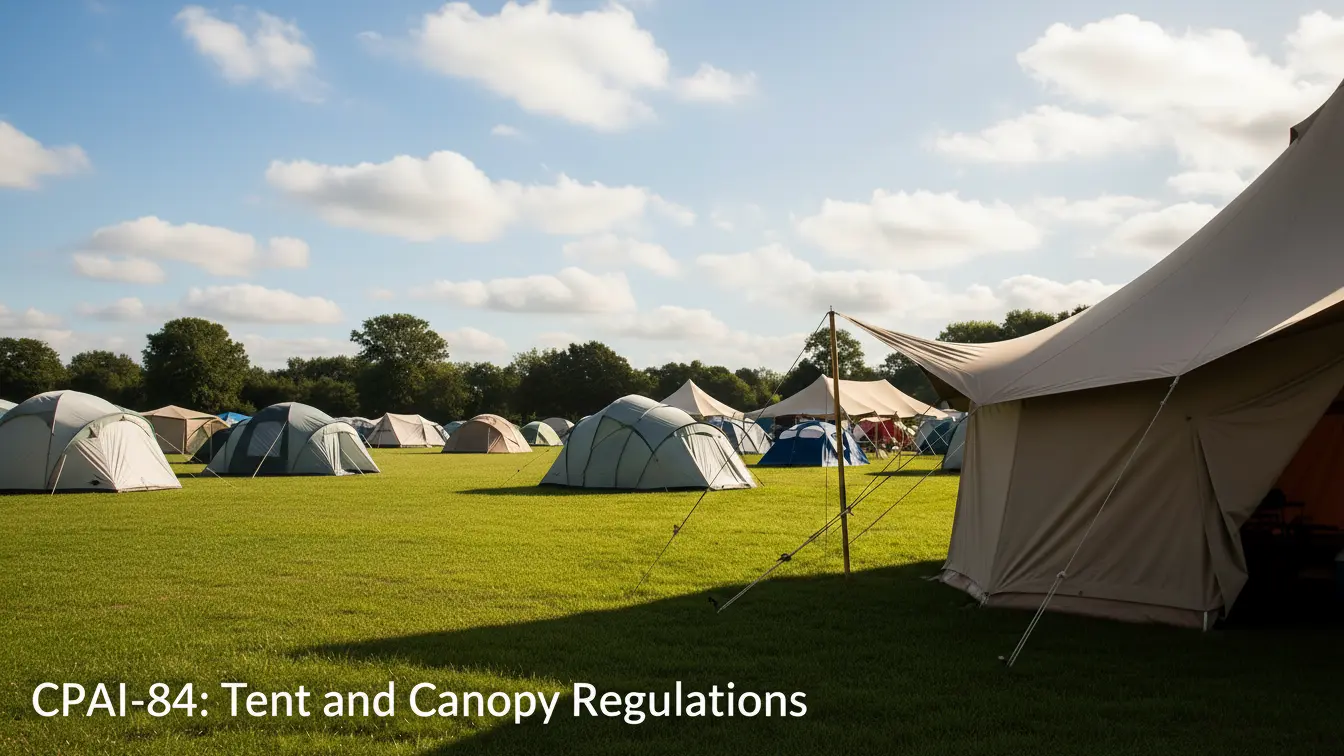
CPAI-84 is a performance standard established by the Industrial Fabrics Association International (IFAI) for flame-resistant materials used in tents and canopies. It mandates self-extinguishing properties, requiring an after-flame of ≤2 seconds and char lengths under 6.5 inches to ensure safety in recreational, commercial, and temporary event structures.
Understanding the CPAI-84 Flammability Standard
Established in 1976 by the Industrial Fabrics Association International (IFAI), the CPAI-84 standard serves as a voluntary yet widely adopted safety benchmark for the textile industry. Unlike materials classified as fireproof, CPAI-84 focuses on “flame-resistant” properties. This distinction is critical in engineering; the goal is to ensure that fabric self-extinguishes once the ignition source is removed, thereby preventing rapid fire spread and allowing occupants a sufficient time window for safe evacuation.
The scope of the regulation encompasses a wide range of temporary membrane structures, including recreational camping tents, large-scale event canopies, awnings, and screen houses. In many regulatory environments, such as those governed by the California Code of Regulations Title 19, CPAI-84 compliance becomes a mandatory requirement for any assembly intended to accommodate 10 or more persons. This ensures that public gatherings in temporary structures meet a baseline level of life safety protection.
Technical Metrics and Compliance Requirements
To achieve certification, materials must undergo rigorous testing to verify specific flame propagation criteria. The technical threshold mandates a maximum after-flame time of 2 seconds and a char length of less than 6.5 inches. Furthermore, the material must cease burning entirely upon reaching the floor level. For field verification by fire marshals and safety inspectors, the standard requires permanent labeling, stenciling, or stamping on every section of the tent top and sidewalls to confirm compliance before permits are issued.
The standard accounts for material density through specific exemptions and modified protocols. For instance, lightweight “no-see-um” mesh or netting weighing 50 g/m² or less is typically exempted from flammability testing because it does not appreciably increase fire risk. Additionally, outdoor fabrics weighing under 100 g/m², common in camping equipment, are subject to modified testing protocols to ensure the metrics remain relevant to the material’s structural integrity.
Beyond material properties, CPAI-84 is often integrated with broader structural fire safety rules. For example, aggregate tent areas are generally limited to 700 square feet (65 m²) unless a 12-foot fire break is provided. While CPAI-84 is a foundational standard for the tent industry, it is frequently paired with NFPA 701 Test Method 2 for larger event applications, as CPAI-84 alone may not satisfy all requirements for high-occupancy membrane structures.
How FR Treatment Works: Coating vs. Inherent
Inherent FR fabrics integrate flame resistance into the fiber’s chemical structure, offering permanent, non-washable protection and superior Thermal Protective Performance (TPP). Treated FR fabrics apply chemical coatings to flammable bases like cotton; while more affordable and improved since 1987, they risk performance degradation over time if not properly maintained.
Inherent FR: Permanent Flame Resistance at the Molecular Level
Inherent fabrics utilize oxidized fibers or modified petrochemical polymers where the fire retardancy is built directly into the molecular structure. Because the flame resistance is a foundational property of the fiber itself rather than an additive, the protection is permanent and entirely independent of wear, mechanical damage, or laundering. This ensures the safety characteristics never wash out or diminish over the entire service life of the garment, providing a reliable safety margin in long-term industrial applications.
The thermal behavior of inherent fibers provides a distinct advantage in extreme conditions. When exposed to high heat or open flame, these fibers are engineered to char and expand rather than melting or dripping, which creates a stable thermal barrier that protects the wearer’s skin. This behavior makes inherent materials the preferred choice for high-hazard environments where visual inspections alone cannot guarantee the presence or efficacy of topical chemical treatments.
Treated FR and TPP Metrics: Performance via Chemical Application
Treated FR fabrics are created by applying a chemical finish to inherently flammable fibers, most commonly cotton or cotton-poly blends. While textile technology has advanced significantly since the first treated FR fabrics were introduced in 1987, the efficacy of these garments can still diminish if strict laundering protocols are not followed. Although modern topical treatments often claim “life-of-garment” protection, they may achieve their safety ratings through added physical mass or chemical additives that can off-gas during thermal events.
A critical metric for evaluating these fabrics is Thermal Protective Performance (TPP). The TPP score is calculated as two times the number of seconds required to reach a second-degree burn when the material is subjected to a 2.0 cal/cm² combination of flame and radiant heat. While treated options typically offer a lower upfront cost and superior softness for daily wear, inherent fabrics generally maintain higher TPP ratings. Choosing between them requires a balance of cost-benefit analysis, comfort requirements, and the specific thermal energy risks present in the work environment.
Impact on Fabric Feel: Stiffness vs. Softness
Historically, FR treatments resulted in stiff, ‘board-like’ fabrics. However, modern inherent FR fibers like Nomex® and engineered blends (FR-polyester/FR-viscose) decouple protection from rigidity. By utilizing low-stiffness fibers and lightweight next-gen constructions, manufacturers now deliver soft, flexible textiles that meet strict NFPA 2112 and EN ISO 11612 safety standards.
The Engineering Trade-off: Fiber Rigidity and Tactile Comfort
Fiber stiffness directly governs the perceived softness of a textile; for instance, 100% carbon or Pyron fibers create the stiffest and bulkiest yarns, leading to increased fabric thickness and a significantly harsher hand. Stiffer fibers tend to trap more air within the yarn structure, which inadvertently increases bulk and degrades the fabric’s ability to drape naturally over furniture frames or guest-facing surfaces.
Technical tactile comfort is now rigorously quantified using precision instruments like the Phabrometer, which measures smoothness, softness, and drape against requisite flammability performance. While legacy FR gear often relied on thick, rigid constructions to provide protection, a “textile-like” hand-feel is now achieved by intentionally selecting fibers with high elongation and low initial stiffness to balance safety with user comfort.

Next-Gen Inherent Blends: Softness Without Sacrificing Compliance
Nomex® meta-aramid fibers are specifically engineered with low stiffness properties to behave like conventional textile fibers, maintaining critical strength at high temperatures without the rigidity associated with traditional aramids. This allows hospitality environments to utilize high-performance safety fabrics that do not compromise the premium tactile experience guests expect.
Blends such as 50/50 FR-polyester and FR-viscose are currently top-ranked for comfort, providing superior moisture management and air permeability while meeting NFPA char length requirements. These modern inherent FR blends—often incorporating modacrylic, aramid, and FR-viscose—are positioned as noticeably softer and more flexible than traditional chemical coatings, optimized for the high-traffic demands of resort and hotel settings.
Furthermore, next-generation FR fabrics are now capable of meeting NFPA 2112 and EN ISO 11612 standards at lower areal densities. This engineering breakthrough allows for lightweight, high-comfort, “long-shift” durability. By reducing fabric weight and optimizing drape, manufacturers can provide standards-compliant fire protection that maintains the soft, flexible hand required for sophisticated interior designs.
Providing Certificates for Local Authorities
Providing certificates for local authorities involves submitting verified proof of fire safety compliance—such as flammability certificates and fire alarm records—to municipal inspectors and fire departments. This process ensures buildings adhere to codes like 527 CMR 1.00, requiring annual renewals by November 30 to maintain operational licenses and public safety standards.
| Document / Requirement | Regulatory Standard | Timeline / Validity |
|---|---|---|
| Flammability Certificates | 527 CMR 1.00 | Mandatory for interior finishes |
| Smoke & CO Certification | M.G.L. Chapter 148 | Valid for 2 months |
| PE Technical Affidavit | 780 CMR 903.1 | Required for system sign-off |
| Annual Renewal Form | LLA Compliance | Due Nov 30; Expires Dec 31 |
The Inspection and Certification Process
The administrative framework for fire safety certification requires a dual-track verification system to ensure public safety. All compliance certificates must be officially signed by both the local building inspector and the head of the fire department for the specific city, town, or district. This process is governed by stringent state fire codes, including 527 CMR 1.00 and M.G.L. Chapter 148, which mandate detailed inspections of sprinkler systems, emergency power, and smoke control mechanisms prior to the issuance of occupancy permits.
For technical systems, verification often requires a Registered Professional Engineer’s Affidavit as per 780 CMR 903.1 standards. These inspections cover high-stakes infrastructure such as fire pump acceptance tests and smoke-control testing. It is important to note that specific certifications, such as those for residential smoke and carbon monoxide detectors, are typically valid only for a two-month window, necessitating precise timing between inspection and the final closing or occupancy of a property.
Mandatory Documentation and Renewal Deadlines
Maintaining valid operational licenses requires the submission of specialized documentation to local authorities. Flammability Certificates are mandatory for all interior finishes, including carpets, upholstery, and draperies; these must often be submitted to specialized municipal offices, such as the BFD Chemist, for physics-based verification of fire resistance. Additionally, facilities must maintain a Contractor’s Material and Test Certificate for piping and a Fire Alarm Record of Completion to prove that life-safety systems were installed and tested according to code.
Local Licensing Authorities (LLAs) enforce strict annual renewal cycles to maintain alcoholic beverage and occupancy licenses. Compliance forms are strictly due by November 30 each year. Failure to submit the required fire safety documentation by this deadline results in the automatic expiration of the license on December 31. This rigid timeline ensures that all public-facing establishments undergo regular system reviews, including generator acceptance tests and fire alarm inspections, to mitigate risk before the start of each new calendar year.
Smoking Areas and Heater Proximity Risks
Fire safety protocols for outdoor hospitality areas require a minimum 3-foot clearance for portable heaters from combustible materials and a strict 50-foot prohibition zone for smoking or open flames near high-hazard operations. These distances, supported by standards like USACE EM 385-1-1, mitigate risks associated with radiant heat, vapor ignition, and spark propagation.
Radiant Heat Dynamics and Basic Heater Clearance Protocols
A 3-foot (1-meter) minimum clearance is mandatory for portable space heaters from all walls, outdoor furniture, and combustible fabrics to mitigate radiant heat risks. Engineering standards emphasize that clearances must account for both steady-state heat and potential tipping hazards in high-traffic hotel environments.
Maintaining a 10-foot clearance around woodpiles or LPG tanks is required to prevent heat-soaking of fuel sources near active heating units. For larger storage setups, a 30-foot minimum distance must be maintained between woodpiles or LPG tanks and the primary structure to ensure localized ignition does not escalate into structural failure.
Technical Separation Distances for Smoking and Flammable Hazards
A 50-foot (15.2 m) prohibition zone is required for all ignition sources, including smoking and matches, near operations with potential fire hazards, supported by “NO SMOKING” signage. This stringent buffer is designed to address the risks of spark propagation and the presence of explosive atmospheres in industrial or hospitality service zones.
Flammable liquid dispensing devices must maintain a 20-foot (6 m) minimum distance from any fixed ignition source to prevent vapor-cloud ignition. Furthermore, fuel container filling operations require a tiered buffer of 10 feet from masonry buildings and 25 feet from all other building types to ensure structural safety during refueling processes.
Compliance with NFPA 51B is necessary for areas involving hot work, requiring specific fire watches and 10-lb minimum fire extinguishers within the immediate vicinity. Additionally, safety relief vents for fuel containers must maintain a 5-foot horizontal distance from building openings or air intakes to prevent flammable vapor ingress.
Final Thoughts
Fire safety in hospitality and commercial sectors is far more than a regulatory hurdle; it is a foundational pillar of guest protection and liability defense. Whether navigating the vertical burn requirements of NFPA 701, the stringent operational mandates of California Title 19, or the specific canopy standards of CPAI-84, project specifiers must prioritize certified materials. Investing in the correct flammability ratings ensures that interior finishes and outdoor structures act as barriers to fire propagation rather than fuel, protecting both lives and property while securing the legal standing required for continuous operation.
As textile engineering evolves, the historical trade-off between rigid fire-retardant coatings and tactile comfort has largely vanished. The shift toward inherently fire-retardant (IFR) fibers like Trevira CS or specialized Sunbrella lines allows hotels and resorts to meet rigorous safety codes without sacrificing the soft, luxurious hand-feel that defines a premium brand experience. By integrating these advanced materials and maintaining meticulous compliance documentation for local fire marshals, property owners can cultivate an environment that is as safe as it is sophisticated, ensuring long-term durability and peace of mind.
Frequently Asked Questions
Do patio umbrellas need to be fire retardant?
While there is no federal code for residential use, commercial umbrellas in public occupancies like hotels and restaurants must often be certified to NFPA 701. In states like California, New York, and Massachusetts, compliance with NFPA 701 and/or California Title 19 is mandatory for permitted use in public spaces.
What is NFPA 701 certification?
NFPA 701 is a laboratory test standard for flame propagation in textiles. To pass, a material must demonstrate an after-flame of less than 2.0 seconds and a maximum char length of 6.5 inches (165 mm). This certification is required for vertical hanging textiles, including commercial shade canopies and draperies.
Are Sunbrella fabrics fire resistant?
Standard Sunbrella shade and upholstery fabrics are not fireproof and do not pass NFPA 701. However, Sunbrella Exceed® FR and Firesist® are specifically engineered as inherently fire-retardant, self-extinguishing materials that meet major codes including NFPA 701, California Title 19, and ASTM E84 Class 1.
What fire code applies to outdoor furniture?
The primary codes are NFPA 701 (flame retardancy for textiles and tarps), CPAI-84 (standards for tents and canopy structures), and California Title 19. For upholstered elements, NFPA 260 and UFAC Class 1 are often cited for cigarette ignition resistance.




 English
  Spanish
  French
  German
  Portuguese