

Focusing on the factory price is a critical error in logistics strategy. The total landed cost—including freight, customs, and fees—can inflate per-unit expenses by over 40.5%, erasing profit margins before a single item is sold. This financial penalty is most severe when sourcing low-value, high-weight components like concrete or stone bases from overseas, a practice that turns perceived savings into a significant liability.
This analysis provides a quantitative framework for a more profitable sourcing model. We break down the non-negotiable physical limits of freight, referencing strict operator rules from entities like GE Power Conversion and mandatory industrial standards such as ASTM D3951. You will learn how to calculate true landed cost, assess a component’s value-to-weight ratio, and determine when to source heavy materials locally to protect your bottom line.
The Allure of the “All-in-One” Package
The “all-in-one” package seems simple but fails reality. Global freight demands modular units with strict weight and size limits to prevent damage and control costs.
The Novice Appeal of Simplified Sourcing
Buyers new to sourcing love the idea of an “all-in-one” package. It feels clean: one transaction for a complete project, one invoice to process, one shipment to track. They assume a single large bundle is more cost-effective than shipping multiple standardized units, but this thinking completely ignores the physical and financial realities of how freight actually works.

The Practical Limits of Palletized Freight
International freight doesn’t care about simple invoices; it cares about physics and standardization. Pallets are the universal unit of measure, and they operate under strict, non-negotiable rules based on weight, dimensions, and stability. Breaking these rules is expensive and risky.
- Weight Limits: Pallets have hard caps. The common ANSI/MHIA-MH1 standard, for example, sets a maximum load of 3000 lbs to prevent the pallet from collapsing during transit.
- Dimensional Constraints: Major operators enforce size rules. GE Power Conversion, for instance, won’t accept single units over 1000 kg (2204 lbs) or taller than 1500 mm (59 in).
- Stackability: Cargo must be stable, stackable, and forklift-ready. This is why you see modular systems like IBM’s server pods, which are designed to be stacked three-high within a single wooden crate.
- Governing Standards: This isn’t optional. Military and industrial specifications like ASTM D3951 and MIL-STD-2073-1 legally mandate specific palletizing practices to ensure cargo stability.
Trying to ship an oversized, non-stackable bundle violates these rules. It results in massive freight surcharges, handling risks, and potential damage, wiping out any perceived savings from the “simple” package.

Understanding Landed Cost: More Than Just the Price Tag
Landed cost is the true per-unit expense after adding shipping, customs, and insurance to the product price. Ignoring it is the fastest way to destroy margins.
Your factory price is dangerously incomplete. To price your products correctly and protect your profitability, you have to calculate the total landed cost—the real cost to get an item from the factory floor into your warehouse.
The Core Components of the Landed Cost Formula
The formula isn’t complex, but you have to be disciplined about tracking every piece. The total cost breaks down into five key parts.
- Product Cost: The initial price on the factory invoice for your furniture.
- Shipping & Freight: Charges for transporting goods via sea, air, or land to your destination.
- Customs, Duties & Taxes: Government-levied import fees, often calculated as a percentage of the product’s value (e.g., 2-5%).
- Insurance: Covers potential damage or loss during transit, protecting your investment.
- Overhead & Handling: All the “other” costs like local port fees, customs brokerage, and potential penalties for delays (demurrage).
Landed Cost in Action: A Sample Calculation
Theory is one thing, but the numbers show exactly why this matters. Let’s run a typical calculation for a shipment of 1,000 units from China to the US.
- Product Cost: 1,000 units @ $10/unit = $10,000
- Freight Costs: +$3,300
- Customs Duties (at 5%): +$500
- Insurance: +$250
- Total Landed Cost: $14,050
Your real cost per unit isn’t $10.00; it’s $14.05. That’s a 40.5% increase over the factory price. If you based your retail pricing on the $10 figure, you’d be losing money before you even sold a single item.
The Weight vs. Value Calculation: Why Shipping Concrete Kills Your Margin
Freight costs, based on weight, can easily exceed the commodity value of concrete. This low value-to-weight ratio makes long-distance shipping unprofitable and local production essential.
The Core Problem: Concrete’s Low Value-to-Weight Ratio
Unlike electronics or machinery, concrete is a bulk commodity. Its value is low, but its weight is high. This gives it one of the worst value-to-weight ratios in the construction industry. The entire economic model hinges on logistics, not the material itself. As soon as you put it on a truck, freight costs per ton start eating away at your margin, quickly surpassing the actual value of the concrete being hauled.

Quantifying the Load: Key Density and Shipping Metrics
The math is simple and brutal. Even a small order of concrete represents a massive tonnage, which is the basis for freight charges. These are the standard industry figures that dictate shipping viability.
| Concrete Type / Unit | Weight / Density |
|---|---|
| Standard (per cubic yard) | ~4,050 lbs (2.025 US tons) |
| Standard (per cubic foot) | 150 lbs/ft³ |
| Reinforced (per cubic foot) | 156.07 lbs/ft³ |
| Portland (per cubic foot) | 143.58 lbs/ft³ |
Your Partner for Custom, Commercial-Grade Umbrellas

The Smarter Alternative: Sourcing Heavy Components Locally
Local sourcing for heavy components cuts international shipping costs and delays, shortens lead times, and boosts supply chain resilience. It’s a strategic alternative to overseas manufacturing.
| Strategic Benefits | Key Evaluation Criteria |
|---|---|
| Cost reduction & shorter lead times | Verification of material datasheets (e.g., T6 aluminum) |
| Improved supply chain resilience | Adherence to engineering standards (EN581, AFRDI) |
| Enhanced quality control & direct relationships | Quantified performance history with hard data |
| Faster product development & launches | Production capacity, flexibility, and scalable MOQs |
Strategic Benefits of a Localized Supply Chain
Shifting component sourcing closer to home isn’t just about patriotism; it’s a cold, hard business calculation. The primary gains come from cost, speed, and de-risking your operation. When you stop putting heavy steel or aluminum parts on a boat for six weeks, you immediately see the benefits.
- Cost Reduction: You eliminate international customs clearance, port fees, and unpredictable ocean freight surcharges.
- Supply Chain Resilience: Your operations are insulated from global port strikes, canal blockages, and geopolitical trade disputes.
- Lead Time Reduction: Transportation shrinks from months to days, allowing for leaner inventory and faster response to market demand.
- Enhanced Quality Control: You can drive to a supplier’s factory for a site inspection instead of relying on third-party reports from 5,000 miles away.
- Faster Development: Same-timezone communication means engineering changes and approvals happen in hours, not days.
Key Evaluation Criteria for Local Component Suppliers
Once you decide to source locally, the vetting process needs to be rigorous. A local supplier who can’t meet spec is just as useless as a distant one. Focus on hard data and verifiable capabilities, not just proximity.
- Material Datasheets: Don’t take their word for it. Demand documentation confirming mechanical properties and material grades, like T6 aluminum or certified hardwoods.
- Engineering Standards: Verify their compliance with relevant commercial codes for your market, such as EN581 for outdoor furniture or AFRDI for commercial seating.
- Quantified Performance History: Ask for case studies with real numbers. Vague promises are a red flag; data on specific lead time reductions or quality benchmarks is a green one.
- Production Capacity and Flexibility: Assess their ability to handle both flexible MOQs for initial runs and the scalable capacity needed for large-scale programs down the road.
A Real-World Example: The Granite Base Case Study
Sourcing a precision granite base often stalls due to missing data: mechanical properties, ASTM standards, dimensions, and pricing. These gaps make any real evaluation impossible.
Trying to source a specialized component like a precision granite base is a textbook example of how quickly a project can get stuck. Without a complete data sheet, engineers and procurement teams can’t make a decision. This case study breaks down what happens when supplier data is incomplete.
Initial Project Requirements and Objectives
The goal was straightforward: find and vet a supplier for a granite base used in industrial machinery. The team created a simple checklist of non-negotiable requirements to qualify any potential partner.
- Supplier Identification: Find a manufacturer of precision granite bases.
- Technical Documentation: Get data sheets detailing key mechanical properties like compressive and flexural strength.
- Standards Compliance: Verify the material meets relevant engineering standards, specifically ASTM C615 for natural stone.
Critical Data Gaps and Sourcing Blockers
The search immediately hit a wall. While several potential suppliers were found, their publicly available information was missing the exact data needed for an engineering review or a cost analysis. This effectively blocked the project from moving forward.
The specific missing information included:
- Mechanical Properties: No hard numbers for tensile or compressive strength in PSI or MPa.
- Dimensions & Schematics: No product drawings or specific size options to evaluate fit.
- Material Standards: No mention of compliance with ASTM or ISO standards for validation.
- Pricing: No commercial data (e.g., ex-works, per unit, or per square foot) was provided to even begin a budget assessment.
How to Talk to Your Supplier: Asking for “Ex-Works”
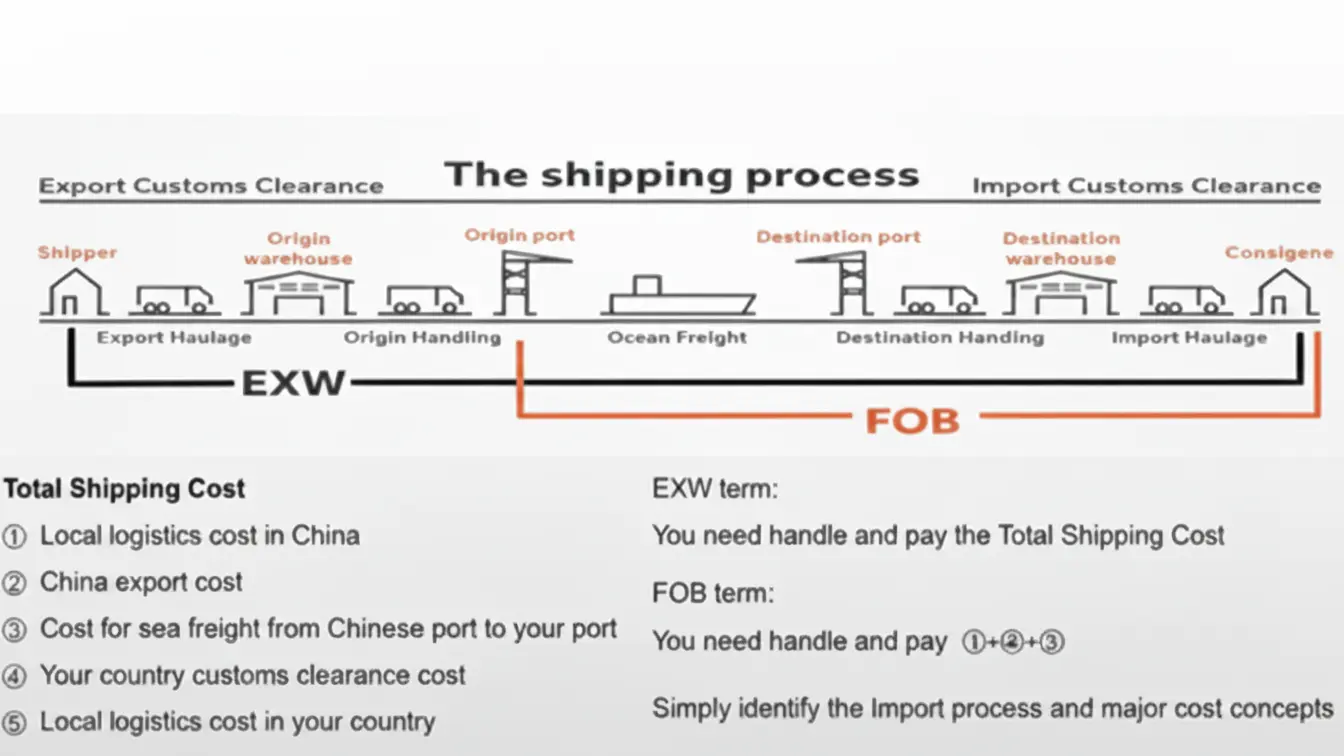
Requesting ‘Ex-Works’ (EXW) means the supplier only makes goods available at their factory. You, the buyer, handle all transport, customs, and risk from that point.
Defining the Request: What ‘Ex-Works’ Means for the Supplier
When you ask for Ex-Works (EXW), you’re telling the supplier their only job is to get the goods packaged, labeled, and ready for pickup at their premises, like a factory in Taizhou. Their responsibility ends the moment the goods are available for collection. The supplier is not required to load the product onto your truck or handle any export customs paperwork.
Your Responsibilities: What You Must Manage as the Buyer
Opting for EXW shifts the entire logistics burden to you. This is a high-control, high-responsibility arrangement. You must manage:
- Total Logistics: You arrange and pay for everything. This includes loading the goods at the factory, trucking to the port, the main international freight, and final delivery.
- Customs Clearance: You handle all paperwork for both export and import. This includes all duties, taxes, and licenses required to get the goods out of the origin country and into yours.
- Risk and Insurance: All risk transfers to you as soon as the goods are available for pickup. You are liable for any loss or damage from that point forward and must secure your own freight insurance.
Your Logistics Strategy: A Competitive Advantage
A smart logistics strategy turns operations into a competitive weapon, boosting margins and creating a market advantage that competitors can’t easily replicate.
The Framework for a Logistics-Driven Advantage
A true logistics advantage isn’t just about efficiency; it’s about achieving sustained, above-average profits. Case studies show this translates to a 12.7% operating margin and 15% profit growth, turning basic warehouse processes into a core strength.
The Resource-Based View (RBV) framework dictates that for a capability to be a real advantage, it must meet four criteria:
- Valuable: It exploits opportunities or neutralizes threats.
- Rare: Few competitors possess it.
- Inimitable: It’s difficult and costly for others to copy.
- Non-substitutable: No strategic equivalent exists.
This edge is maintained through dynamic capabilities. Things like deep managerial knowledge, strong cross-functional teamwork, and a continuous learning process are what keep the operation ahead of the market.
Key Enablers: Technology and Infrastructure Investment
Building this kind of advantage requires serious capital. We’re not talking about small software subscriptions, but major infrastructure projects, like the EURO 110 million warehouse expansions seen in leading firms.
This physical infrastructure is powered by in-house IT systems and Supply Chain 4.0 technologies. The key tools include:
- The Internet of Things (IoT) for real-time asset visibility.
- Advanced analytics and big data for accurate demand forecasting.
- Cloud platforms for optimized warehouse management.
These investments deliver measurable performance gains. Companies see direct improvements in Overall Equipment Effectiveness (OEE), higher throughput in their facilities, and more precise inventory control.
Final Thoughts
Shipping heavy, low-value components overseas is a margin killer. The factory price is a distraction; your profit is won or lost based on the final landed cost, not the supplier’s invoice.
Adopt a hybrid sourcing model now. Buy heavy bases locally and import only the high-value frames and canopies to slash freight costs and protect your bottom line.
Frequently Asked Questions
Is it worth importing umbrella bases from China?
No, importing umbrella bases from China is generally not worth it due to highly variable quality. While premium Tier 1 suppliers can meet standards like EN581, lower-tier factories often lack verification, leading to product failures in UV stability, hardware durability, and wind load resistance.
How much does it cost to ship heavy umbrella bases?
Specific shipping cost data isn’t publicly available because it varies significantly by weight, dimensions, and destination. But shipping is a primary cost driver for heavy, pre-filled bases, often making locally-sourced bases a more predictable and cost-effective option.
What is the cheapest umbrella base to import?
The cheapest umbrella base to import is a standard 50 lb steel base from suppliers in Zhejiang province, China. FOB prices can range from $8.50 to $14.00 per unit, with some manufacturers offering prices as low as $8.75 per unit for a Minimum Order Quantity (MOQ) of 200 pieces.
Can I buy umbrella bases locally and frames from China?
Yes, this is a common and effective strategy. You can buy heavy umbrella bases from local retailers to save on significant shipping costs, as they are widely available with standard pole compatibility (1.5-2.5 inches). The umbrella frames and canopies can then be sourced cost-effectively from China, ensuring the pole diameters match the base’s tube for a secure fit.




 English
  Spanish
  French
  German
  Portuguese