


Choosing the correct Standard Sizes is less about customer preference and more about freight efficiency. Sourcing a non-optimized size directly inflates your per-unit shipping cost, eroding margins on high-volume container orders intended for promotional retail.
This analysis explains how specific models like our PTMU-010 are engineered for high-density container loading, fitting over 2,700 units per 40HQ. We examine the cost trade-offs between 6-rib and 8-rib frames to define the most profitable specification for your market.
What Are the “Big Three” Standard Umbrella Sizes? (7.5ft, 9ft, and 11ft)
The three standard sizes are 7.5ft, 9ft, and 11ft. 7.5ft is for small bistro sets, 9ft is the versatile standard for 4-6 person tables, and 11ft covers large 8+ person areas.
The 7.5-Foot Umbrella: Coverage for Compact Spaces
This size is designed for small patio tables up to 48 inches in diameter. It’s the go-to choice for shading 2-4 person bistro sets. Think apartment balconies or tight cafe patios where space is a premium. For safe free-standing use, a 7.5-foot umbrella needs a base weighing around 40 to 60 lbs.
The 9-Foot Umbrella: The Versatile Industry Standard
The 9-foot (2.7m) model is the most popular size by a wide margin. It hits the sweet spot for standard 4-6 person dining tables, typically those between 48 and 54 inches. This is the core of our high-volume business, especially our 2.7m “Volume King” models. We optimize these for maximum container loading, making them ideal for supermarket chains and promotional buyers. It provides plenty of shade for most homes without overwhelming the patio.
The 11-Foot Umbrella: Shade for Large Seating Areas
When you need to cover an oversized dining table (up to 84 inches) for 8 or more guests, the 11-foot umbrella is the right tool. It delivers about 95 square feet of shade, making it a solid option for large residential patios or commercial lounge areas. An umbrella this large creates significant leverage, so it demands a heavy-duty base of at least 75 lbs to keep it stable and safe.
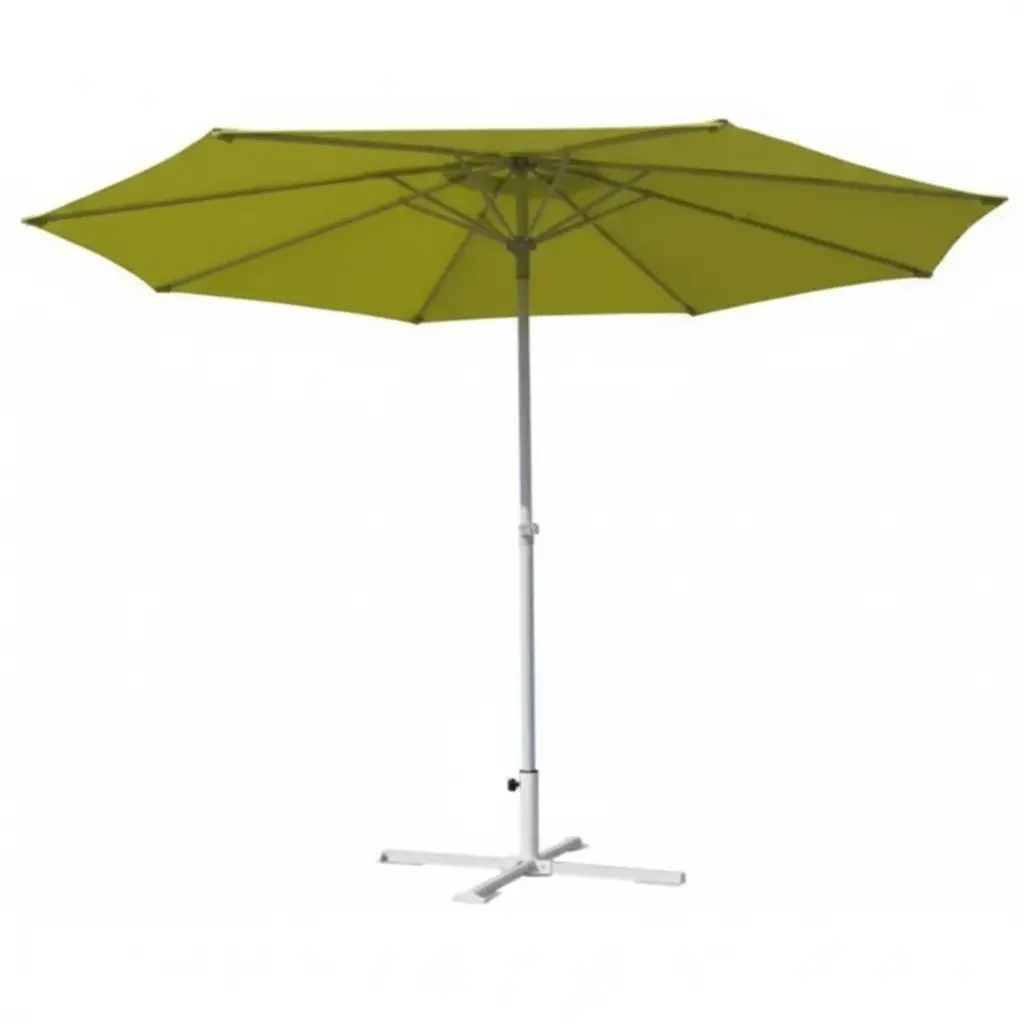
Why Is the 9ft Umbrella Considered the Global Industry Standard?
The 9ft umbrella is the residential standard because it perfectly shades the most common 4-6 person patio tables. This predictable consumer demand makes it the default choice for high-volume container orders.
Optimal Coverage for Standard Dining Tables
The 9-foot umbrella isn’t a standard because of some committee decision. It’s the standard because it solves the most common problem for the largest part of the residential market. Most households have a 4- to 6-person dining table, which usually measures between 36 and 48 inches wide. A 9-foot canopy is the perfect size for these setups.
There’s a practical “2-foot rule” in the industry: the canopy should extend at least two feet beyond the edge of the table. This ensures people are actually sitting in the shade, not just the table itself. A 9-foot umbrella delivers about 65 square feet of coverage, hitting the sweet spot between providing useful shade and not overpowering a typical backyard patio.
The 9ft (2.7m) Model: Optimized for High-Volume Logistics
From a B2B perspective, the popularity of the 9-foot umbrella translates directly to logistical efficiency. Our PTMU-001 model comes in a 2.7m size—the metric equivalent of 9 feet—making it a true “Volume King” for mass-market retailers. The dimensions are engineered to maximize freight space.
We can fit approximately 2260 units of the PTMU-001 into a single 40HQ container. This high loading quantity lowers the per-unit shipping cost, which is a critical factor for buyers in the promotional and discount retail space. Because demand for this size is constant and predictable, it’s a reliable product for supermarket promotions and seasonal “Special Buys” that need to move in high volume.
Boost Your Margins with Factory-Direct Umbrellas

6-Rib vs. 8-Rib: Which Configuration Offers Better Value and Stability?
An 8-rib design offers greater canopy stability for demanding environments. But the 6-rib configuration provides superior value for budget-focused, high-volume promotional markets.
The Core Difference: Canopy Support vs. Material Cost
The choice between 6 and 8 ribs is a straightforward engineering trade-off. An 8-rib frame provides more contact points with the fabric. This creates a tighter, more uniform canopy that holds its shape better in light breezes and looks more premium. A 6-rib frame simply uses less steel or aluminum, which directly reduces raw material costs and the final unit price. This makes it the most economical choice for mass production.
Why 6 Ribs Dominate the Promotional Market
The 6-rib configuration is the default for what we call ‘Promotional Grade’ umbrellas. For clients in high-volume retail or promotional goods, achieving the lowest possible price for mass distribution is the primary goal. The 6-rib design delivers on that. It perfectly aligns with our ‘Seasonal Value’ proposition, offering adequate performance for short-term use in environments with wind speeds at or below Grade 3. For any application where budget is the main driver, the 6-rib model is the standard.
How Do Fabric Width Constraints (60″ Rolls) Affect Seams and Sizing?
Standard 60-inch fabric rolls create large canopy panels with fewer seams. This streamlines manufacturing, avoids pattern disruption, and keeps costs down for high-volume promotional umbrellas.
Why Wider Fabric Means Fewer Seams
Using a standard 60-inch fabric roll allows us to cut large, continuous panels for an umbrella canopy. This simple manufacturing advantage directly reduces the number of stitched seams required to construct the surface.
Fewer seams result in a cleaner, more professional appearance. This is critical for promotional umbrellas featuring large custom logos or solid colors, where multiple seams would interrupt the design and cheapen the look.

Application for 160g/180g Polyester Canopies
Our umbrellas use standard 160g/m² or 180g/m² polyester fabric, which is sourced in wide rolls specifically to optimize for efficient, high-volume production. The whole process is built for speed and consistency, not bespoke projects.
This approach is what allows us to produce promotional-grade umbrellas with a uniform appearance across large orders. It’s particularly effective for our recommended stable colors like Beige and Sky Blue, ensuring a consistent finish from the first unit to the last.
Container Loading: How Does Umbrella Size Impact Your Freight Costs?
An umbrella’s collapsed size directly determines units per container, setting your per-unit freight cost. Efficiently packed models like the PTMU-010 allow over 2,700 units, significantly cutting shipping expenses.
Calculating Freight Costs by Cubic Meter (CBM)
For most umbrella orders, freight isn’t about weight; it’s about volume. Shipments are typically calculated using Less-than-Container Load (LCL) rates, where space is the commodity you’re buying. The critical metric is the Cubic Meter (CBM). The less CBM your shipment occupies, the lower your total bill.
An umbrella engineered with minimal collapsed dimensions takes up less space in a container. This directly translates to a lower CBM measurement for the total shipment and a reduced freight cost for each individual unit.
The PTMU-010: Engineered for High-Density Loading
We designed our PTMU-010 model specifically to maximize container space. It’s a 2.5m steel pole umbrella, but its key feature is its logistics efficiency. The design allows us to load approximately 2,750 units into a single 40HQ container.
Achieving such a high loading quantity isn’t an accident. It’s a core strategy for serving volume retailers and promotional clients. For businesses where every cent on the landed cost matters, packing more units per container is the most effective way to lower the price of getting product from our factory to your warehouse.
How Do You Correctly Match Umbrella Sizes to Base Weights?
A standard 9-foot umbrella needs a 50-75 lb freestanding base. Cantilever (offset) models have different physics and require much heavier bases, often 200+ lbs, to stay upright.
| Umbrella Type | Canopy Size | Recommended Base Weight |
|---|---|---|
| Standard (Freestanding) | 9–11 ft | 50–75 lbs |
| Standard (Through a Table) | 9–11 ft | 40–60 lbs |
| Cantilever (Offset) | 9–11 ft | 280+ lbs |
Standard Weight Guidelines by Umbrella Type
The right base weight depends entirely on whether the umbrella is a standard center-pole model or a cantilever (offset) design. The physics are completely different.
- For a freestanding standard market umbrella in the 9 to 11-foot range, a base between 50 and 75 lbs is the industry minimum for stability.
- If that same umbrella is placed through a sturdy outdoor table, the table itself acts as a massive stabilizer. In this case, you can often use a lighter base in the 40 to 60 lb range.
- Cantilever umbrellas are a special case. Because their weight is off-center, they create significant leverage. A 9 to 11-foot cantilever model requires a base of 280 lbs or more to safely counteract this tipping force.

Factoring in Promotional Grade Wind Resistance (≤ Grade 3)
It’s critical to understand that our umbrellas are built for seasonal, promotional-grade use. They are rated for wind resistance up to Grade 3, which is a gentle breeze of about 12-19 km/h. A heavy base provides stability, but it does not reinforce the umbrella’s frame or canopy against wind damage. For this reason, you must close the umbrella when it’s not in use or during any breezy conditions. Relying on a heavy base in strong wind is a common and costly mistake.
When Should You Choose a 7.5ft Umbrella? (Best for Balconies and Bistros)
A 7.5-foot umbrella is the right choice for small, intimate outdoor areas. It provides shade for bistro tables or compact balconies without overwhelming the space.
Ideal Applications for Compact Spaces
The 7.5-foot umbrella is designed for specific, space-constrained environments where larger umbrellas are impractical. It excels in providing targeted shade for small-scale seating arrangements common in both commercial cafes and residential settings.
- Provides sufficient shade for small bistro tables designed to seat two to four people.
- Fits perfectly on residential balconies or small patios where every square foot counts.
- Best suited for shading tables that are approximately 3 to 4 feet in diameter.
Key Considerations for Stability and Use
While its compact size is an advantage, it also dictates its operational limits. Understanding the stability requirements is critical for safe and effective use, especially since these are often used in freestanding applications.
- Base Weight: Requires a base of 50 pounds or more for proper freestanding stability.
- Wind Resistance: Built for seasonal use in gentle breezes, with a maximum wind resistance of Grade 3 (12-19 km/h).
- Usage Protocol: The umbrella must be closed when not in use or in any breezy conditions to prevent damage to the frame.
When Is an 11ft Umbrella Necessary? (Ideal for Large Resort Lounges)
An 11-foot umbrella is for large commercial areas like resort lounges needing 95+ sq ft of coverage. Its size demands robust construction and strict wind limitations for safety.
Defining Large-Scale Coverage: Shading 95+ Square Feet
An 11-foot umbrella is the right choice when you need to cover a large footprint. It provides about 95 square feet of shade, making it a practical solution for expansive outdoor areas. This is ideal for commercial settings like resort lounges or poolside patios, where you need to cover multi-chair arrangements or small group gatherings with a single unit.
Structural Demands: Wind Resistance Ratings for Large Canopies
A large canopy acts like a sail, so managing wind is critical. Our promotional-grade large umbrellas are rated for gentle breezes only, which is a Grade 3 wind or less (approximately 12-19 km/h). For any commercial operator, this is a key operational and safety point. The umbrella must be closed when not in use or during breezy conditions to prevent damage and ensure guest safety. This isn’t a suggestion; it’s a mandatory procedure for this product class.
Frequently Asked Questions
What is the most popular size for a patio umbrella?
The 9-foot umbrella is the most popular and standard size for residential use. It provides around 65 square feet of shade, which is ideal for covering a 4 to 6-person dining set, offering a great balance between functional coverage and manageable size for most patios.
Is an 11ft umbrella too big for a standard deck?
An 11ft umbrella is not too big if your deck can accommodate a 6 to 8-person dining set or a large lounge area. It works best for spaces wider than 84 inches. A key consideration is stability, as it requires a base weighing at least 75 lbs to be secure.
What is the main difference between a 9ft and a 10ft umbrella?
The primary difference is coverage. A 9ft umbrella fits tables up to 54 inches, while a 10ft umbrella covers tables up to 62 inches, providing about 20-25% more shade. The larger 10ft size also requires a heavier base (at least 65-75 lbs) for stability, compared to the 50-65 lb base needed for a 9ft umbrella.
How many ribs does a 9ft umbrella typically have?
A standard 9-foot umbrella almost always has 8 ribs. This configuration creates a stable octagonal canopy and is considered the industry standard for both strength and appearance. While 6-rib versions exist, the 8-rib design offers better support and durability.
Final Thoughts
While rock-bottom pricing is tempting, our Promotional Grade standard—using phosphated steel and documented color fastness—is the minimum safe bet. This protects your brand from the rust and fading claims that sink margins on generic, untested inventory. Sticking to a proven standard ensures predictable performance for high-volume seasonal sales.
The next step is to verify our logistics-optimized models for yourself. Request a sample of our “Volume King” PTMU-010 to confirm the build quality and finish. Our team is ready to provide a full container loading plan and discuss your private label requirements.



 English
  Spanish
  French
  German
  Portuguese