
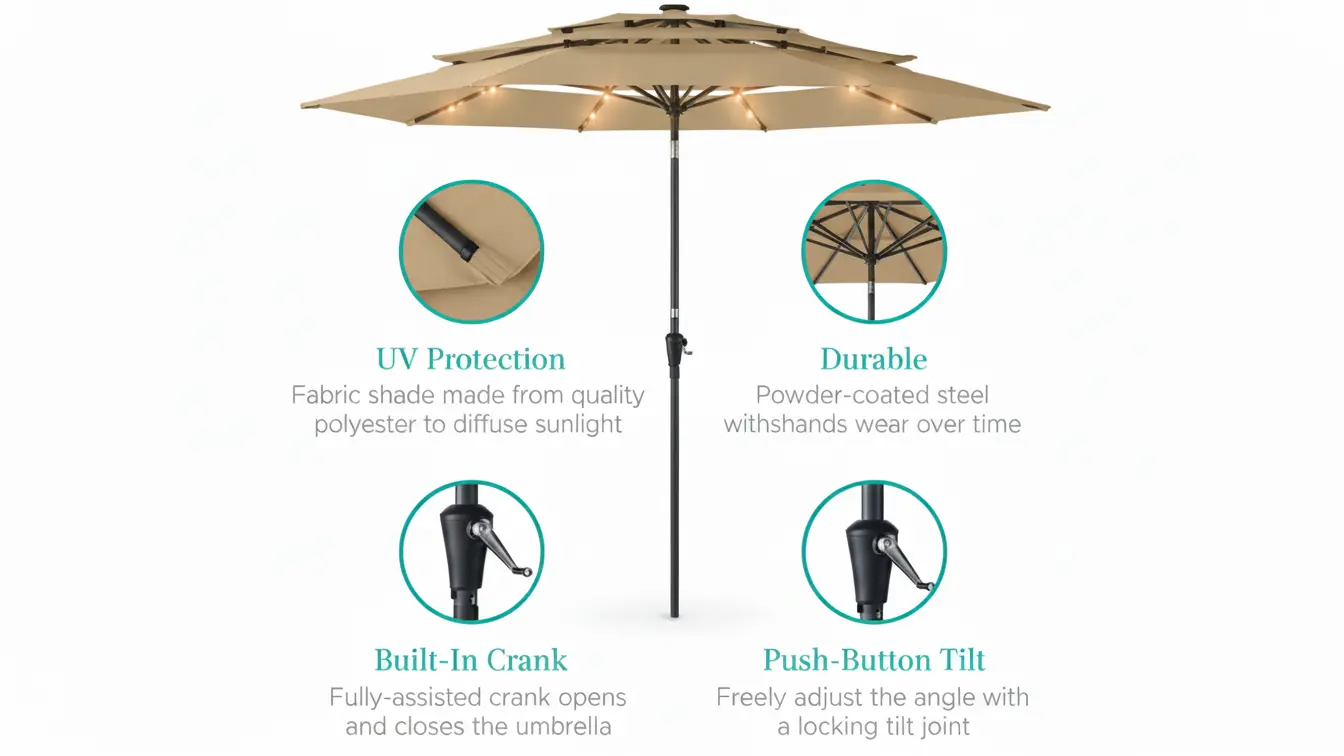
Market umbrellas often fail first at the tilt mechanism, making the choice between crank and push button systems a key decision for buyers. Each design affects durability, convenience, and long-term cost, which can determine how often replacements or maintenance are needed.
This guide explains how each mechanism works, compares their durability and accessibility, and breaks down total cost differences so shoppers can choose the tilt system that lasts longer and fits their usage needs.
How Crank Tilt Mechanisms Work
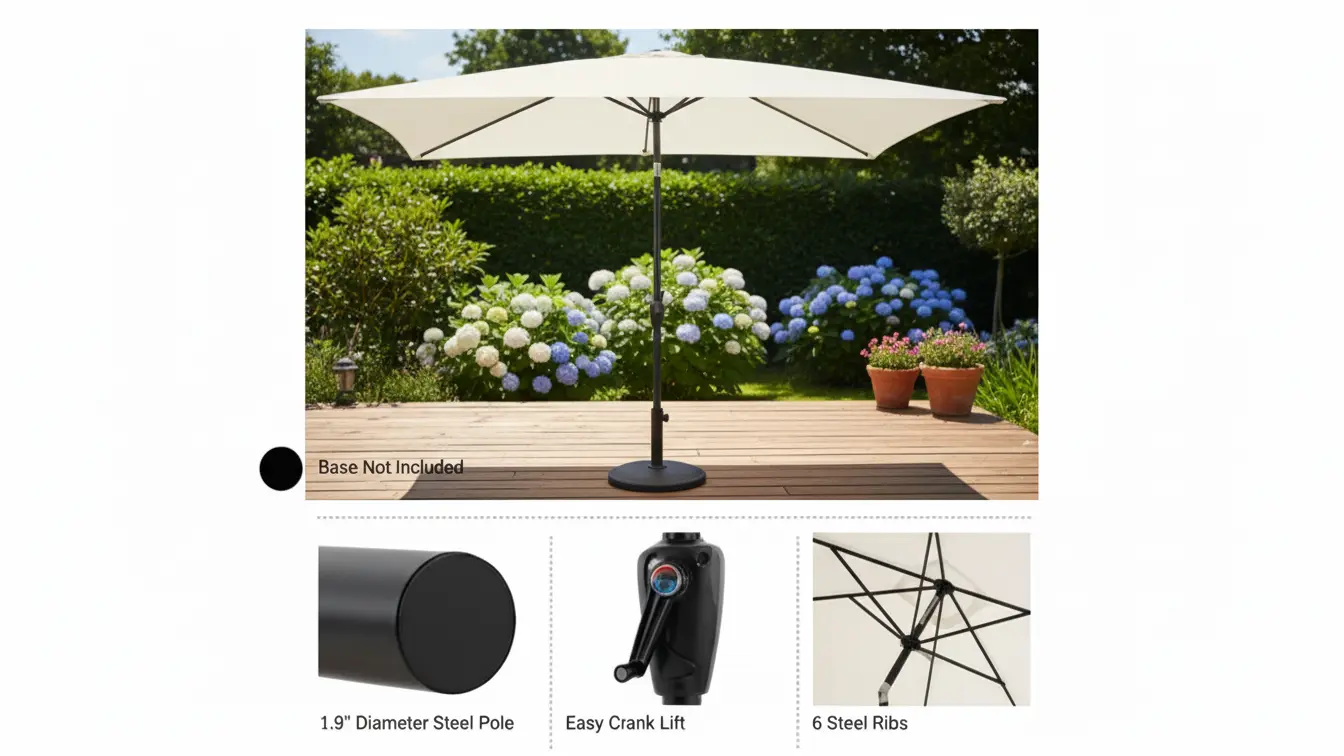
Crank tilt mechanisms convert rotational motion from a hand crank into linear reciprocating motion that adjusts the umbrella angle. A crank arm rotates, moving a connecting rod attached to a slider, which shifts linearly to tilt the canopy precisely.
Crank tilt mechanisms are commonly found in commercial-grade patio umbrellas where precision and durability matter. They transform simple hand rotation into a controlled tilting motion, giving users better angle adjustment than push-button systems. This section explains their mechanics and why they are preferred for high-use hospitality settings.
Mechanical Operation of Crank Tilt Mechanisms
The crank tilt assembly works through a series of interlinked parts that translate rotary motion into a linear path. The essential components include:
- ⚙️ Crank Arm – rotates manually to generate motion.
- 🔩 Connecting Rod – transfers force between crank and slider.
- 🧭 Slider Block – moves linearly along a constrained path to adjust canopy angle.
As the crank arm rotates, it pushes and pulls the connecting rod, which in turn drives the slider forward and backward. This smooth reciprocating motion tilts the umbrella canopy incrementally. Maintaining ideal crank-to-rod ratios and transmission angles prevents binding and ensures consistent movement.
Comparison Between Crank and Push Button Tilt Systems
When comparing push button vs crank tilt systems, key differences appear in operation, precision, and cost. The table below highlights each mechanism’s characteristics.
| Feature | Crank Tilt System ⚙️ | Push Button Tilt System 🔘 |
| Motion Type | Rotational input converted to linear motion ✅ | Pneumatic or spring release ❌ |
| User Effort | Requires continuous hand rotation ⚙️ | Single push activation 🖐️ |
| Precision | Incremental adjustment with high accuracy ✅ | Limited to few fixed angles ⚠️ |
| Mechanical Complexity | More parts (crank, rod, slider) ⚙️ | Simpler internal design 🧩 |
| Durability & Cost | High durability, lower production cost 🚀 | Less durable, higher material cost ⚠️ |
Engineering Considerations and Inertial Dynamics
Engineering a crank tilt mechanism involves balancing smooth operation with long-term reliability. The system’s transmission angle between the connecting rod and slider path should stay within 40°–140° to maintain consistent motion. Likewise, the crank-to-rod length ratio is kept below 1:4 for even force distribution.
- ⚙️ Rotating crank arms produce centrifugal forces that create unbalanced loads on bearings.
- 💡 Counterbalancing masses reduce vibration and mechanical wear.
- ✅ Proper engineering keeps required user torque around 2–5 Nm, comparable to turning a car window handle.
These considerations ensure the mechanism operates smoothly under frequent use without excessive user effort or component stress.
Advantages of Crank Tilt Mechanisms for Commercial Applications
For B2B buyers in hospitality or retail sectors, crank tilt mechanisms offer tangible benefits that align with long-term operational needs. Their design supports intensive daily use and minimal maintenance downtime.
- ✅ High durability with fewer failure-prone elements such as pneumatic seals.
- ✅ Lower production and replacement cost, ideal for bulk procurement.
- ✅ Incremental user control enhances guest comfort and ambience management.
- ✅ Performs reliably across extreme temperatures without material degradation.
- ✅ Widely adopted in hotels, resorts, and outdoor venues needing stable shade solutions.
In our experience at Patiofurnituresco, the crank system remains the most dependable option for contract-grade umbrellas because it balances precision, longevity, and cost efficiency.
Common Misconceptions About Crank Mechanisms
Some users assume crank systems require excessive manual force. Modern designs eliminate this concern through optimized geometry and lightweight internal components. Most mechanisms today operate with only 2–5 Nm of torque.
- 💡 The effort feels similar to rolling down a car window.
- ⚙️ Misconceptions arise mainly from older or low-quality products.
- ✅ Recognizing recent engineering improvements helps buyers make informed decisions about ease of use and comfort.
How Push Button Tilt Mechanisms Work
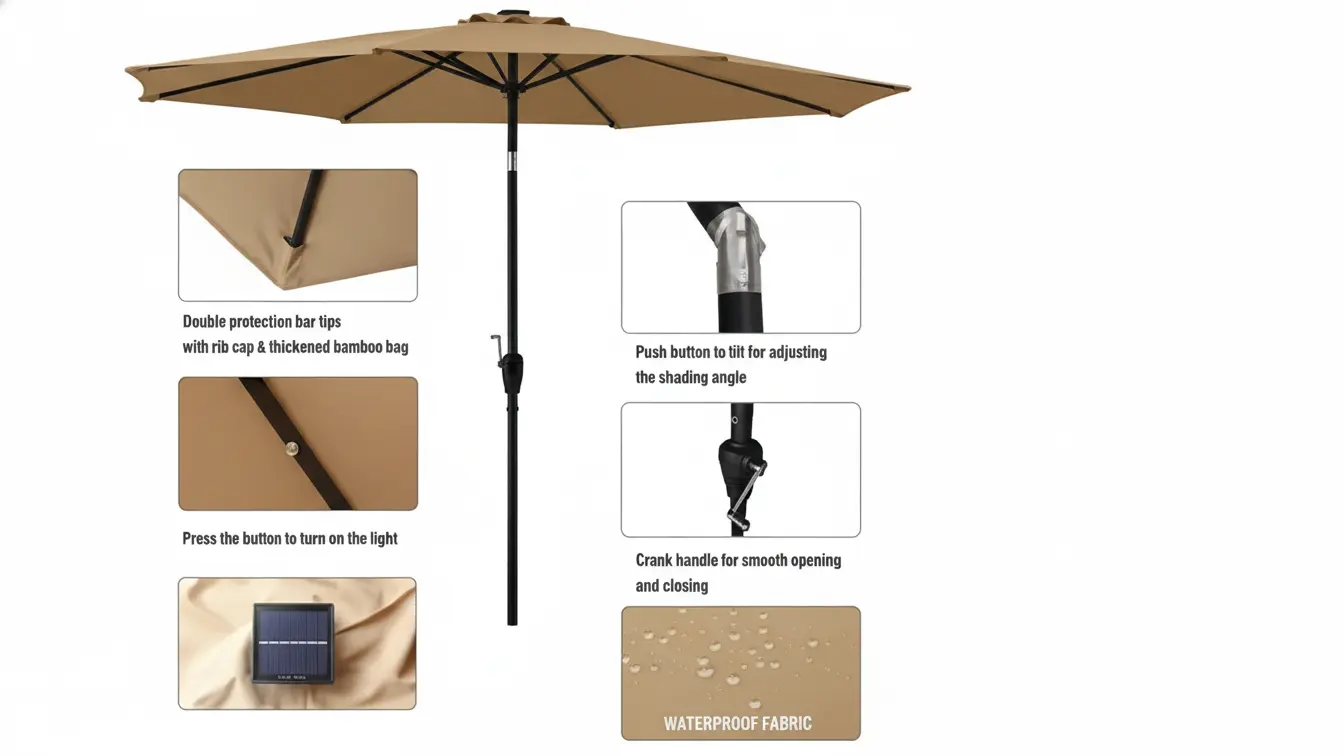
Push button tilt mechanisms operate by pressing a spring-loaded button that releases a locking latch, allowing manual adjustment of the umbrella pole angle. Releasing the button re-locks the pole in place, enabling quick, simple repositioning of the umbrella tilt.
Push button tilt systems are a common choice in commercial patio umbrellas because they simplify the process of adjusting shade angles throughout the day. They rely on straightforward hardware and a user-driven locking method, balancing function with cost efficiency. Understanding their operation helps buyers compare push button vs crank tilt options for their business needs.
Mechanical Operation of Push Button Tilt Mechanisms
In our experience, the mechanism’s simplicity is what makes it reliable in busy commercial environments. The operation focuses on a direct, tactile interaction between the user and the locking system.
- ⚙️ A spring-loaded button integrated into the umbrella pole controls an internal latch or locking pin.
- 🔓 Pressing the button disengages the lock and frees the pole to pivot at its base joint.
- ↔️ The user manually adjusts the umbrella angle, typically up to 45°, to achieve optimal shade.
- 🔒 Releasing the button re-engages the lock, securing the pole firmly in its new position.
- 🚀 This design allows quick transitions between angles, ideal for frequent repositioning.
Comparison Between Push Button and Crank Tilt Mechanisms
When comparing push button vs crank tilt umbrellas, the main differences relate to effort, precision, and mechanical complexity. The table below provides a clear overview for buyers choosing the right system for their applications.
| Type | Operation | Mechanism | Best For | Maintenance |
|---|---|---|---|---|
| Push Button Tilt | Manual press and tilt | Spring-loaded latch | 🚀 Quick daily adjustments | ✅ Low (fewer moving parts) |
| Crank Tilt | Turn handle for tilt | Gear-based locking | 💡 Smooth, controlled repositioning | ⚠️ Higher (more mechanical components) |
Push button systems typically cost less and have fewer maintenance points, but crank mechanisms may offer smoother control and are easier to operate in high wind or by users with limited strength.
Benefits and Considerations for Commercial Use
For commercial venues like cafes, resorts, and event patios, push button tilt umbrellas provide a strong balance between function and operational speed. They keep shade management simple for staff members and flexible for changing sun angles.
- 🚀 Offers rapid shade adjustments, ideal for busy environments with high guest turnover.
- 💡 Intuitive design reduces staff training time.
- ✅ Lower maintenance needs compared to crank systems, improving cost efficiency.
- ⚠️ Requires manual effort, which can be challenging in strong wind or by less-abled users.
- 🔒 Users must engage the button completely to prevent slippage or missed locking.
- 🏢 Recommended for commercial users who prioritize speed and reliability with trained personnel available.
In summary, push button tilt mechanisms suit operations that need frequent, hands-on adjustment and value low-maintenance simplicity. For operators aiming for smoother or more automated shade movement, crank systems remain a good alternative depending on environment and user preference.
Durability and Common Failure Points
Push button mechanisms usually last between 1 to 5 million cycles, while crank/toggle mechanisms offer a longer lifespan of 1 to 10 million cycles. Crank tilts typically outperform push buttons in high-frequency commercial use environments, though industrial-grade push buttons can also achieve high durability with proper sealing and materials.
When choosing between a push button and a crank tilt for market umbrellas, durability plays a major role in long-term performance, especially in commercial installations. In our experience, the mechanical structure and protection level define the true service life of each mechanism type.

Key Durability Comparison
| Specification | Push Button ⚙️ | Crank/Toggle ⚙️ |
|---|---|---|
| Mechanical Life | 1–5 million cycles | 1–10 million cycles 🚀 |
| Rated Current | 1–10A | 1–20A |
| Rated Voltage | Both support 12V–220V AC/DC | |
| Protection Rating | IP65 ❌ | IP65+ ✅ (Better dust/water resistance) |
| Wear Pattern | Faster wear due to spring and contact fatigue ⚠️ | Slower wear with distributed mechanical stress ✅ |
Crank-based systems show better stability in heavy-duty operation because mechanical stress is shared across gears and levers. Push button units are simpler but more prone to early fatigue if operated frequently without reinforced materials.
Common Failure Points
- ⚠️ Push Buttons: Button sticking, contact oxidation, spring fatigue, and membrane degradation are common issues over long use.
- ⚠️ Crank Tilts: Bearing corrosion, seal degradation causing water ingress, lever pivot wear, and gear tooth stripping in geared versions can lead to failures.
Crank mechanisms tend to handle harsh outdoor climates better due to sealed stainless steel parts. Push buttons need premium IP67 sealing to achieve comparable resilience.
Another difference lies in feedback quality: push buttons may lose illumination clarity over time, while crank handles keep both the lever’s visual position and tactile feel consistent through extended use.
Critical Insight and Usage Recommendations
For commercial umbrellas that undergo frequent tilt adjustments, crank mechanisms typically last 2–3 times longer. They provide smoother cycling and lower long-term maintenance costs in hospitality settings.
- ✅ Push Buttons: Best for low-frequency or backup control points rather than daily movement.
- ✅ Industrial Push Buttons: Sealed and reinforced models can match crank durability, though they involve higher cost and specification standards.
- 💡 Crank Systems: Ideal choice for restaurants, cafes, and resorts requiring dependable high-cycle performance.
Selecting the right mechanism directly affects total cost of ownership. Buyers should factor in duty cycles, replacement intervals, and environmental exposure when choosing between a push button vs crank tilt system for their commercial setups.
Elevate Your Outdoor Spaces with Durable, Custom-Engineered Shade Solutions
Partner directly with a trusted manufacturer offering factory-direct pricing, low MOQs, and innovative features like integrated solar lighting. Get premium commercial umbrellas designed for longevity and tailored to your brand’s exact needs.

Which Tilt Mechanism Is Easier to Reach?
There is no available direct comparative data on ease of reach for push button versus crank tilt mechanisms for patio umbrellas in the current research. Typically, push button tilts offer quick, one-handed operation, while crank tilts require two hands but provide more precise angle control. The best choice depends on user preferences and ergonomic considerations.
When comparing the push button vs crank tilt options on commercial umbrellas, each mechanism is designed for specific ease-of-use priorities. In our experience, both systems meet durability expectations in hospitality and retail settings, but their accessibility differs based on installation height and user mobility.
- 💡 Definition: A push button tilt uses a simple press mechanism located along the umbrella pole to activate the tilt, while a crank tilt relies on a rotating handle that adjusts the canopy angle gradually.
- 🚀 Types: Push button systems are quicker and need just one hand to operate, but they require reaching up to the button. Crank systems allow progressive angle control yet involve more arm movement.
- ✅ Benefits & Trade-offs: Push buttons favor speed and simplicity for easily reachable setups. Cranks deliver finer adjustments across larger tilt ranges but can be harder to reach depending on pole height.
- ⚠️ User Experience Factors: The actual reachability is influenced by the umbrella’s total height, user mobility, and the mounting point of the tilt mechanism.
- ❌ Lack of Industry Data: No standardized ergonomic or usability studies currently compare these two systems for commercial patio umbrellas.
For B2B buyers working with Patiofurnituresco, both tilt types can be customized within OEM or ODM umbrella programs, ensuring the design matches user requirements, brand aesthetics, and operational environments such as resorts, cafes, or retail settings.
User Experience: Accessibility and Convenience
Push button tilt mechanisms offer fast, one-handed operation ideal for rapid adjustment in busy commercial settings. Crank tilt systems provide easier operation for users with limited hand strength by using mechanical leverage, making them more accessible though slower to deploy.
From a commercial perspective, both tilt mechanisms deliver unique advantages. The best choice depends on how often the umbrella will be adjusted and the accessibility needs of the end users.
Key Comparison of Push Button and Crank Tilt
Below is a side-by-side comparison of each mechanism focusing on deployment speed, effort, maintenance, and cost. This overview helps property managers and buyers weigh productivity against accessibility.
| Feature | Push Button Tilt ✅ | Crank Tilt ♻️ |
|---|---|---|
| 🚀 Deployment Speed | 1–2 seconds for quick angle change | 10–30 seconds due to hand rotation |
| 💪 Physical Effort | Minimal finger pressure needed | Moderate, sustained crank rotation |
| ♿ Accessibility | Requires precise motor control ❌ | More suitable for users with limited hand strength ✅ |
| ✋ One-Handed Operation | Yes, truly single-hand friendly ✅ | No, usually requires both hands ❌ |
| 🧰 Maintenance Complexity | Electronic or pneumatic parts ⚠️ | Simpler mechanical gears ✅ |
| 🔧 Failure Points | Battery or solenoid may fail ❌ | Gradual gear wear, easy repair ✅ |
| 💰 Cost Premium | 15–25% more expensive ⚠️ | Lower cost, better value ✅ |
| 🏨 Ideal Commercial Use | High-traffic hospitality or fast-paced venues | Mixed-use environments prioritizing reliability |
Convenience Versus Accessibility: Practical Insights
In our experience working with hotels, resorts, and retail clients, the right mechanism often depends on operational priorities. Push button systems shine in places needing rapid repositioning—think pool bars or event patios during peak hours.
- 🚀 Push button umbrellas benefit venues that frequently adjust shading throughout the day.
- ⚠️ Hidden costs include battery replacements, exposure to moisture, and more frequent part servicing.
- ♿ Crank tilt umbrellas align with ADA and EN581 accessibility guidelines, using simple mechanics instead of electronics.
- 💡 The ergonomic crank handle design helps users with arthritis or limited grip apply less force.
- 📅 Most commercial operations adjust umbrellas only 2–4 times daily, which rarely requires push button speed.
Patiofurnituresco often recommends crank tilt designs for large mixed-use sites and hospitality projects. They combine ease of use, mechanical reliability, and lower total cost of ownership for long-term commercial performance.
Cost Comparison Between Crank Tilt and Push Button
Crank tilt mechanisms cost more upfront but offer a longer lifespan, stronger durability, and better performance in high-traffic settings. Push button umbrellas have a lower entry price and simpler operation, but they tend to need replacement more often over time.
Both crank tilt and push button mechanisms are popular in commercial patio umbrellas. This comparison helps buyers understand where costs differ across installation, longevity, and total ownership over time.
Cost and Installation Comparison
| Aspect | Push Button | Crank Tilt |
| 💲 Typical Price Range | $80–200 (entry-level) | $200–500+ (mid to premium range) |
| 🚀 Upfront Cost Difference | Lower initial investment | Costs 150–400% more upfront |
| 🛠️ Installation Time | ~30 minutes | ~30 minutes |
Installation requirements are nearly the same for both systems. The main difference lies in material quality and operational hardware, which justify the pricing gap for commercial buyers.
Durability, Maintenance, and Lifespan
| Factor | Push Button | Crank Tilt |
| ⏳ Lifespan | 1–3 years | 3–7+ years (2–4× longer) |
| ⚙️ Maintenance | Simpler structure with fewer moving parts | Requires more upkeep due to mechanical system |
| 🧵 Material Quality | Basic olefin/polyester with aluminum frame | Marine-grade acrylic and reinforced aluminum |
In our experience, crank tilt umbrellas handle long-term outdoor exposure better. Their reinforced materials can withstand daily commercial use where standard push button frames might degrade sooner.
Operational Effort and User Experience
| Aspect | Push Button | Crank Tilt |
| 💡 Operation Type | Simple hydraulic or pneumatic push button | Manual crank mechanism |
| 🖐️ User Effort | Minimal physical effort | Manual control with tactile feedback |
| ⚠️ Reliability Risks | Possible failure of fluid-based tilt system | Fewer hidden defects, less downtime |
While push button systems are easier to operate for casual users, crank tilt models provide a predictable, mechanical experience preferred in commercial patios where reliability matters most.
Cost-Benefit Perspective for Commercial Buyers
| Criterion | Push Button | Crank Tilt |
| 🔁 Replacement Frequency (5+ yrs) | Replaced 2–4× more often | Rarely replaced during same period |
| 📈 ROI Potential | Lower total value due to recurring cost | Higher ROI from longer service life |
| 🏢 Best Use Case | Short-term, budget-cover, light traffic | High-traffic, long-term commercial sites |
For B2B buyers, the crank tilt design offers better economics across a multi-year project cycle. Though expensive upfront, fewer replacements and less downtime make it more profitable in the long run.
Final Recommendations for Different Users
Push button tilt umbrellas suit high-traffic commercial settings needing speed and convenience, while crank tilt umbrellas fit budget-conscious residential buyers valuing simplicity and low maintenance.
This section provides a breakdown of which umbrella tilt mechanism type makes the most sense for different users, alongside key technical and market data. The goal is to help business buyers, homeowners, and developers make confident choices based on performance, cost, and operation needs.
User Profiles and Ideal Choices
- 🏨 Commercial/Hospitality users – benefit from push button tilt due to frequent operation cycles and quick handling that suits staff and guest areas.
- 🏡 Residential and budget-focused users – prefer crank tilt designs that deliver simple, dependable functionality without the added cost.
- 🎪 Event rental operators – favor push button models with built-in redundancy for rapid assembly and reliable performance during multiple daily setups.
- 🏗️ Developers and large-scale projects – choose push button umbrellas that allow OEM customization for cohesive branding across large installations.
Key Comparison of Push Button vs. Crank Tilt
| Criteria | Push Button Tilt | Crank Tilt |
|---|---|---|
| Market Segment | 🏨 Dominates commercial/hospitality | 🏡 Best for residential patrons with tight budgets |
| Speed | 🚀 Operates in 3–5 seconds | ⚙️ Manual crank takes 20–30 seconds |
| Cost | 💰 25–40% higher upfront | 💰 Baseline entry-level pricing |
| Maintenance | ⚙️ Quarterly button or motor check | 🔧 Annual gear inspection |
| Durability | 🏆 Tested to 10,000+ cycles | ⏳ Withstands 5,000–7,000 cycles |
| Failure Rate | ⚠️ 2–3% annual rate under commercial loads | ⚠️ 5–8% under heavy manual use |
| Accessibility | ✅ Friendly for elderly and disabled users | ❌ Requires moderate grip and rotation strength |
Market Trends and User Considerations
In the current B2B landscape, push button tilt umbrellas are gaining traction thanks to the global shift toward touchless and rapid-operation features in hospitality and retail environments.
Commercial clients report measurable ROI through faster daily setup times and improved guest satisfaction despite a 25–40% higher capital expense. Residential users, by contrast, continue to favor the mechanical simplicity and lower maintenance of crank tilt options, which align with individual usage and tighter budgets.
Event and rental sectors find that push button systems enhance logistics efficiency, while developers often prioritize OEM customization opportunities offered by manufacturers like Patiofurnituresco.
Practical Recommendations per User Group
- 🏨 Commercial buyers: Choose push button tilt umbrellas with verified safety certification such as UL4041 or EN581 for reliable operation and durability in busy hospitality settings.
- 🏡 Homeowners: Opt for crank tilt for cost savings and simple functionality if daily manual use is acceptable.
- 🎪 Rental operations: Deploy push button designs equipped with backup systems to ensure quick turnaround between events.
- 🏗️ Developers and project managers: Work with direct manufacturers like Patiofurnituresco to access bulk pricing and tailored OEM options for large rollouts or branded site furnishings.
Frequently Asked Questions
How does auto tilt work on a patio umbrella?
An auto tilt umbrella works by using the crank system. Once the canopy is fully opened, you keep rotating the crank until the top part of the pole begins to tilt. This motion activates a built‑in gear mechanism that shifts the upper section without any additional buttons or levers.
In our experience, auto tilt systems are convenient for daily use in commercial patios or resorts because they allow staff to adjust shade angles with one continuous motion. It also minimizes small parts that can wear out over time.
Is push button tilt hard to use?
A push button tilt umbrella uses a spring‑loaded button near the joint of the pole. You press the button, then manually tilt the canopy to your preferred angle. It’s a simple mechanical design with fewer internal parts than a crank system.
Most users find it easy, but when the umbrellas are tall or used in high‑traffic commercial settings, staff may prefer the crank tilt for easier, hands‑free adjustment. Each design has its ideal use case depending on frequency of operation and staff convenience.
Which tilt mechanism lasts longer?
Durability depends on how the umbrella is used and how well it’s made. A push button tilt includes fewer moving parts, which means fewer chances for failure in rough commercial use. The crank tilt, on the other hand, offers smooth motion but can wear if the internal gears aren’t high quality.
At Patiofurnituresco, umbrellas with both tilt styles are built using contract‑grade materials and corrosion‑resistant gears. When maintained properly, either style can last for seasons of regular use. For environments with frequent repositioning, the crank tilt typically holds up better.
Can I fix a broken tilt button?
Yes, in most cases you can replace a broken push button tilt mechanism. The process involves removing the old button assembly at the joint, aligning the spring, and snapping in a replacement kit. These parts are usually inexpensive and widely available.
For commercial customers, it’s best to keep spare button kits on hand. They allow quick maintenance without disrupting operations during peak outdoor seasons.
Why is my auto tilt umbrella not tilting?
If your auto tilt umbrella stops tilting, the most common reason is that the crank cable or internal gear has jammed or worn out. Sometimes the umbrella isn’t fully opened before the tilt motion is engaged, which can also prevent movement.
Try the following steps:
- 💡 Make sure the canopy is completely open before continuing to crank.
- ⚠️ If the crank turns loosely without resistance, the internal cable might be detached.
- ✅ Lubricate the gear joint occasionally to prevent corrosion or stiffness.
If these checks don’t solve the issue, the tilt gear set might need replacement. Patiofurnituresco offers compatible parts and OEM support for commercial buyers needing factory‑grade repairs.
Final Recommendations for Different Users
Across all comparisons, crank tilt umbrellas stand out for their mechanical reliability, long service life, and consistent performance in demanding environments. Push button tilts deliver quick operation and better accessibility for busy staff, while crank systems excel in durability and long-term cost efficiency. Each mechanism supports specific user priorities—speed and ease for push buttons, precision and endurance for cranks—making the right choice dependent on usage frequency and ergonomic reach.
For commercial buyers, aligning tilt type with operational needs can reduce maintenance workloads and improve return on investment across hospitality or retail projects. Partnering with an experienced supplier like Patiofurnituresco ensures access to OEM customization, verified quality controls, and dependable parts support for scalable outdoor programs built to last season after season.



 English
  Spanish
  French
  German
  Portuguese