

Most buyers first meet MOQs when they try to place a small, custom order and the factory replies with a minimum that feels disconnected from the project size. A mill might insist on 500 meters per fabric color, an extrusion plant might ask for hundreds of kilos per profile, and a printer might only quote for a few hundred custom mailers at a time.
Those numbers are not random. This article explains how machine batch sizes, fabric dye lots, die and tooling costs, LCL freight rules, stock colors, and custom colors all shape the minimums that factories ask for. It also walks through practical ways to work with MOQs—using pilot runs, mixing SKUs, choosing the right printing method, and building a track record with suppliers—so you can plan new products around how production really works.
The Fabric Dye Lot: Why 500 Meters is the Minimum
Fabric dyeing is an industrial batch process where machines are optimized for loads of several hundred kilograms to ensure consistent color and efficiency. A 500-meter minimum is a typical commercial floor that reflects the conversion of a machine’s minimum weight capacity into a specific fabric length, preventing waste and quality issues.
How Dyeing Machines Dictate Batch Size
Fabric dyeing relies on batch processing in large vats to guarantee uniform color across an entire order, creating a single dye lot. Each machine is engineered for an optimal load, which is measured in hundreds of kilograms, not meters. Running a machine significantly below its capacity wastes substantial amounts of water, energy, and chemicals per unit of fabric. Short runs also increase the risk of quality issues like “tailing,” where the color shade varies from the start to the end of the fabric roll.
Converting Weight to Length: The Technical Math
A mill’s MOQ is based on weight (kg), which translates to length (m) depending on the fabric’s density, measured in grams per square meter (g/m²). For a standard 160 g/m² cotton jersey, a minimum machine load of 100 kg requires a continuous fabric length of about 320 meters. Industrial equipment for processes like pad-batch dyeing is designed to hold 450–700 kg of fabric in a single batch. Because of these physical constraints, a request for a custom Pantone color match often results in a quote for 300-500 meters or more.
Aluminum Extrusion Batches: Setup Costs
The main setup cost for custom aluminum extrusions is a one-time die tooling charge, typically ranging from USD 300 for simple profiles to over USD 2,000 for complex hollow shapes. This initial investment, combined with per-batch operational costs, makes small orders expensive because these fixed expenses are spread across fewer units.
The One-Time Die and Tooling Charge
The primary setup cost for any new custom aluminum profile is the creation of the steel die, which is the tool that shapes the hot aluminum. This is a significant one-time investment that applies only to new designs and must be factored into the total production cost. A die for a simple, solid profile typically costs between USD 300 and USD 800. For more intricate hollow shapes or large profiles with multiple voids, the cost can increase substantially, ranging from USD 800 to over USD 5,000.
Per-Batch Operational Costs
Beyond the initial die investment, each production run incurs its own set of operational costs. These include configuring the extrusion press, heating the aluminum billets, and accounting for the initial material scrap generated during setup. These expenses are typically bundled into a processing rate, often between USD 1.00 and USD 3.00 per kilogram, which is added to the cost of the raw aluminum. This pricing structure makes small batches financially inefficient, as the fixed die cost and run setup expenses are divided by a small number of parts, driving up the per-unit price. A common strategy to avoid the custom die charge entirely is to use one of the manufacturer’s existing standard dies.
Negotiating MOQs: Stock Colors vs. Custom Colors
Choosing a supplier’s stock colors results in a much lower Minimum Order Quantity (MOQ) because the material is produced in bulk and its cost is shared among many buyers. Requesting a custom Pantone-matched color requires a dedicated production run, forcing the factory to impose a higher MOQ (often 50-300 units) to cover setup costs.
| Product Category | Typical Stock MOQ | Typical Custom Color MOQ |
|---|---|---|
| Packaging | ~100 units | ~250 units |
| Apparel | Varies (Lower) | 50–300 units per color |
| Promotional Items | ~25-50 units | 100+ units per color |
The Economics of Shared vs. Dedicated Production
Suppliers offer low MOQs on stock colors because they produce the material in large, continuous batches for multiple customers. This shared production model spreads the fixed costs of machine setup and raw materials across a wide client base, which means no single buyer has to bear the full expense. Your order simply pulls from an existing inventory.
Requesting a custom Pantone match completely changes the financial equation. The factory must halt its standard operations to run a production line exclusively for your order. This dedicated process includes machine calibration, unique dye mixing, and material waste that cannot be sold to anyone else. The higher MOQ for a custom color is set specifically to cover these one-off costs and ensure the production run is financially viable for the factory.
Typical MOQ Differences by Product Type
This principle holds true across different industries. In packaging, a company might offer stock-design mailers with a 100-unit MOQ but require a 250-unit minimum for custom-printed tissue paper. The higher threshold for the custom product accounts for the specific ink and plate setup.
The apparel industry follows the same logic. Custom garment orders often demand MOQs between 50 and 300 pieces per style and color to justify the cost of creating a new fabric dye lot. Even simple promotional products, like silicone wristbands, can carry a 100-piece MOQ just for a custom material color, a requirement that exists before any branding or printing is even considered.
Get Custom, Contract-Grade Umbrellas Direct from the Factory

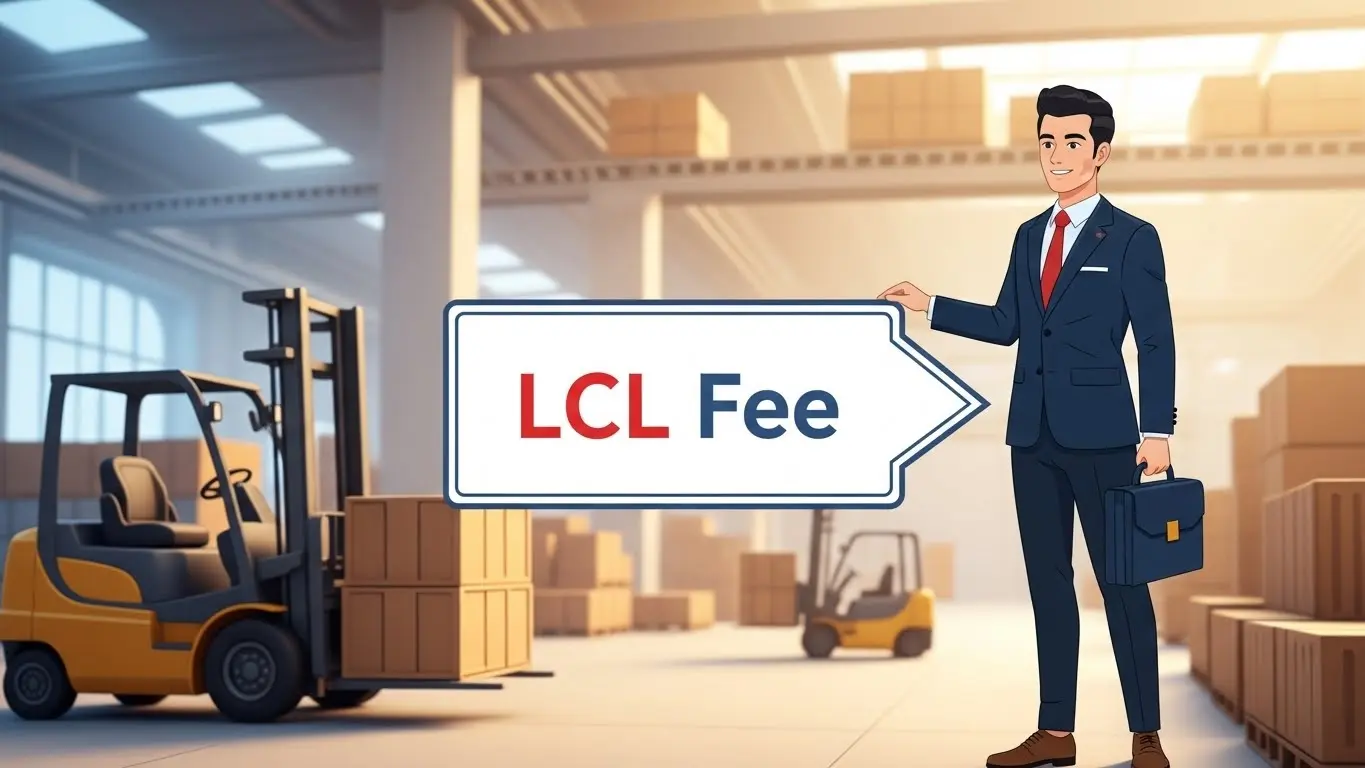
Surcharges for Small Orders: The “LCL” Fee
The ‘LCL fee’ refers to shipping surcharges for orders too small to fill a container. Carriers bill for a minimum of 1 cubic meter (CBM), making tiny shipments costly. Additional per-CBM fees like Terminal Handling (USD 20-50) and Destination Services (USD 30-80) further increase the per-unit cost for low-volume orders.
Understanding LCL and the Minimum Billing Rule
LCL (Less than Container Load) is a shipping method used when your order is too small to fill an entire container. Your cargo shares space with shipments from other companies. Pricing is determined by “Weight or Measure” (W/M), where the carrier charges based on whichever is greater: the shipment’s volume in cubic meters (CBM) or its weight per 1,000 kg. The primary cost issue for small orders is the industry-standard minimum billing rule of 1 CBM. This means a tiny shipment of just 0.2 CBM is priced as if it were a full 1 CBM, establishing a high cost floor that makes very small quantities expensive to ship.
The Per-CBM Fees: How Costs Add Up
Unlike Full Container Load (FCL) shipping, which has fixed local fees per container, LCL shipments incur multiple local charges billed on a per-CBM basis. These costs stack on top of the base freight and the 1 CBM minimum. Common surcharges include the Terminal Handling Charge (THC) at the port, which typically adds USD 20 to USD 50 per CBM. At the destination, Destination Service Fees for tasks like deconsolidation and paperwork can add another USD 30 to USD 80 per CBM. When these per-CBM fees are applied to a shipment already billed at the 1 CBM minimum, the total cost per unit rises significantly.
Pilot Runs: Strategies for New Brands
For new brands, a pilot run is a small production batch, typically 100-1,000 units, used to validate the manufacturing process. It uses quality metrics like Cpk ≥ 1.33 and ≥95% yield to prove production readiness, allowing factories to accept smaller initial orders before scaling.
The Pilot Run: Bridging Prototypes and Mass Production
A pilot run is a small-scale production test that validates the entire manufacturing system before a brand commits to a high Minimum Order Quantity (MOQ). Instead of making single prototypes, a pilot run typically produces 100 to 1,000 units to stress tooling, assembly processes, and logistics under production-like conditions. This approach generates statistically useful data on potential failure modes. For highly complex or regulated products, a run might start with just a few dozen units, which is enough to challenge the process and provide necessary samples for regulatory testing and validation.
Key Quality Metrics for a Successful Pilot Run
A successful pilot run relies on objective data, not just functional parts. Manufacturers use specific quality metrics to confirm a process is stable and ready for larger volumes. Process capability for critical dimensions is measured with a target of Cpk ≥ 1.33, which shows the process is consistent and well-centered. For general assemblies, an Initial Pass Yield (IPY) of 95% or higher is a common benchmark. Parts are often inspected using acceptance sampling standards like ANSI/ASQ Z1.4, with a zero-tolerance policy (AQL=0) for any critical defects. In many industries, especially regulated ones, a process is only considered validated after achieving these targets across three consecutive successful pilot batches.
Consolidation: Mixing SKUs to Meet MOQ
Consolidation is a strategy where you group multiple distinct products from the same supplier into one larger order. This allows the total quantity of the combined order to meet the supplier’s overall Minimum Order Quantity (MOQ), even if each individual SKU’s quantity is below the minimum.
The Core Strategy: Grouping by Shared Constraints
The fundamental approach to SKU consolidation is grouping different items from a single supplier, allowing their quantities to collectively satisfy one MOQ. This works well when combining products that share common materials or construction elements. For instance, an order for wallets and keychains made from the same leather can be batched into a single production run. The focus shifts from meeting per-SKU minimums to achieving a total order value or unit count, such as ordering 100 total widgets composed of various colors and sizes.
Practical Methods for Combining Orders
To apply this strategy, new brands can simplify their product catalog by offering fewer variations—like one or two primary colors instead of a full spectrum across multiple sizes—to make batch minimums more attainable. You can also structure complex orders with sub-minimums, where a total order of 100 widgets might require at least 50 red units and 50 medium-sized units. Inventory management software helps by incorporating MOQ constraints into purchasing logic. It can suggest larger, less frequent orders when a supplier’s MOQ exceeds the calculated Economic Order Quantity (EOQ).
| Consolidation Method | Description | Example |
|---|---|---|
| Supplier-Level Aggregation | Combine all SKUs from one supplier to meet a total order value or unit count MOQ. | Ordering 50 shirts, 30 hoodies, and 20 hats to meet a supplier’s 100-unit total MOQ. |
| Shared Component Batching | Group products using the same raw materials or manufacturing process into a single production run. | Ordering wallets and keychains made from the same leather to meet a fabric MOQ. |
| Complex Order with Sub-Minimums | Meet a total MOQ while also satisfying smaller minimums for specific product attributes. | An order for 100 widgets total must include at least 50 red units and 50 medium-sized units. |
MOQ for Custom Printing/Branding
For custom branding, the minimum order quantity (MOQ) depends entirely on the printing method. Digital printing like DTG often has no minimum, starting at one piece. Methods with high setup costs, like screen printing or flexography, require higher volumes (12-100+ units) to be cost-effective.
Why Printing Method Dictates the Minimum
Printing methods with high setup costs require larger orders to be profitable. Analog processes like screen printing and flexography involve significant upfront work creating physical screens or plates and calibrating machinery. These fixed costs must be distributed across the entire print run, which is why suppliers set a minimum order quantity. In contrast, digital printing methods like Direct-to-Garment (DTG) have almost no setup cost. A design file is sent directly to the printer, making it economical to produce even a single item.

Common MOQs by Product Type
The required minimums vary widely based on the product and the technology used to customize it. For screen-printed apparel, the industry standard MOQ is often between 12 and 25 pieces per design. Promotional hard goods like water bottles or pens usually require 50 to 100 units. Specialized items such as custom umbrellas have minimums from 48 to 72 units. Custom packaging shows the most extreme range; inline flexo-printed poly mailers can demand 25,000 units, but digitally printed boxes might be available in quantities as low as 100.
Growing Your Account: Lowering MOQs Over Time
As your business grows, manufacturers often lower MOQs from initial levels like 1,000 units down to 300–500. You can earn this by demonstrating consistent order volume, providing accurate forecasts, and consolidating product variations. This process builds trust and reduces the supplier’s risk.
The Partnership Path: From Initial Orders to Strategic Supply
Suppliers set initial Minimum Order Quantities (MOQs) to cover fixed costs, such as the machine setup for a production run, which can be around $5,000. This ensures each batch is profitable. When you establish a history of consistent orders, you give the factory predictable demand, which lowers their financial risk on raw materials and scheduling. This transforms the relationship from a simple transaction into a long-term partnership, creating the foundation for more flexible terms and lower MOQs over time.

Data-Driven Strategies for Reducing Minimums
To secure lower MOQs, you need to provide clear, actionable data. Share accurate monthly consumption figures, like 500 kg/month, to justify smaller, more frequent production runs that align with your actual sales. You can also consolidate components or raw materials across multiple SKUs. This helps the factory meet its own MOQs from its suppliers while producing smaller, customized batches for you. Proposing long-term volume commitments or accepting a slightly higher per-unit price are effective ways to negotiate MOQ reductions from 1,000 units down to a 300–500 unit range. A proven track record of reliable orders can also shorten lead times, sometimes from six weeks down to just four.
Frequently Asked Questions
Why do factories have high MOQs?
Factories set high MOQs because their own raw material suppliers sell in bulk. Fixed costs for molds, machine setup, labor, and quality control also need to be spread across a large production run to keep the per-unit price low enough to be profitable.
Can I order a very small quantity if I pay a higher price?
Yes, it’s often possible. Some manufacturers accept smaller orders if you pay a premium. For example, a factory might waive its standard 300-unit minimum for a special process like UV coating if you agree to a 20% surcharge, making a small trial batch of 50 units feasible.
What is the typical MOQ for a custom fabric color?
For custom-dyed fabric from a large mill, the MOQ is typically around 500–1,000 kg per color. For smaller projects, digital printing platforms offer much lower minimums, sometimes as low as 10–25 meters per custom color or print.
Does the MOQ apply to my total order or to each color?
The MOQ almost always applies per color and per style, not to the total order quantity. You generally cannot mix multiple colors to meet a single MOQ. A common industry standard is 30–100 units per design, per color.
Final Thoughts
MOQs can feel like a barrier when you start, but they simply mirror the way factories pay for machines, labor, raw materials, and freight. Each minimum points back to a real constraint: dye-lot size, die and tooling cost, LCL fees, print setup, or the way a supplier’s own vendors sell to them.
When you map your launch plan to those constraints—using pilot runs, consolidating SKUs, choosing stock options where it makes sense, and sharing real forecasts—you move from pushing against MOQs to working with them. Over time, that approach builds enough trust and volume for factories to lower minimums, tighten lead times, and treat your brand as a long-term account rather than a one-off order.



 English
  Spanish
  French
  German
  Portuguese