

An effective Layout Strategy is more than maximizing table density; it’s a critical defense against ADA non-compliance fines and fire code violations. Ignoring mandated egress paths or wheelchair turning space doesn’t just create operational friction—it exposes a business to significant liability, negating any revenue gains from extra seating.
This analysis provides layout blueprints based on real-world constraints. We factor in required service corridors and the operational limits of promotional-grade umbrellas, which often carry a Grade 3 wind rating, to create designs that balance density with non-negotiable safety standards.
What Is the “Waiter Path” and What Are the Minimum Aisle Widths?
The “Waiter Path” is a clear route for staff between the kitchen and tables. The key guideline is keeping at least 36 inches (91 cm) between tables.
Optimizing Server Flow with Dedicated Pathways
A well-designed restaurant floor plan isn’t about cramming in chairs; it’s about creating clear, unobstructed paths for staff. This “waiter path” is the dedicated highway servers use to move efficiently from the kitchen to the dining room and back again.
The layout must prevent bottlenecks by carefully placing tables, service stations, and other furniture. You also want to separate traffic flows. The route guests take to the restrooms should not intersect with the main path servers use to carry hot food and drinks.
The 36-Inch Rule for Table Spacing
The industry standard for spacing is straightforward: allow at least 36 inches (91 cm) between the edges of adjacent tables. This isn’t just a suggestion; it’s a functional minimum for both guest comfort and operational safety. This gap ensures servers and guests can move between tables without bumping into each other or feeling cramped.

Shade Overlap: Is It Better to Have Gaps or Continuous Coverage?
Continuous coverage from overlapping umbrellas is better than leaving gaps. This eliminates disruptive moving sun spots and creates a more consistent, comfortable shaded environment for guests.
The Problem with Gaps: Eliminating Moving Sun Spots
Slightly overlapping umbrella canopies is the most effective way to block unwanted light leakage between units. When you leave even small gaps between umbrellas, you create moving slivers of intense sunlight across your seating area as the sun moves.
These sun spots are distracting and can be a major source of complaints from guests, forcing them to shift their seats. This undermines the whole point of providing shade and compromises the comfort of your outdoor space.
Using Offset Umbrellas for Seamless Coverage
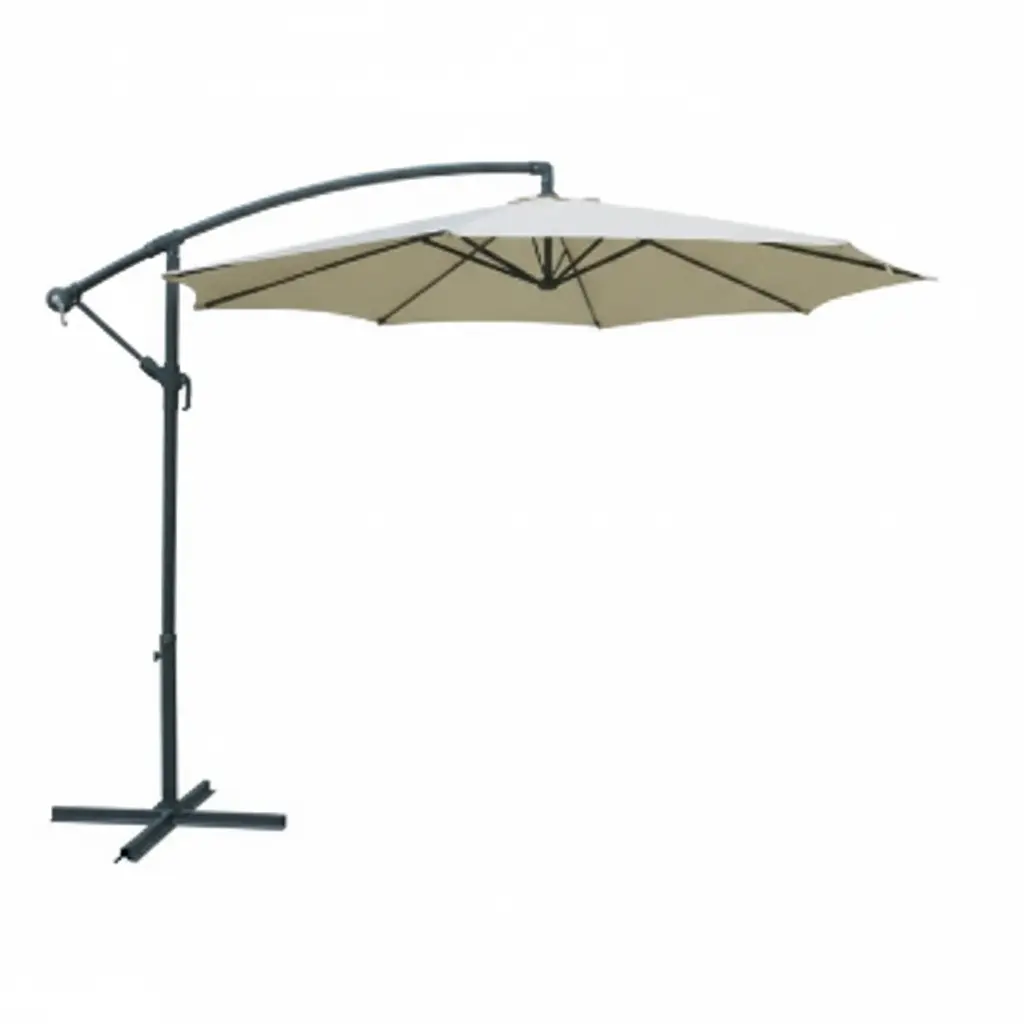
For creating continuous, overlapping coverage, cantilever umbrellas are the right tool for the job. Our PTZHU-003 ‘Banana’ series, for example, features an offset base and a hanging canopy. This design is ideal for commercial layouts.
The offset base allows the canopy to hang directly over tables or lounge areas without a central pole obstructing the space. This makes it much easier to arrange multiple units side-by-side to create a seamless, gap-free shaded area, maximizing usable space and guest comfort.
Source Durable, Custom Umbrellas Factory-Direct

Density vs. Comfort: How Do You Avoid the “Sea of Canvas” Effect?
A “sea of canvas” is a monotonous grid of identical umbrellas that feels cramped. Avoid it by mixing standard and cantilever umbrellas to create visual variety and functional zones.
The Problem: When Maximizing Seating Creates Monotony
The “sea of canvas” effect happens when an outdoor patio is just a grid of identical umbrellas. It’s a common mistake made to cram in as many seats as possible, but it ignores atmosphere. While this layout might seem efficient on a spreadsheet, the result is a space that feels cramped, repetitive, and uninviting for guests.
A uniform layout also fails to create different zones. There’s no clear separation between dining areas, lounge spots, or waiting sections, making the entire space feel like one large, undifferentiated block.
The Solution: A Mixed Umbrella Strategy for Visual Variety
The fix is to use a mix of umbrella types. This approach immediately breaks up the visual monotony and helps define different areas of the patio. You create functional zones that improve both the look and feel of the space.
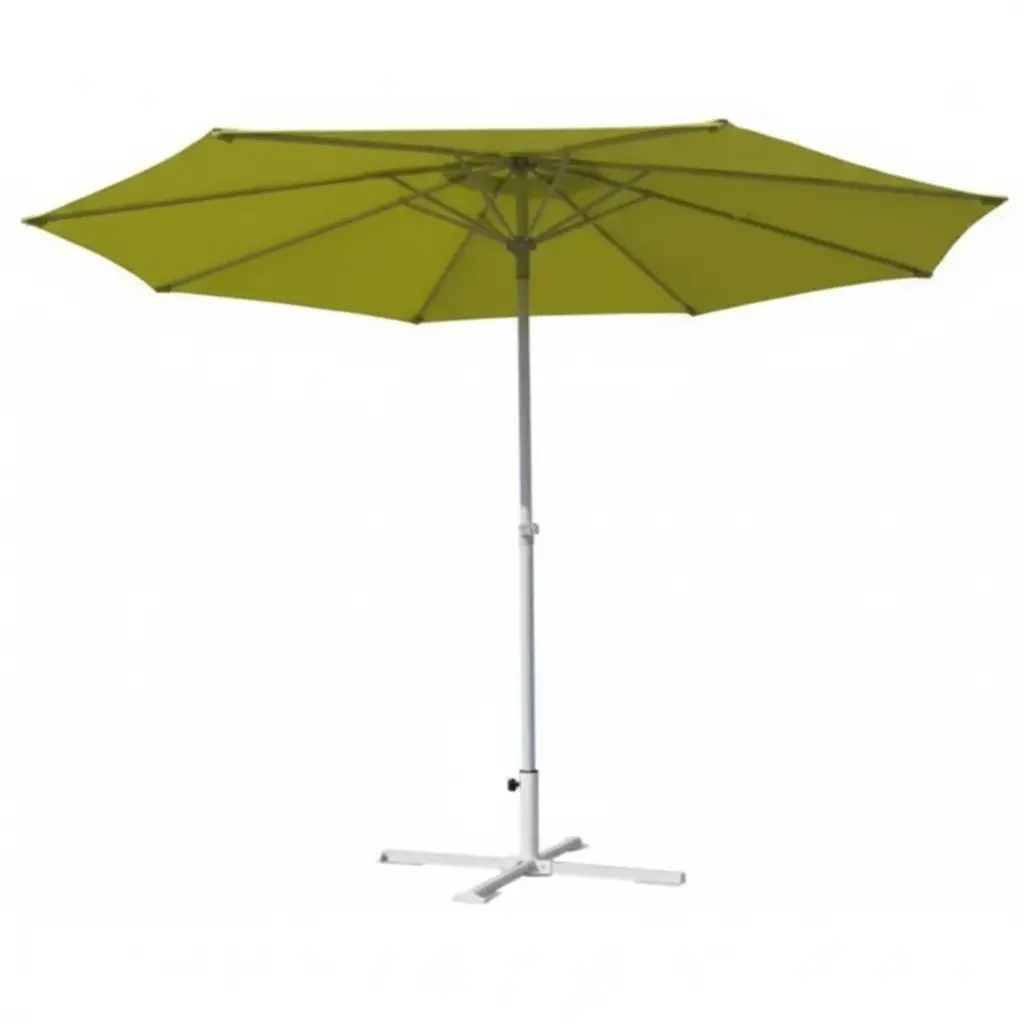
For example, use standard market umbrellas like our PTMU-001 for individual dining tables. Then, deploy larger offset cantilever umbrellas, like the PTZHU-003 ‘Banana’ style, to anchor lounge sections or cover conversational seating groups. Cantilevers are great for these spots because they provide wide coverage without a center pole getting in the way of guests.
This strategy introduces varied heights and footprints. It instantly disrupts the boring grid pattern, making the entire patio feel more thoughtful and well-designed.

ADA Compliance: What Is the Required Wheelchair Turning Radius?
The ADA requires a clear 60-inch diameter circle or an equivalent T-shaped space for a 180-degree turn. It’s a space requirement, not a radius.
When planning commercial outdoor layouts, one of the most common points of confusion is the Americans with Disabilities Act (ADA) standard for wheelchair mobility. The rules don’t actually specify a “turning radius.” Instead, they define a minimum clear floor space that must be kept free of obstructions to allow someone in a wheelchair to execute a 180-degree turn.
Defining the 60-Inch Turning Space
Compliance can be achieved in one of two ways. Both options require the space to be completely level and clear of any protruding objects or furniture.
- Circular Space: The most straightforward option is a clear circular floor area with a minimum diameter of 60 inches (1,525 mm).
- T-Shaped Space: As an alternative, a T-shaped space is also compliant. It must fit inside a 60×60 inch square area, with arms and a base that are at least 36 inches wide.
Using Offset Umbrellas to Maintain Clear Space
Traditional market umbrellas with a center pole can easily obstruct the required turning space between tables. This is where offset umbrella designs become a practical solution for maintaining compliance without sacrificing shade coverage.
Products like our ‘Banana’ (PTZHU-003) and ‘Roma’ (PTZHU-020) series are designed with the support pole and base located off to the side, outside the main traffic path. This configuration keeps the critical area under the canopy and between tables completely open. By placing the hardware away from seating areas, you can more easily design a layout that preserves the required 60-inch turning circle, ensuring your patio is accessible to all guests.
Fire Safety: Do Your Layouts Comply with Egress Path Regulations?
Egress paths are legally required exit routes that must remain completely unobstructed. Regulations mandate minimum widths, typically 36 inches, and require clear access to multiple exits for rapid evacuation.
Core Requirements for Unobstructed Exit Routes
Regulations from bodies like the NFPA and OSHA are not suggestions; they are strict requirements for occupant safety. Any furniture layout, temporary or permanent, must maintain clear exit pathways. Blocking these routes, even partially, creates a serious liability.
- Constant Clearance: Egress routes must be kept free of all obstructions at all times. This includes chairs, planters, umbrella bases, and any other items that could impede instant use in an emergency.
- Minimum Path Width: The required clear width is generally 36 inches for new layouts. For some existing buildings, the minimum might be 28 inches, but adhering to the 36-inch standard is the safest practice.
- Multiple Exits: Most commercial spaces must provide at least two separate exit routes. This ensures that if one path is blocked by fire or debris, an alternative is available for a quick evacuation.
How Umbrella Wind Ratings Impact Egress Path Safety
A standing umbrella seems harmless, but its stability is a critical factor in fire code compliance. An umbrella that falls over can instantly create a dangerous obstruction in a designated egress path. This is a particular concern for promotional-grade products not designed for high-wind environments.
Our promotional umbrellas have a wind resistance rating of Grade 3 or less, meaning they can handle a gentle breeze up to about 19 km/h. To maintain clear pathways and comply with safety rules, they absolutely must be closed when not actively in use or during any breezy conditions. A fallen umbrella isn’t just an inconvenience; it’s a fire code violation waiting to happen.
Sun Path Analysis: How Do You Account for Morning vs. Evening Angles?
Sun path analysis tracks altitude (height) and azimuth (direction) to predict shade patterns. Low morning and evening sun requires strategic umbrella placement for consistent coverage.
Understanding Solar Altitude and Azimuth Angles
To predict shade, you need to know the sun’s position. This is determined by two primary coordinates. The first is the altitude angle, which measures the sun’s height above the horizon. It’s lowest in the morning and evening, which creates the long shadows that can be tricky to block. The second is the azimuth angle, which tracks the sun’s directional position as it moves from east to west.
Sun path diagrams plot both these angles for every hour of the day and every month of the year. This gives you a reliable map to see exactly where shadows will fall on a patio at any given time, removing all the guesswork from your layout planning.
Strategic Placement with Offset Umbrella Designs
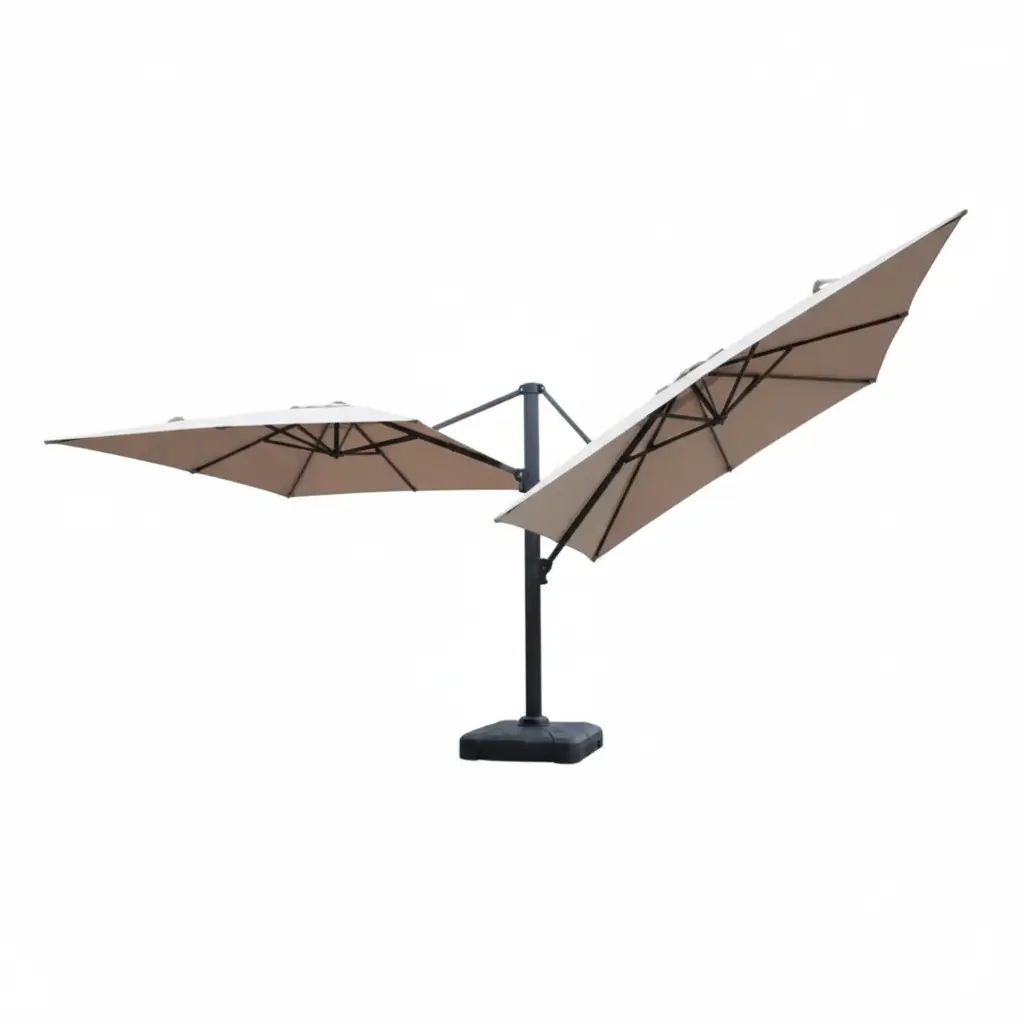
Knowing the sun’s path is useless without the right equipment. The offset design of hanging umbrellas, like our PTZHU-003 ‘Banana’ series, is built specifically to handle the changing sun angles throughout the day. Because the base sits to the side of the seating area, the canopy can be tilted and rotated to block low-angle sun without forcing you to move heavy furniture.
This provides far more flexible and continuous shade compared to a static, center-pole market umbrella. A center pole is fixed, offering limited protection as the sun moves lower on the horizon. An offset design allows for adjustments that keep seating areas covered from the first morning light to the last evening glow.
The “Grid” vs. “Organic” Placement: Which Layout Style Is Right for You?
Grid layouts use uniform patterns to maximize density in structured patios. Organic layouts use free-flowing patterns for natural landscapes. Your choice depends on balancing space versus operational needs.
Choosing between a grid or an organic layout isn’t just about looks; it directly impacts how many people you can seat and how efficiently your staff can operate. The right choice depends on your physical space and the specific umbrella models you plan to use. One style prioritizes order and density, while the other values flexibility and adapting to the environment.
| Factor | Grid Layout | Organic Layout |
|---|---|---|
| Core Concept | Uses uniform, rectangular blocks. The entire setup is structured like a grid, simplifying navigation and maximizing land use. | Uses curved, irregular patterns. The layout flows with the natural terrain, working around obstacles like trees or uneven ground. |
| Best For | Maximizing seating in defined spaces like square commercial patios. Ideal for promotional events using many PTMU-010 market umbrellas for a tidy look. | Creating a relaxed, visually interesting environment. Perfect for accommodating large offset models like the PTZHU-003 Banana Umbrella that require significant clearance. |
| Operational Impact | Predictable pathways make it easy for staff to quickly close all umbrellas in breezy conditions, which is critical given their Grade 3 wind limit. | Requires more careful planning to ensure clear staff access. Pathways may be less direct, potentially slowing down service or emergency closures. |
Some spaces benefit from a hybrid approach. You can use a grid structure for the main dining area to maximize seating, but switch to an organic placement around the edges to accommodate landscape features or create a casual lounge zone. This gives you a practical balance between structure and flexibility.
How Can You Optimize Revenue per Square Foot Through Strategic Layouts?
Optimize revenue with layouts that guide customers to high-margin zones. Offset umbrellas like our PTZHU-003 create unobstructed premium seating, maximizing usable space and its perceived value.
Establish High-Margin Zones to Guide Customer Flow
A well-planned layout isn’t just about aesthetics; it’s a tool for directing customer behavior and spending. Data shows that optimized layouts can boost sales by 15% to 40% simply by guiding traffic patterns. When you position your most comfortable seating in high-visibility areas, you increase customer “dwell time.” This extended stay directly correlates with higher average transaction values. Use your layout to create distinct zones, encouraging people to move through the space and discover everything you offer.
Use Offset Umbrellas to Create Unobstructed Premium Seating
Specific products enable this strategy. Our offset models, like the PTZHU-003 ‘Banana’ with its phosphated steel frame or the aluminum PTZHU-020 ‘Roma’, feature a cantilevered design. This removes the central pole from the seating area. The result is more usable square footage and the flexibility to arrange tables for different group sizes without obstruction. An open, clear space is perceived as more premium, making it the perfect high-margin zone for group bookings or VIP seating.
Frequently Asked Questions
How Far Apart Should Patio Umbrellas Be?
A good rule is to leave at least 18 to 24 inches of clearance between the edge of the umbrella canopy and any walls, furniture, or walkways. This gives people room to move around and ensures the canopy can open fully without obstruction.
How do you lay out a restaurant patio?
An effective layout starts with a clear floor plan that balances seating capacity with comfortable traffic flow for both guests and staff. Use a variety of table sizes, provide adequate shade with umbrellas or pergolas, and incorporate elements like lighting and plants to create a welcoming atmosphere. Always check local regulations for compliance.
What are the ADA requirements for outdoor dining?
Outdoor dining areas must have an accessible route at least 48 inches wide. At least 5% of the tables must be wheelchair-accessible, with specific dimensions for height (28-34 inches) and knee clearance (27 inches). These accessible tables should be distributed throughout the seating area, not clustered in one spot.
How much space is needed between tables with umbrellas?
For guest comfort and staff mobility, plan for 6.5 to 7 feet of space between tables. This clearance allows guests to easily pull out their chairs without hitting another table’s umbrella and ensures servers have a clear path to navigate the patio.
Final Thoughts
Layouts built on unrated hardware are a liability, not a bargain. Our adherence to phosphated steel frames and documented wind ratings (≤ Grade 3) provides the minimum safety standard for commercial use. This protects your reputation against compliance risks, from blocked egress paths to ADA obstructions.
The next step is to verify the hardware yourself. Request samples of our core models, like the PTZHU-003 offset and PTMU-001 market umbrella, to evaluate their application. Contact our team to get a detailed quote and discuss OEM branding for your next container.




 English
  Spanish
  French
  German
  Portuguese