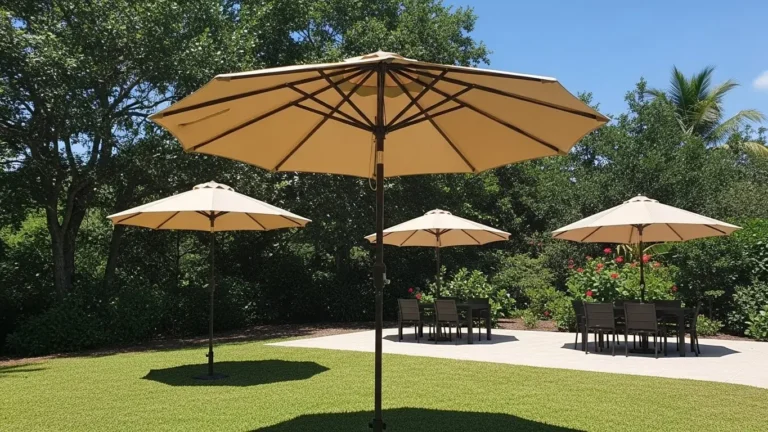



Commercial outdoor installations face wind forces that turn standard equipment into airfoils. Insufficient anchoring leads to the “Kite Effect,” where wind uplift and lateral pressure shift heavy furniture across rooftops or resort patios. To prevent detachment, industry standards require a 5,000-pound ultimate load capacity for anchors to handle dynamic forces and protect against swing falls.
We analyze the mechanics of the 10lbs-per-foot rule, which dictates that a 9-foot umbrella requires at least a 90-pound base for stability. This guide covers load factor calculations—applying a 1.2 multiplier for dead loads and 1.6 for live loads—while comparing the performance of concrete, sand, and steel plate foundations for long-term safety compliance.
The “Kite Effect”: Why Weight is Non-Negotiable
The ‘Kite Effect’ describes wind uplift and lateral forces that can lift or shift heavy equipment if anchoring is insufficient. Commercial standards require a 5,000-pound ultimate load capacity to prevent detachment, ensuring structures withstand dynamic loads and prevent swing falls in high-wind environments like rooftops and coastal resorts.
Mechanics of Wind Uplift and Lateral Force
Umbrella canopies act as airfoils, trapping wind to create upward lift similar to a kite. This aerodynamic behavior generates significant vertical force that can overcome the static weight of standard outdoor furniture. When air moves across the curved surface of the fabric, the resulting pressure differential pulls the structure upward, potentially leading to total detachment from the ground or roof surface.
Lateral forces convert wind speed into horizontal pressure that tests the friction and stability of non-penetrating bases. These forces often cause heavy equipment to shift or slide across a substrate before any vertical lift occurs. Swing fall risks increase when anchors exceed a 12-foot spacing from the leading edge or maintain an angle greater than 15 degrees. Modern engineering environments require mass that exceeds simple static calculations to counteract sudden gust spikes and dynamic loads.
Safety Standards and Minimum Load Capacity
Commercial safety standards mandate a 5,000-pound minimum strength rating for all roof and ground anchors. This rating represents the ultimate load capacity required to prevent structural deformation or fracture during extreme wind events. Industry professionals design energy-absorbing systems to manage an 1,800-pound typical maximum fall arrest force, applying a safety factor of two to maintain structural integrity under stress.
Substrate stability determines the overall safety of the installation. Concrete must meet a minimum compressive strength of 2,500 PSI, which typically requires the use of wedge anchors rated at 6,000 pounds each in a 4-inch cured slab. For installations on steel decking, a 20-gauge minimum thickness ensures the structure can distribute forces effectively across raised channels. Systems requiring a 2:1 safety margin often adhere to a 2,400-pound maximum certified load capacity to ensure long-term stability in high-wind coastal or rooftop environments.
Calculating Minimum Base Weight: The Formula
Determine the required mass by totaling dead and live loads while applying safety factors: 1.2 for structure weight and 1.6 for environmental forces. For steel plates, use the formula W = 7.85 × thickness (mm) to calculate kilograms per square meter, ensuring the base effectively counters wind-induced uplift and overturning.
| Material or Load Type | Calculation Formula / Density | Standard Reference |
|---|---|---|
| Mild Carbon Steel | 7850 kg/m³ | Industry Standard |
| Steel Plate (m²) | W = 7.85 × thickness (mm) | ASTM / Metric Weight |
| Structural Concrete | 25 kN/m³ | AS/NZS 1170 |
| Steel Rebar (m) | D² / 162 (kg/m) | Standard Bar Weight |
Structural Load Factors and Stability Requirements
Engineers calculate base stability by applying Load Factors under the Ultimate Limit State (ULS) framework. This process involves a 1.2 multiplier for dead loads—the self-weight of the structure—and a 1.6 multiplier for live loads as defined by ASCE 7-16 standards. For concrete installations, a unit weight of 25 kN/m³ serves as the baseline; a 0.25m thick slab results in a self-weight of 6.25 kN/m². We resolve these distributed loads into specific reactions to confirm the anchorage resists uplift and shear forces during high-wind scenarios.
Calculations must also account for superimposed dead loads, such as floor finishes or integrated mechanical, electrical, and plumbing (MEP) systems, typically estimated at 6 kN/m². Residential live loads add another 2 kN/m² to the stability threshold per ASCE 7-16 Table 4.3-1. These combined forces dictate the minimum mass required to achieve equilibrium without relying solely on mechanical ties.
Material Density and Mass Calculation Formulas
Accurate mass determination relies on specific material density values and geometric formulas. Mild carbon steel typically requires a density of 7850 kg/m³, though stainless steel variants may reach 7.93 g/cm³. To find the weight of a steel plate per square meter, multiply 7.85 by the plate thickness in millimeters. This provides the kilograms per square meter needed to size ballast plates for outdoor equipment or architectural features.
For linear reinforcements like rebar or round bars, the formula W = 0.00617 × d² or the simplified D²/162 kg/m yields the weight per meter. Square steel sections use W = 0.00785 × a², where “a” represents the side width in millimeters. We verify beam load distribution for large-scale bases by analyzing the total dead load across the span; for instance, a 12.25 kN/m² dead load distributed over a 2m span results in a reaction of 6.125 kN/m at the base supports.
Cantilever Physics: Counter-Balance Requirements
Cantilever systems maintain stability through torque equilibrium, where an extended backspan offsets the overhanging load. For optimal performance in 2026 installations, the counterbalance length should reach at least 50% of the opening width, ensuring the center of gravity remains securely behind the main support posts.
Torque Equilibrium and Weight Distribution Ratios
Moment equilibrium, defined by the physics formula ΣM = 0, dictates that the counterbalance force and length must effectively offset the cantilevered load. This mechanical balance prevents tipping and structural failure by keeping the system center of gravity behind the support posts at all times. Industry standards specify a minimum counterbalance length of 50% of the gate opening. A 20-foot opening requires a total gate structure of at least 30 feet, providing the necessary 10-foot counterbalance tail to maintain stability during operation.
Weight distribution within the gate frame relies on internal truss rigidity. To prevent sagging or twisting, vertical member spacing should never exceed the total height of the gate. For a gate standing 72 inches tall, the vertical supports must be placed 72 inches apart or less. Using 51mm x 51mm aluminum tubing for these members provides a lightweight yet rigid frame that reduces the overall load on the hanger brackets without sacrificing structural integrity.
Backspan Specifications and Structural Load Data
Ideal backspan ratios range between 100% and 150% of the cantilever span to minimize pivot load and prevent long-term gate sag. Shortening the backspan increases stress on the hardware exponentially. Data shows that reducing a backspan from 1000mm to 500mm triples the deflection to 52mm and increases the pivot load to 300kg. By extending the backspan to 2000mm, the pivot load drops to 150kg and total deflection decreases to 12mm, significantly extending the life of the rollers and support bearings.
Support posts must meet specific O.D. (outside diameter) requirements to resist the combined bending and tensile stresses of a cantilevered system. Standard installations for gates under 8 feet tall require 4-inch O.D. ASTM A1043 steel posts. Gates exceeding 10 feet in height require 6-5/8 inch O.D. schedule 40 steel supports. These robust posts, paired with 3/8-inch hot-dip galvanized steel hanger brackets, ensure the assembly withstands both the dead weight of the gate and external forces like wind pressure.
Scale Your Business with Factory-Direct Commercial Shade Solutions

Mobile Bases: Locking Wheels in Wind
Mobile bases utilize total-lock casters and diagonal braking patterns to secure outdoor equipment against wind-induced drift. Engineering standards for 2026 prioritize systems that lock both the wheel and the swivel mechanism, meeting OSHA requirements to support four times the intended load while passing ICWM fatigue and side-load tests.
Total-Lock Mechanisms and Pivot Prevention
Total-lock casters create a rigid foundation by simultaneously freezing wheel rotation and the swivel mechanism. Standard wheel locks often allow a base to pivot around the locked point when hit by lateral wind gusts, leading to structural instability. By immobilizing the swivel, total-lock systems transform a mobile base into a stationary platform that resists multi-directional forces.
Implementing a diagonal locking pattern provides the most effective defense against twisting. When operators engage total-lock casters on opposite corners of a rectangular base, they neutralize the equipment’s tendency to rotate around a single axis. This configuration ensures that any wind pressure distributes across the entire footprint rather than focusing on a single point of failure.
Wheel material also dictates how well a base handles wind-induced vibrations. Heavy-duty polyurethane and pneumatic wheels offer high-friction contact points that grip uneven surfaces better than hard plastic. These materials absorb energy from wind gusts, preventing the “skipping” effect that can occur when rigid wheels lose contact with the ground on textured outdoor surfaces.

Load Standards and Caster Testing Protocols
Safety protocols for wind-resistant mobile bases often mirror OSHA 1926.451 standards for scaffolds. These regulations require every component to support at least 400% of the maximum intended load without failure. This high safety margin accounts for the dynamic loading caused by wind, where a sudden gust can effectively double the downward or lateral force applied to the caster stems and locking pins.
The Institute of Caster and Wheel Manufacturers (ICWM) validates hardware through specific side-load and swivel lock efficiency tests. These assessments simulate the lateral pressure of wind against large equipment profiles. Hardware must withstand repeated stress cycles and vertical impacts to ensure the braking teeth or friction pads do not slip or shear when the environment becomes volatile.
For environments with extreme wind exposure, wheel chocks with extra-long footbeds provide a necessary secondary safety layer. These chocks leverage the weight of the equipment to apply continuous downward force against the floor. This mechanical advantage creates a high-friction anchor that prevents sliding even if the primary wheel brakes reach their holding limit, ensuring zero drift during commercial-grade wind events.
Permanent Solutions: In-Ground & Surface Mounts
Permanent mounting systems provide the highest level of stability by anchoring furniture directly into concrete or structural framing. These solutions utilize high-tensile materials like stainless steel to achieve breaking strengths of 5,000 lbs, ensuring compliance with 2026 safety codes while maximizing usable floor space in high-traffic commercial environments.
Structural Integration and Space Efficiency
Attaching equipment directly to 2×4 to 2×12 trusses or concrete slabs transfers dynamic wind loads into the building foundation. This structural integration removes bulky ballast weights, which eliminates trip hazards and increases total seating capacity in commercial zones. High-performance mounts incorporate injection-molded TPE flashing and self-sealing aluminum bodies to meet TAS-100 watertight standards. These engineering choices support a 4-to-1 safety factor, ensuring the installation remains secure under constant dynamic pressure.
Material Standards and Load Requirements
Technical specifications for permanent mounts require a minimum breaking strength of 5,000 lbs to comply with OSHA 1910.140 and ANSI Z359.18 safety standards. Fabricating these systems from 304/316 stainless steel or ASTM A123 hot-dip galvanized steel prevents corrosion during long-term outdoor exposure. Installers use Grade 8 bolts and 5/16-inch stainless steel lags to secure the hardware and prevent failure under extreme stress. These components maintain their mechanical properties in temperatures ranging from -30°F to 130°F.
Sand vs. Concrete vs. Steel Plate Bases
Concrete offers the highest permanence with 5,000 psi strength, while sand provides a cost-effective, adjustable 1-inch bedding layer for flexible paving. Steel plates deliver the highest weight-to-volume ratio, using 3×3 inch spreaders to stabilize heavy loads on loose or sandy soils without bulky footprints.
Comparative Stability and Material Performance
Sand bases function as flexible bedding layers, requiring 100-150 mm (4-6 in.) lifts of compacted aggregate to mitigate uneven settlement. These layers transmit subgrade irregularities unless the installer compacts the material with 7,000 lbf reversible plate compactors. Concrete bases deliver a rigid, high-strength solution, often reaching a 5,000 psi rating to withstand commercial contract environments. Steel plate bases, such as Beam Bolsters (BBP), utilize 3×3 inch spreaders to distribute weight effectively across loose subgrades and prevent sinking. For specialized load-bearing needs, blast furnace slag-derived sand (ABF206) provides superior capacity over standard bank-run gravel due to its angular particle shape.

Load-Bearing Specifications and ASTM Standards
Technical standards ensure the stability and safety of these base materials. Bedding sand must comply with ASTM C144 or CSA A179, maintaining a fineness modulus between 2.2 and 3.2 for optimal workability. Concrete mixes intended for permanent anchors should hold a slump value of 25-75 mm to balance structural integrity with flow characteristics. In high-traffic or vehicular zones, engineers specify 80 mm thick pavers over a 20 mm bitumen-sand setting bed containing particles smaller than 6 mm. Temporary steel plates or sand plates typically utilize heights of 5-6 inches to bridge gaps in uncompacted soil during heavy formwork operations.
Reducing Liability: The Importance of Anchoring
Anchoring reduces liability by preventing umbrella-related injuries and property damage through verified structural connections. In 2026, safety protocols require anchors to support 5,000 pounds per attachment point and undergo periodic load testing. Proper installation on certified substrates like 4-inch concrete ensures compliance with modern safety factors.
| Requirement Category | Technical Specification | Compliance Interval |
|---|---|---|
| Fall Arrest Support | 5,000 lbs (22.2 kN) | Per Attachment Point |
| Adhesive Anchor Testing | Hydraulic Load Test | Every 5 Years |
| Mechanical Anchor Testing | Professional Certification | Every 10 Years |
| Structural Substrate | 4″ Concrete / 20-Gauge Steel | At Installation |
Safety Standards and Fall Protection Load Requirements
Liability protection relies on strict adherence to load-bearing specifications. Anchors must support at least 5,000 pounds per employee to prevent structural failure during a fall event. By maintaining a safety factor of two, the system guarantees that it can withstand forces far beyond the expected maximum arrest force of 3,600 pounds. Professional engineers must certify these values to create a valid documentation trail for insurance and safety audits.
Different applications demand specific resistance thresholds. Fall restraint systems must meet a 1,000-pound limit, while work positioning requires 3,000 pounds of resistance. Utilizing the highest standard across all attachment points minimizes the risk of human error during setup and ensures the facility remains prepared for any commercial application.
Testing Schedules and Structural Substrate Compliance
Regular maintenance identifies hidden weaknesses in the mounting hardware. Adhesive and expansion anchors require hydraulic testing every five years to account for environmental wear or chemical degradation that might not be visible to the naked eye. Standard mechanical systems undergo similar professional load testing every ten years to maintain their certification status.
Success depends heavily on the quality of the mounting surface. Installers must verify a concrete thickness of at least 4 inches or use 20-gauge steel for metal decks to ensure the substrate can handle the tension. Spacing anchors between 6 and 10 feet apart distributes loads effectively and prevents excessive stress on the building’s structural components. Systems must resist 2,500 pounds during assessments without showing permanent deflection to pass certification.

Bolt-Down Patterns for Decks
Decking relies on specific fastening patterns like the 36-4 configuration for 1.5-inch composite metal panels. Professionals use 3/4-inch arc spot welds or self-drilling carbon-steel screws spaced at 12-inch perimeter intervals to ensure code compliance and lateral stability, maintaining a minimum 2-inch end bearing for consistent load transfer.
Standard Attachment Patterns and Load Path Continuity
Structural integrity for metal decking begins with the 36-4 attachment pattern, designed specifically for 1.5-inch composite metal and B-Decks. This configuration utilizes four support fasteners across a standard 36-inch panel width, securing every other rib to the underlying structure. These patterns create a rigid diaphragm capable of resisting lateral forces and ensuring the deck remains anchored during seismic or high-wind events.
A continuous load path must extend from the ledger board through the joists and down to the post base to meet IBC 2026 standards. This vertical and lateral resistance prevents structural failure by transferring loads directly into the foundation. To support these requirements in commercial environments, builders select galvanized steel sheets with a minimum yield strength of 33,000 psi and 20-gauge thickness. These materials resist corrosion while providing the tensile strength necessary for heavy-duty load requirements.
Technical Specs for Perimeter Fastening and Welding
Perimeter edges require more frequent fastening than the interior of the panel to counteract uplift. Installers place perimeter fasteners at a maximum of 12 inches on center. When spans exceed 5 feet, the addition of side-lap ties at mid-span or 36-inch intervals becomes mandatory to prevent the panels from separating or buckling under load. This spacing ensures the deck acts as a single, unified surface rather than individual shifting sheets.
Proper load transfer also depends on the physical contact area between the deck and its supports. Minimum end bearings must reach 2 inches over standard supports, while end laps at open-web steel joists require a 3-inch minimum. For securing 16-22 gauge decks, 3/4-inch diameter arc spot welds provide the highest shear resistance. In cases where welding is not feasible, self-drilling carbon-steel screws with hexagonal washer heads or power-actuated fasteners offer a reliable alternative for rapid installation without sacrificing structural code compliance.
Final Thoughts
Choosing the right anchoring system prevents equipment from becoming hazardous in high winds. The 10-pounds-per-foot rule offers a reliable baseline for daily operations, but professional-grade installations require attention to specific load factors and substrate integrity. Matching the mass to the canopy’s surface area ensures the structure remains stable during sudden gusts and prevents the dangerous uplift associated with the “kite effect.”
Proper anchoring reduces liability and protects property from damage. Adhering to the 5,000-pound load standard and maintaining a regular inspection schedule creates a safe environment for commercial and residential spaces. Investing in verified hardware and precise bolt-down patterns keeps outdoor areas functional and secure through every season.
Frequently Asked Questions
What is the recommended base weight for a wind-resistant patio umbrella?
Professional standards for 2026 dictate a minimum of 10 pounds of base weight per foot of umbrella diameter. A 9-foot umbrella requires at least 90 pounds, while an 11-foot model needs 110 pounds. For freestanding setups in exposed areas, adding 20% to 50% more weight provides necessary stability against sudden gusts.
At what wind speed must I close a commercial umbrella?
Standard patio umbrellas require closure when wind speeds reach 15 to 20 mph. High-quality models built with flexible fiberglass ribs can withstand 20 to 24 mph, but users should retract all canopies once sustained winds hit these thresholds to prevent structural failure or tipping.
Which material is most effective for filling weighted umbrella bases?
Sand is superior to water because it offers higher density and greater total mass within the same footprint. While water provides convenience, sand remains stable and does not leak or evaporate, ensuring the base maintains its rated weight over long-term outdoor exposure.
Is it possible to bolt a cantilever umbrella directly to a wooden deck?
You can secure cantilever umbrellas to decks using 8×8-inch or 14×14-inch steel or aluminum base plates. For safety, installers must align the bolts with the underlying support joists rather than just the deck boards to ensure the structure can handle the significant leverage exerted by the offset canopy.
Why are fiberglass ribs preferred for high-wind environments?
Fiberglass ribs possess a high strength-to-weight ratio and natural elasticity, allowing them to bend and absorb wind energy without snapping. This flexibility prevents the frame from breaking during unpredictable 2026 weather patterns compared to rigid steel or wood alternatives.