


The factory price of a commercial umbrella base is only part of the story. Once you ship a heavy, pre-filled unit overseas, its real cost emerges in freight bills and import duties. For dense products like concrete or steel bases, shipping can account for 20–50% of the total landed cost, turning an apparent bargain into a significant logistical expense.
This article provides a clear cost analysis for sourcing commercial umbrella anchors. We’ll compare the landed cost of importing finished units against the price of buying locally. We also cover hybrid strategies, such as shipping empty shells for on-site filling, which can reduce the final cost by up to 30% by eliminating dead weight from your freight.
Why Freight Costs Are the #1 Problem with Imported Bases
Importing filled umbrella bases is expensive because ocean freight charges are based on weight or volume. Heavy ballast like concrete maxes out a container’s weight limit, meaning you pay a full price to ship low-value material. This also inflates the customs value, increasing import taxes and the total landed cost.
The Weight-Versus-Value Problem in Ocean Freight
Ocean freight carriers price shipments based on weight or volume (W/M), charging for whichever measurement is greater. This pricing model makes shipping dense, heavy products disproportionately expensive. Filled umbrella bases, which can contain 30–90 kg of ballast, quickly reach a shipping container’s payload limit of around 28,000 kg. As a result, the container maxes out on weight long before its cubic volume is filled.
This inefficiency means you pay full container rates primarily to transport low-value ballast like concrete—a material that is cheap and readily available at the destination. For these heavy goods, freight can easily account for 20–50% of the total landed cost. This is a sharp contrast to lighter, higher-value products, where freight typically represents only 5–10% of the cost.
How Freight Inflates Import Duties and Total Landed Cost
High freight costs do more than just add to shipping bills; they also increase taxes. Import duties, which have historically been 20–30% for umbrella parts in markets like the United States, are calculated on the CIF value (Cost, Insurance, and Freight). Because the freight cost is part of this calculation, shipping heavy bases directly inflates the dutiable value, increasing the total tax paid per unit.
A more cost-effective approach is to ship empty components, such as hollow HDPE shells or nestable Q235 steel plates. This strategy minimizes shipment weight, which in turn lowers freight costs and the dutiable value. It effectively shifts costs away from international freight and taxes toward local assembly and filling. By sourcing ballast locally, you can significantly reduce the final landed cost of each umbrella base.
The Real Cost of an Imported Umbrella Base
The real cost of an imported commercial umbrella base is not just its purchase price, which ranges from about $51 to over $785. The final cost is heavily influenced by shipping expenses, especially for heavier models (70-150 lbs) that require pallet freight, which can often exceed the product’s value on smaller orders.
Price Factors: Material, Weight, and Features
The initial product cost depends on its material and weight. Entry-level 50 lb steel bases provide basic stability and start around $51 to $125. Mid-range options, like 80-84 lb cement-filled resin or cast iron bases, are usually priced between $134 and $187. Premium bases made from 95-150 lb galvanized steel or aluminum can cost from $599 to $785, often including features like wheels and protective powder coating.
Logistics: How Shipping Defines the Final Cost
Shipping significantly inflates the final price for heavy commercial products. Any base weighing more than 70 pounds usually requires palletized freight shipping. For small orders, this freight cost can be higher than the price of the base itself. To manage this, manufacturers supplying bulk B2B orders often use stackable, low-profile galvanized steel bases between 70 and 100 lbs. This design maximizes container space and lowers the per-unit shipping expense, making logistics a primary hidden cost in the total landed price.

When Importing Makes Sense (Despite the Freight)
Importing commercial umbrella bases makes sense when you ship lightweight, engineered shells or stackable plates instead of heavy, pre-filled units. This strategy avoids high freight costs on low-value ballast like concrete or sand, allowing you to fill the base locally to meet the required 75–150 lb weight target.
Shipping Shells, Not Ballast
The most effective import strategy focuses on shipping the engineered components while leaving the heavy ballast behind. Suppliers offer empty umbrella base shells made from materials like powder-coated aluminum or polyethylene, which often weigh less than 15–25 pounds each. These shells are designed to be filled on-site with locally sourced, inexpensive materials like sand, gravel, or concrete. Another approach involves modular systems with stackable steel or aluminum plates. Both methods allow for dense packing within a shipping container, maximizing the number of units per shipment and dramatically cutting freight costs.
Meeting Weight and Fit Specifications Locally
Once the lightweight system arrives, it must be prepared to meet two critical specifications. First, the base needs enough mass for stability. A common rule for commercial settings is a minimum of 10 pounds of base weight for every foot of the canopy’s diameter, resulting in a final weight between 75 and 150 pounds. Second, the base’s sleeve must correctly fit the umbrella pole, which typically measures between 1.5 and 2.5 inches in diameter. This approach separates the logistics: you import the high-value engineered shell or plate system and source the low-value commodity ballast at the destination.
Get Factory-Direct Pricing on Custom, Commercial-Grade Patio Umbrellas

When Buying Bases Locally is the Smarter Financial Move
For heavy umbrella bases weighing 50 lbs or more, buying locally is often more cost-effective than importing. The high cost of shipping dense materials like cast iron or concrete can easily exceed any factory-direct price advantage, making local retail a smarter financial choice for anchoring.
The Impact of Freight Costs on Heavy Items
Patio umbrella bases are dense products where shipping expenses are dictated by weight, not volume. Unlike umbrellas that can be packed efficiently, bases made of cast iron, steel, or resin are subject to significant freight charges that are frequently quoted separately from the main product order.
Logistics for these heavy goods often add $10 to $20 per unit or require full commercial freight quotes. This added expense can quickly erode any savings from factory-direct pricing, making international sourcing a poor financial choice for heavy components.
Analyzing the Break-Even Point for Local Sourcing
The financial logic typically favors local sourcing for bases weighing more than 50 lbs. A standard 50 lb cast iron base from a local retailer might cost around $51.65, which is often less than the total landed cost of a comparable imported unit once shipping is included.
For commercial needs requiring 80 lb to 220 lb bases, local fillable designs offer a practical alternative. These models are filled with sand or water on-site, providing the necessary stability without the high cost of shipping that dead weight internationally.

A Head-to-Head Comparison: Landed Cost vs. Local Price
Importing patio umbrella bases often results in a higher landed cost due to significant freight charges on heavy materials like concrete and granite, plus import duties. Local fabrication avoids these costs, especially for heavy bases, while hybrid models—importing raw steel or empty shells for local assembly—offer a balanced approach.
| Cost Factor | Imported Bases (Landed Cost) | Local / Hybrid Fabrication |
|---|---|---|
| Freight & Logistics | High due to shipping penalties on dense, heavy materials (>80 lbs) like pre-filled concrete or solid granite. | Minimal to none. Avoids all international freight and significantly reduces domestic transport costs. |
| Import Duties & Tariffs | Applied to the full value of the finished product, typically adding 5-10% for steel or concrete goods. | Eliminated on the finished base. Tariffs may apply only to imported raw materials, which have a lower base cost. |
| Container Optimization | Inefficient and costly for pre-filled bases. Heavy cantilever bases (220-350 lbs) quickly reach container weight limits. | Highly efficient. Shipping empty shells for on-site filling can cut total landed cost by 15-30% by maximizing container payload. |
| Material Cost Strategy | Includes overseas labor, overhead, and material costs for a finished product. | Allows importing cost-effective raw materials (e.g., Q235 carbon steel), cutting material costs by 20-40% before local assembly. |
Key Cost Drivers for Imported Bases
The final landed cost of an imported patio umbrella base is heavily influenced by its weight and density. Shipping carriers often apply penalties to dense materials like solid granite or pre-filled concrete bases, which can weigh 80 lbs or more. These costs escalate for cantilever umbrella bases that require 220-350 lbs of ballast, making it difficult to optimize container space and driving up per-unit freight expenses. On top of logistics, import duties typically add another 5-10% to the cost of finished steel or concrete products from overseas, making fully assembled, heavy bases an expensive option to import.
The Economic Case for Local Fabrication and Hybrid Sourcing
Local fabrication directly counters the high shipping costs and tariffs associated with imports, making it an ideal strategy for heavy concrete bases, especially those needed for high-wind environments. A hybrid sourcing model offers a strategic balance. Companies can import cost-effective raw materials, such as Q235 carbon steel, to reduce material expenses by 20-40% before performing final assembly locally. Another effective hybrid approach involves importing empty plastic shells. These lightweight shells maximize container payload and can be filled with sand or water on-site, a method that can lower the total landed cost by 15-30% compared to shipping pre-filled units.
Beyond the Basics: Advanced Solutions for Veterans
Advanced umbrella bases for commercial use move beyond simple weight, utilizing modular, fillable, and stackable designs. These systems often use HDPE shells filled with sand or water to reach 120-220 lbs, or stackable steel plates, ensuring superior stability in high-wind conditions while optimizing shipping and handling.
| Component | Technical Specification | Operational Benefit |
|---|---|---|
| Weight System | Fillable HDPE shells (sand/water) or stackable steel plates | Adjustable ballast (120–220 lbs) for wind resistance and efficient shipping |
| Pole Mount | 20-inch stainless steel stem with dual tightening knobs | Secures 1.5–2.5 inch poles, preventing wobble and rotation |
| Mobility | Integrated locking casters and ergonomic handles | Easy repositioning of heavy bases without compromising stability |
Modular and Fillable Base Engineering
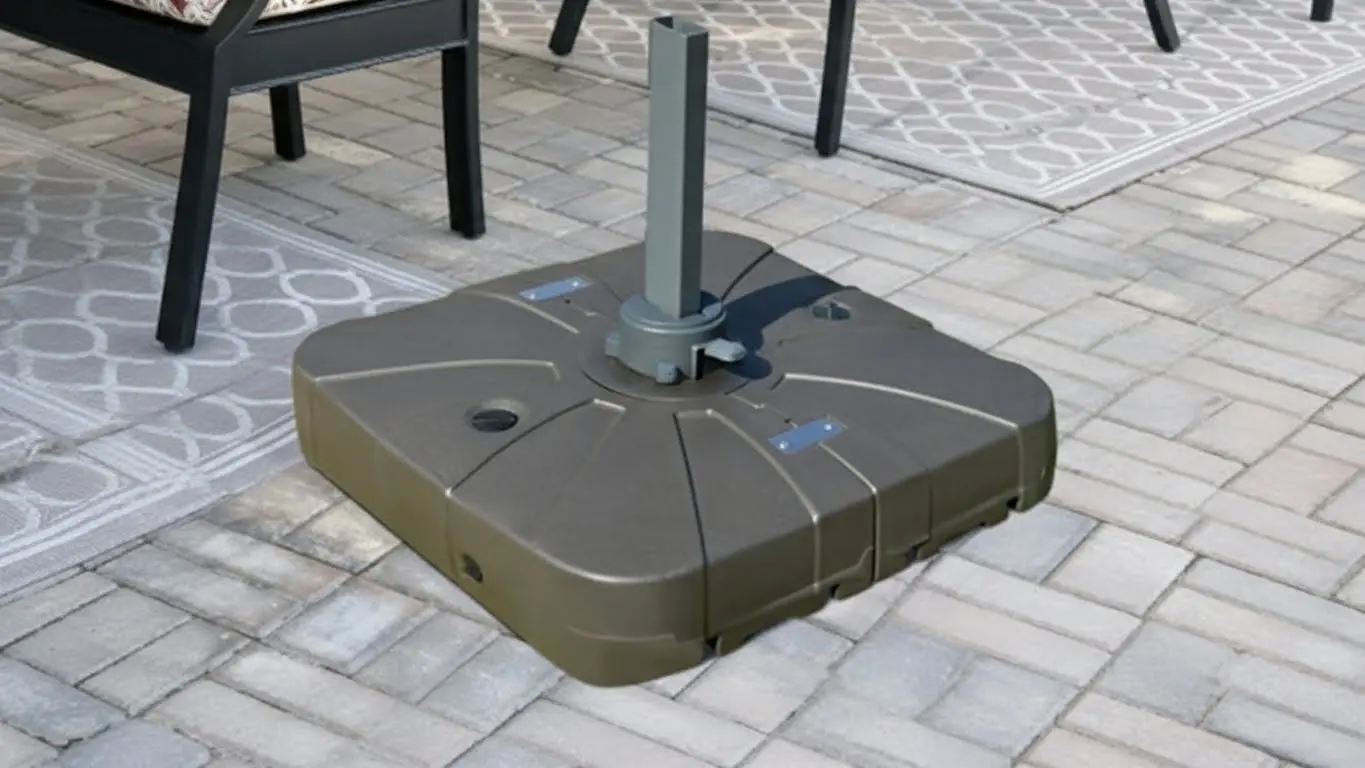
Commercial-grade umbrella bases are engineered for adaptability and superior stability, moving past simple static weights. Many advanced systems use High-Density Polyethylene (HDPE) shells designed to be filled on-site with sand or water. This approach allows users to adjust the ballast from 120 lbs up to 220 lbs, providing the necessary mass to anchor large canopies in windy conditions. The ability to ship the shells empty significantly reduces transportation costs and logistical challenges.
Other designs use stackable steel plates or modular add-on weights. This lets operators incrementally increase stability as needed, scaling the base’s weight to match environmental demands. These systems provide a significant upgrade over typical setups, starting at a minimum of 75 lbs for freestanding commercial use, whereas table-mounted residential umbrellas might only require 30 to 50 lbs.
Material Specifications and Mobility Features
High-performance bases are built with materials chosen for durability and weather resistance. Common options include cast iron, galvanized steel, and UV-protected HDPE. These materials are often finished with a powder coating to provide an extra layer of protection against corrosion and environmental wear. The engineering also focuses on a secure connection to the umbrella pole, accommodating standard diameters from 1.5 to 2.5 inches. To prevent instability, these bases feature extended 20-inch stainless steel stems and dual tightening knobs that lock the pole firmly in place.
Functionality is just as important as stability. Many heavy-duty bases include integrated mobility features to simplify repositioning. Locking casters and built-in handles allow a single person to move a heavy base across a patio or deck without needing to lift it, ensuring both operational flexibility and safety.
Decision Framework: Which Strategy is Right for You?
Choosing the right base depends on your umbrella type and size. Standard center-pole umbrellas follow a 10-lbs-per-foot-of-canopy rule, needing about 90 lbs for a 9-ft canopy. Offset cantilever umbrellas require much heavier bases, often 150-200+ lbs, or direct anchoring to counteract tipping forces.
Assess Your Umbrella Type: Center-Pole vs. Cantilever
The structural design of your umbrella is the primary factor that dictates its anchoring needs. Center-pole, or market, umbrellas channel wind loads directly down the pole, which allows for lighter bases in protected environments. Cantilever umbrellas feature an off-center design that creates a significant tipping moment. This requires much heavier bases, typically 150 to over 200 pounds, or permanent anchoring to remain stable. In commercial settings with high traffic or wind exposure, you should double or even triple the standard base weight to ensure public safety.
Calculate Weight and Select a Mounting System
For center-pole umbrellas, a reliable baseline is the 10-pounds-per-foot rule: provide 10 pounds of base weight for every foot of canopy diameter. An 11-foot umbrella, for example, calls for a 110-pound base. Once you know the required weight, match the mounting system to the surface. Freestanding bases provide flexibility, while in-ground anchors and deck mounts offer permanent stability on soft or hard surfaces. It is also critical to ensure a proper fit; the base’s tube diameter should be no more than 1/4 inch larger than your umbrella pole (usually 1.5–2.5 inches) to prevent wobbling and reduce structural stress.
Frequently Asked Questions
Shipping concrete bases from China is too expensive. What do you suggest?
For very heavy, pre-filled concrete or stone bases, ocean freight and import duties usually wipe out most of the factory-direct savings because you are paying container rates on low-value “dead weight” instead of high-value engineered components.
A more efficient strategy is to import only lighter parts like empty shells or steel frames and then fill them locally with sand, gravel, or concrete to reach the target weight.
In many projects, the best option is to source the ballast itself—or even the entire base—from local suppliers, while reserving imports for the umbrellas and hardware that have a much higher value-to-weight ratio.
How heavy should the base be for a 10ft umbrella?
A simple rule of thumb for commercial center-pole market umbrellas is about 10 lb of base weight per foot of canopy diameter under normal conditions.
For a 10 ft umbrella, that points to roughly a 100 lb base as a starting point, with additional weight recommended for exposed rooftops, coastal decks, or busy circulation areas where wind and guest contact are more frequent.
If you are dealing with an offset cantilever rather than a center pole, plan on a significantly heavier base or a permanent mount, because the side-arm design creates much greater tipping leverage than a traditional straight pole.
Do you offer permanent mounting options for windy resorts?
Yes, for high-wind resorts and oceanfront properties, permanent or semi-permanent mounting is often the safest and most cost-effective solution over the life of the project.
Typical systems include in-ground anchors set in concrete, surface-mount base plates bolted to structural slabs, and custom flanges engineered to match your deck or pool surround.
These options eliminate loose, trip-prone bases in crowded walkways and provide a higher safety margin than simply stacking more weight on a portable base in extreme wind zones.
Will your steel bases rust and stain my patio deck?
Our commercial steel bases are built from galvanized or otherwise corrosion-protected steel and finished with exterior-grade powder coating to resist rust in typical outdoor hospitality environments.
On very wet or coastal sites, any exposed metal edge can eventually oxidize, which is why better bases add details like sealed welds, drainage paths, and non-marking feet or pads that keep the metal off porous stone and wood.
With the right materials, finishing, and occasional cleaning, you dramatically reduce the risk of rust bleed or orange “tea stains” on your patio deck compared with generic, uncoated steel plate bases.
Final Thoughts
Deciding whether to import umbrella bases or buy them locally comes down to a simple question: are you paying to ship heavy ballast? If the answer is yes, local sourcing for pre-filled bases over 50 lbs is almost always more cost-effective. High freight costs and import duties on dense materials like concrete or cast iron can quickly erase any factory-direct savings. The smarter import strategy is to ship only the high-value, engineered components—like hollow HDPE shells or stackable steel plates—and fill them with inexpensive, locally sourced ballast upon arrival. This approach separates the logistics of specialized parts from the commodity weight.
Ultimately, the logistics of an umbrella base are not just a shipping detail; they are a central part of the product’s cost structure. A successful sourcing strategy focuses on minimizing the transport of low-value, heavy materials across long distances. By breaking down the base into its core components—the engineered shell and the simple ballast—you can make smarter financial decisions. Calculating the total landed cost, rather than just the factory price, will show that for heavy anchoring, the most efficient supply chain often ends at a local supplier or with a hybrid model you assemble yourself.




 English
  Spanish
  French
  German
  Portuguese