


Hospitality infrastructure often fails because materials aren’t matched to their specific environmental stressors. A standard stainless steel frame might work for a city sidewalk, but it can suffer from stress corrosion cracking in indoor pool zones at temperatures as low as 30°C. For project managers and architects, selecting the right specifications is a matter of long-term safety and protecting the bottom line.
This guide examines the technical requirements for different commercial applications, including beach clubs that must withstand 100 mph wind speeds and fine dining terraces engineered for 4.0 kN/m² live loads. We review structural standards like EN 15372:2008 for stability and 2026 material benchmarks to help you align equipment choices with site-specific demands.
Poolside: Corrosion Resistance is King
Poolside environments demand materials that resist stress corrosion cracking (SCC) and pitting caused by chlorinated humid air. While 304-grade steel suffices for general use, pool zones require 316L, high-alloy austenitic grades like 1.4529, or fiberglass (FRP) to handle low LSI water and high chloride levels.
Chlorine and Stress Corrosion Cracking Risks
Chlorinated humid air acts as a primary catalyst for stress corrosion cracking (SCC), specifically in indoor or enclosed pool environments. Metallurgical data confirms that field failures in 1.4301 (304) and 1.4401 (316) stainless steel components occur at temperatures as low as 30°C. This finding contradicts historical assumptions that SCC risks only emerge above 55°C, making standard grades unsuitable for safety-critical overhead structures.
Aggressive water chemistry further accelerates material degradation. When the Langelier Saturation Index (LSI) drops to -0.31 or lower, the water prevents the formation of protective calcium films on metal surfaces. Safety-critical components exposed to pool vapors face the highest risk profile, which necessitates the complete avoidance of galvanized metals in any splash or high-moisture zone.
Material Standards for 2026 Hospitality Specs
2026 project specifications require high-alloy austenitic stainless steels, such as 1.4529 (20% Cr, 25% Ni, 6% Mo), for structural fasteners and over-pool shade frames. For non-structural deck hardware, designers utilize 316L molybdenum-bearing stainless steel to provide superior pitting resistance compared to standard architectural grades. These alloys maintain structural integrity despite constant exposure to chloride-laden air.
Non-metallic solutions like pultruded fiberglass (FRP) offer total immunity to chlorinated water and industrial cleaning agents for stair treads and poolside grating. Engineers also adhere to 2018 IRC E4202.2 standards by replacing aluminum conduits with brass or approved corrosion-resistant alloys. Finally, maintaining sulfate concentrations below 300 ppm in maintenance protocols reduces the rate of metal oxidation and prevents chemical attacks on cementitious foundations.
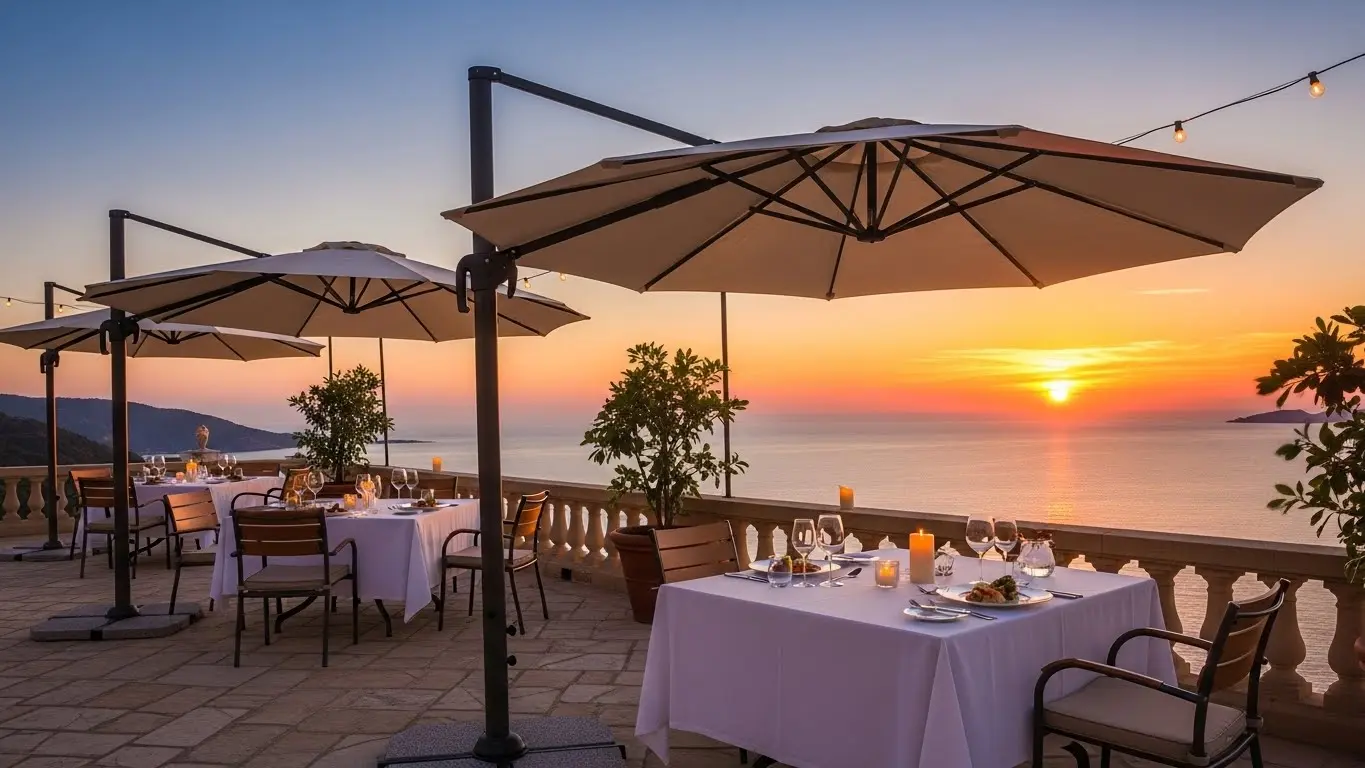
Fine Dining: Cantilevers for Unobstructed Views
Fine dining establishments utilize cantilevered structures to eliminate central poles, providing 100% unobstructed views for guests. These systems rely on high-grade materials like S355 structural steel or AISI 316L stainless steel and meet EN 1991-1-1 standards to handle live loads of 4.0 kN/m² while maintaining strict deflection limits for safety and comfort in 2026.
| Parameter | Standard/Material | Technical Specification |
|---|---|---|
| Terrace Live Load | EN 1991-1-1 Table 6.2 | 4.0 kN/m² (≈ 83 psf) |
| Structural Steel | EN 10025 / ASTM A572 | S355 / Grade 50 |
| Deflection Limit | EN 1990 Serviceability | L/180 to L/240 |
| Corrosion Protection | ISO 1461 / ISO 12944 | 70–100 μm Zinc (C3–C5) |
| Balustrade Line Load | EN 1991-1-1 Table 6.12 | 0.74–1.5 kN/m |
Spatial Efficiency and Guest Experience Design
Cantilevered umbrellas and pergolas remove vertical obstructions from the table layout, enabling flexible seating configurations that maximize floor area. Side-post engineering creates a visual “infinity” effect, which is a critical requirement for high-revenue coastal or rooftop terraces where the panorama is the primary product. Removing central posts simplifies staff movement and service trolley navigation, lowering collision risks in high-traffic fine dining paths. Clean architectural lines achieved through these structures align with 2026 minimalist design trends in the luxury hospitality sector.
Structural Engineering and Material Resilience
Load-bearing components utilize S355 or ASTM A572 Grade 50 steel to maintain stability over cantilever spans reaching 3.0 to 3.5 meters. Engineers apply deflection limits of L/180 to L/240 under service live loads to prevent glassware vibration and guest discomfort. For corrosion protection, hot-dip galvanizing per ISO 1461 with zinc thicknesses of 70–100 μm ensures the structure withstands C3 urban or C4/C5 coastal environments. In marine settings, fasteners and rail supports require AISI 316/316L stainless steel to prevent pitting and tea-staining from constant salt spray exposure.
Integrating glass balustrades into the cantilevered frame requires the edge beams to support line loads of 0.74–1.5 kN/m at 1.1 meters height, following EN 1991-1-1 specifications. Floor vibration for dining spaces is verified using ISO 10137 methods, targeting peak accelerations below 0.5–1.0% g for occupant comfort. Proper drainage for these terraces involves minimum gradients of 1–2% away from the building, as detailed in DIN-based flat roof terrace standards, to prevent water pooling on high-end timber or composite decking.
Cafes & Bistros: Through-Table Stability
Commercial stability relies on compliance with the EN 15372:2008 standard, which tests for vertical force and horizontal fatigue. Effective designs utilize wide base splays between 705 mm and 865 mm, alongside self-leveling technologies like FLAT® or Rockless bases, to ensure safety on uneven terrace surfaces.
| Model/System | Physical Specifications | Stability Mechanism |
|---|---|---|
| Ali ALI650DL | 705 mm splay, 10.2 kg weight | EN 15372:2008 Compliant |
| Ali ALI850S | 865 mm splay, 17.4 kg weight | Low Center of Gravity |
| Rockless Base | 22-inch leg span, 40.25 in height | Self-leveling Dual Joints |
| FLAT® Technology | Varies by base model | Hydraulic Auto-adjustment |
Engineering Compliance for High-Traffic Environments
Manufacturers align bistro table designs with EN 15372:2008 standards to ensure they withstand the rigors of commercial use. This performance benchmark requires frames to pass specific tests for vertical impact and horizontal static loads, preventing structural failure when diners apply weight to the table surface. Engineering teams focus on eliminating shear or squeeze points and ensuring that load-bearing parts do not loosen during frequent operation.
Maintaining structural integrity in crowded cafe layouts requires a focus on vertical static loads. These tests confirm that the table remains upright even if a customer leans heavily on the edge of the top. By adhering to these engineering requirements, designers create furniture that avoids the tipping risks common with lightweight or poorly balanced residential alternatives.

Self-Leveling Mechanisms and Dimensional Precision
Self-leveling systems like FLAT® technology use hydraulic components to automatically adjust and lock table bases on irregular pavement. This technology allows staff to align multiple tables for a seamless dining surface without using manual adjustment glides or shims. Rockless bases provide a similar benefit through specialized joints and 22-inch leg spans, stabilizing tops as large as 33 x 72 inches on rugged outdoor terraces.
Dimensional precision plays a critical role in achieving a low center of gravity. Heavy-duty models such as the ALI850S utilize a 17.4 kg weight and a wide 865 mm base splay to provide maximum stability for 750 mm high tables. Matching the base splay to the top diameter ensures that the center of mass stays within the support footprint, reducing the physics-related risks caused by wind or uneven floor surfaces.
Premium Commercial Umbrellas Direct from the Manufacturer

Beach Clubs: Wind Resistance and Sand Anchors
Beach clubs operate in Exposure D zones, requiring furniture and structures to withstand 100 mph wind speeds. Technical standards like ASCE 7 and SPRI RE-2 guide the use of ballasted anchors and reinforced fasteners, ensuring umbrellas and decks resist uplift pressures of up to 150 lb/sq ft.
Coastal Exposure Zones and Safety Factors
Exposure D classifications apply to flat, unobstructed coastal environments extending 660 feet inland from the shoreline. Regional building codes mandate that seaward structures resist a minimum 100 mph basic wind speed to protect against tropical storm events. Engineers apply a safety factor of 2.0 to the building envelope, while exterior equipment anchorage necessitates a 3.0 factor to maintain stability. Designers also account for wind speeds reaching 95 mph for structures located further inland but still within coastal boundaries where surface roughness remains low.
Technical Anchoring and Uplift Pressure Standards
Commercial umbrellas for the 2026 resort season utilize ASCE 7 stability protocols to reach a benchmark 50 mph wind rating. To prevent displacement during sudden gusts, ballasted edge devices require a minimum load resistance of 100 lbs/ft. Testing standards like SPRI RE-2 and RE-3 validate that edge flashings and copings can resist design pressures reaching 150 lb/sq ft in high-velocity zones. Perimeter and corner zones require double the fastening density because wind uplift loads often reach 1.5 times the levels found in central areas. For Exposure C sites at a 60-foot height, equipment must maintain at least 25 psf resistance to withstand 90 mph wind speeds.
Rooftop Bars: Extreme Wind Engineering
Rooftop installations face amplified wind loads, including vertical uplift and horizontal shear, particularly in coastal Exposure Category D zones. Engineering for these environments requires adherence to ASCE 7 standards and ASTM testing protocols to ensure stability at wind speeds ranging from 100 mph to over 160 mph.
Aerodynamic Loads and Uplift Resistance
ASCE 7 standards classify rooftops as high-risk zones due to vertical uplift and horizontal shear forces that ground-level sites rarely encounter. These aerodynamic forces act differently at elevation, requiring structural calculations that account for both the upward suction on canopies and the lateral pressure on vertical supports.
Wind pressures amplify significantly at roof corners and edges, necessitating tighter anchorage spacing and reinforced frame joints. Engineers designate these areas as high-pressure zones where turbulence creates localized vortices, often requiring specialized hardware to prevent mechanical fastener fatigue.
Risk Category D designations apply to coastal or large water-facing rooftops where unblocked wind speeds trigger high-wind provisions. Without the friction provided by surrounding buildings or terrain, wind maintains its full velocity, striking rooftop furniture and shade systems with maximum kinetic energy.
Continuous load paths prevent progressive failure by transferring wind force from the canopy through the mast to the weighted or bolted base. Maintaining this path ensures that every component, from the fabric attachment to the structural substrate, contributes to the overall stability of the system during a storm event.
Testing Protocols and Safety Factors
ASTM E330 and E1592 testing validates structural performance under uniform static air pressure for frames and panels. These protocols simulate the sustained pressure differentials that rooftop structures must withstand, ensuring the materials do not deform or fail under extreme loads.
Impact and cyclic pressure testing per ASTM E1886 and E1996 ensures equipment survives hurricane-level gusts up to 160 mph. This testing involves launching debris at the components and applying thousands of pressure cycles to mimic the fluctuating nature of a severe windstorm.
SPRI ES-1 protocols define termination forces for edge systems, requiring resistance up to 150 lb/sq ft in high-exposure areas. These standards specifically address the perimeter of the roof, where wind is most likely to catch the underside of a fixture and initiate an uplift failure.
Engineers apply a minimum safety factor of 2.0 for all anchorage systems, increasing to 3.0 for critical hospitality infrastructure. This margin of safety accounts for unpredictable weather extremes and ensures that the structure remains secure even if localized wind speeds exceed historical averages.
Double fastening at structural corners mitigates peak loads identified in site-specific wind maps. By reinforcing these high-vulnerability points, designers create a more resilient installation that can withstand the complex turbulence patterns found on high-rise terraces.
Branding Needs: Valance Printing for Chains
Valance printing allows hospitality chains to maintain visual consistency across locations using durable 600D polyester and full-color dye sublimation. Standard heights of 13.8 to 16 inches provide optimal brand real estate without increasing wind load, while specialized 135gsm fabrics offer light transmittance for enhanced visibility in diverse lighting conditions.
Consistency and Scalable Branding for Franchises
Standardized valance heights of 13.8 to 16 inches ensure uniform logo placement across 10-foot canopy frames in global chain networks. This uniformity allows multi-location hospitality brands to maintain a professional image across different geographic regions. Dye sublimation printing supports edge-to-edge graphics and precise Pantone matching, which is vital for coffee shop awnings and restaurant terraces where brand color accuracy is a priority.
Interchangeable valance banners allow chains to rotate seasonal marketing messages or localized promotions without making structural canopy changes. These banners attach easily to existing frames, providing a cost-effective way to update branding. By using standardized dimensions, management can ensure that promotional materials produced for one site remain compatible with the infrastructure at all other franchise locations.
Material Performance and Technical Standards
600 Denier PU-coated polyester provides a waterproof and fireproof baseline for 2026 commercial outdoor environments. This material is chosen for its weight-to-strength ratio, weighing approximately 0.77 lbs for a standard 10′ x 1′ banner. For premium applications, specialized 135gsm woven polyester, such as Avery Dennison MPI 5344, offers 38% light transmittance. This feature allows for backlit visibility, making the brand stand out in low-light settings while maintaining wrinkle resistance and a translucent matte finish.
Technical reliability depends on materials that meet established industrial benchmarks. Fabrics undergo ISO 534 testing for basis weight and ASTM D1907 for yarn consistency to ensure long-term dimensional stability. These standards confirm that the valance will resist shrinking or stretching when exposed to temperatures ranging from 10°C to +60°C. By adhering to these specifications, chains ensure that their outdoor branding remains taut and legible despite heavy use in high-traffic environments.
Space Constraints: Square vs. Round Canopies
Square canopies provide superior coverage in angular spaces, offering up to 119 sq/ft of shade with docile handling and flush-to-wall alignment. Round canopies use a 360-degree gore design for radial symmetry, though they require additional clearance to accommodate oscillation and high drag coefficients in tight corridors.
Geometric Alignment and Footprint Optimization
Square and rectangular canopies eliminate dead zones by aligning flush with architectural boundaries and neighboring umbrellas. These configurations support larger sizes up to 119 sq/ft, making them suitable for covering wide dining communal tables or lounge sections. Round hemispherical designs create radial gaps when placed in rows, reducing the effective shaded area per square foot of deck space. Corner placements benefit from the low taper ratio of square frames, which provide consistent head clearance across the entire perimeter.

Technical Load Management and Structural Physics
Square canopies operate with wing loadings of 1.9+ and maintain stability through tail-first packing tension at 3 PSI compression. In contrast, round models follow a nominal area rule of 1 sq ft per 1 lb payload and require specific apex venting to manage wind-induced oscillation. Taper ratios in square units minimize canopy twists during high-velocity gusts, keeping the structure on-heading compared to high-taper elliptical variants. Measurement standards for chord and span reach 1/2-inch precision to ensure structural frames fit within 2026 urban zoning constraints.
Guest Interaction: Ease of Operation for Staff
In 2026, staff efficiency relies on centralized ecosystems that automate guest requests. By utilizing platforms like STAY or LoungeUp, hotels reduce task completion times and error rates. These systems integrate real-time messaging via WhatsApp or SMS directly into staff dashboards, ensuring team members manage room service and amenities without cognitive overload.
Cognitive Load and Intuitive Interface Design
High first-time success rates ensure staff handle guest requests correctly on the first attempt without extra training. When software follows established interaction design standards, team members process room service orders or facility bookings immediately, removing the need for lengthy onboarding processes.
Clear signifiers and intuitive button layouts minimize error rates when staff manage high volumes of simultaneous guest messages. By using distinct visual cues and familiar UI patterns, platforms prevent accidental deletions or misrouted service tickets during peak operational hours.
Responsive design across mobile and desktop platforms allows teams to maintain service consistency regardless of their physical location on the property. Staff members can switch from a back-office workstation to a handheld tablet while walking the floor, ensuring guest interactions remain fluid and uninterrupted.
Quantitative Metrics for Operational Efficiency
Task completion time serves as the primary metric for measuring how quickly staff resolve guest inquiries or service tickets. Shorter durations indicate that the staff dashboard operates intuitively, allowing employees to focus on hospitality rather than navigating complex software menus.
System Usability Scale (SUS) surveys provide quantifiable data to identify and eliminate points of frustration in staff-facing software. These metrics help technical teams refine the user experience by pinpointing specific features that cause cognitive friction or delay responses.
Integrating WhatsApp and Facebook Messenger into a unified CMS reduces queue times and replaces manual paper-based tracking used in older hospitality models. This consolidation allows a single employee to manage multiple communication channels from one screen, boosting throughput and response accuracy.
Zafiro Hotels reported improved control and reduced paper waste by migrating concierge chats to centralized digital apps. By adopting the STAY app, the property streamlined its internal communication, enabling faster request fulfillment and more precise oversight of guest services.
Final Thoughts
Selecting outdoor infrastructure requires aligning structural engineering with the specific environmental pressures of a site. A pool deck needs corrosion-resistant 316L steel to survive chlorinated air, while a rooftop bar depends on ASCE 7-compliant anchoring to handle vertical uplift and high-velocity wind. These technical decisions determine whether a project maintains safety and visual appeal over years of use or fails prematurely due to material fatigue.
High-performance equipment supports operational goals by reducing maintenance cycles and streamlining guest service. Integrating self-leveling table bases or digital communication platforms allows staff to focus on hospitality rather than equipment troubleshooting or manual request tracking. Adhering to these 2026 specifications builds a resilient property that protects guests and secures long-term brand value in high-traffic commercial environments.
Frequently Asked Questions
What is the best commercial umbrella for windy rooftop terraces?
Specify center-pole parasols tested in wind tunnels to handle speeds of 80–100 km/h (50–62 mph). For stability, use sizes like 3.0 m square or 3.5 × 2.5 m and permanently anchor the units to the roof structure. Frames featuring 2.3 mm wall thickness aluminum and flexible fiberglass ribs provide the structural integrity needed for high-altitude environments.
Should commercial dining areas use round or square umbrellas?
Square umbrellas are more efficient for restaurant layouts, offering 30% more shade coverage than round models of the same size. They align seamlessly with square or rectangular dining tables, eliminating gaps in shade and maximizing the usable cool space for guests in high-density seating areas.
Which umbrella specifications are required for high-traffic beach clubs?
Choose 7.5 ft (2.3 m) round umbrellas with fiberglass or thick-wall aluminum frames and solution-dyed acrylic canopies. To comply with ASTM F3681-24 safety standards for 2026, these setups require at least 75 lb of base resistance to remain stable in 30 mph coastal winds.
Is a cantilever or market umbrella better for a hotel pool deck?
Cantilever umbrellas in the 3.0–3.5 m range are superior for pool decks because they provide unobstructed space for loungers and rotate 360° to track the sun. These systems require heavy counterweight bases of at least 200 lb. Market umbrellas are better for tight spaces or dining tables where central pole support offers more inherent wind stability.


 English
  Spanish
  French
  German
  Portuguese