

For hospitality procurement officers and facility managers, the poolside environment is a high-maintenance battlefield where chlorine, body oils, and intense UV rays rapidly compromise the integrity of standard outdoor textiles. Replacing faded or chemically degraded upholstery every season isn’t just a logistical headache; it is a significant drain on a property’s operational budget and bottom line.
In this technical analysis, we explore why Olefin—specifically the European-engineered Texsilk—has become the definitive “Chlorine & Bleach Champion” for high-traffic aquatic zones. We will examine the material’s unique molecular backbone that enables a near-zero water absorption rate of less than 0.1%, its industry-leading Grade 5/5 resistance to pool water, and the solution-dyeing process that ensures colorfastness even after 300 hours of active chlorine exposure.
The Chemistry of Olefin (Polypropylene)
Olefin is a synthetic fiber made from isotactic polypropylene, a saturated hydrocarbon polymer ([-CH2–CH(CH3)-]n). Produced via Ziegler-Natta polymerization, its non-polar molecular structure results in a low-density, hydrophobic material that resists chemical degradation and requires pigments to be integrated during the melt stage rather than through traditional dyeing.
Isotactic Polypropylene: The Molecular Backbone
Olefin upholstery is primarily composed of isotactic polypropylene homopolymers or propylene–ethylene copolymers with a repeating unit of [-CH2–CH(CH3)-]n. At the molecular level, the chain consists entirely of carbon and hydrogen atoms with pendant methyl groups. This saturated hydrocarbon backbone is highly non-polar, which serves as the foundation for the material’s inherent resistance to aqueous stains and chemical attacks.
The manufacturing process involves bulk polymerization using Ziegler–Natta catalyst systems, typically conducted at temperatures of 60–80°C and pressures ranging from 30–40 atm (approximately 440–588 psi). This specific catalytic process ensures the stereoregular alignment of the polymer chains, which is essential for achieving the physical properties required for durable textiles.
Commercial fiber-grade polypropylene maintains an 85–95% isotactic index. This high degree of tacticity allows the polymer to form a semi-crystalline morphology. This crystalline structure enhances the material’s stiffness, softening point, and creep resistance—critical factors for high-tension applications such as poolside umbrellas and sling seating that must withstand constant mechanical stress and solar heat.
Physical Constants and the Solution-Dyeing Process
One of the most notable physical constants of polypropylene is its exceptionally low density, measured at approximately 0.90–0.91 g/cm³. This makes olefin one of the only fibers lightweight enough to float on water, which significantly reduces the dead weight of large-scale commercial shade structures and facilitates easier handling during the installation of heavy-duty marine or patio upholstery.
Thermal performance is characterized by a melting point range of 130–171°C. However, the specialized alpha-crystalline regions within the fiber can reach higher thermal stability points of 185–220°C depending on the specific fiber morphology. This range ensures the textile remains stable in extreme outdoor temperatures while remaining efficient to process during the extrusion phase.
Because of its non-polar, chemically inert surface, olefin cannot be colored using traditional post-dyeing methods; the dye molecules simply have no “anchor” points on the hydrocarbon chain. Consequently, pigments must be introduced as solution dyes directly into the polymer melt before the fiber is spun. This “solution-dyeing” process results in color that is locked throughout the entire fiber, providing exceptional colorfastness even when exposed to harsh UV rays or concentrated bleach cleaners.
Finally, olefin polymers used in these high-performance textiles are strictly regulated. In the United States, they are defined and performance-tested under FDA 21 CFR 177.1520. This regulatory oversight ensures that the material is safe for consumer-facing environments, maintaining consistent chemical purity and structural integrity across various commercial outdoor applications.
Bleach Resistance: The “Dip Test” Results
Bleach resistance is validated through standardized immersion tests such as AATCC TS-001 and EN13528-2001, which measure colorfastness and structural integrity. High-performance Olefin fabrics, such as Texsilk, achieve a Grade 5/5 rating, maintaining color and tensile strength for over 300 hours in chlorinated environments, whereas standard materials often fail after 75 hours.
| Standard / Material | Exposure Protocol | Performance Rating |
|---|---|---|
| AATCC TS-001 | Non-Chlorine Bleach Soaking | Grade 4.0 Colorfastness |
| PBT/Polyester Blend | 300+ Hours Active Chlorine | Excellent Durability |
| Texsilk Olefin | EN13528-2001 Pool Water | Grade 5/5 Resistance |
| ASTM Standard | 10ppm Chlorine @ 24 hrs | Structural Integrity Pass |
Standardized Protocols for Chemical Immersion
Laboratory validation of bleach resistance relies on the AATCC TS-001 Soaking Test, a critical benchmark for contract-grade textiles. This protocol specifically evaluates colorfastness (CF) during non-chlorine bleach immersion, requiring a minimum Grade 4.0 rating. Without this certification, outdoor fabrics are prone to rapid oxidative degradation when treated with standard sanitizing agents.
Chlorine-specific testing involves more rigorous environmental simulations. Standards such as EN13528-2001 and JPMA utilize exposure levels ranging from 2mg/L to 10ppm of active chlorine. These tests are conducted at elevated temperatures between 30°C and 40°C for durations of 24 to 72 hours, effectively compressing months of real-world poolside exposure into a controlled laboratory cycle.
Evaluation criteria for these immersion tests are multifaceted, extending beyond simple visual checks. Engineers utilize Gray Scale ratings to quantify color change and staining susceptibility. Furthermore, fabrics are inspected for physical deformations, such as bubbling or fiber mass gain, which indicate the chemical breakdown of the polymer matrix.
Simulated pool conditions, often referred to as “dip tests,” are designed to replicate the high-frequency cleaning and heavy chemical exposure common in hospitality and resort environments. These protocols ensure that textiles can withstand the daily maintenance required for hygiene without compromising the aesthetic or structural value of the installation.
Comparative Performance and Durability Metrics
Texsilk Olefin represents the pinnacle of chemical resistance in outdoor textiles, achieving a Grade 5/5 for swimming pool water resistance. This rating indicates zero color migration or degradation under standard test conditions, ensuring that the fabric remains vibrant even in environments with high bather loads and constant chlorination.
Material durability thresholds vary significantly across fiber types. PBT and specialized polyester blends provide over 300 hours of chlorine durability, which drastically outperforms traditional Nylon/Lycra blends. While standard swimwear and upholstery materials often fail within 50 to 75 hours, dope-dyed technical fabrics maintain their integrity throughout the lifecycle of the product.
The retention of breaking force is a critical safety and longevity metric. Engineering data reveals that standard materials experience a 65.7% reduction in breaking force after 300 hours of exposure. In contrast, dope-dyed variants and advanced Olefins maintain structural stability, preventing the premature thinning and tearing associated with chemical weathering.
Advanced engineering data also monitors mass and thickness changes during immersion. Superior technical fabrics limit mass gain to approximately 3.7% and thickness increases to 3.2% after 300-hour cycles. By preventing the fiber swelling that causes a “soggy” feel, these materials ensure that outdoor cushions and gear retain their original ergonomics and tactile quality.
Water Absorption: Why Olefin Dries Faster
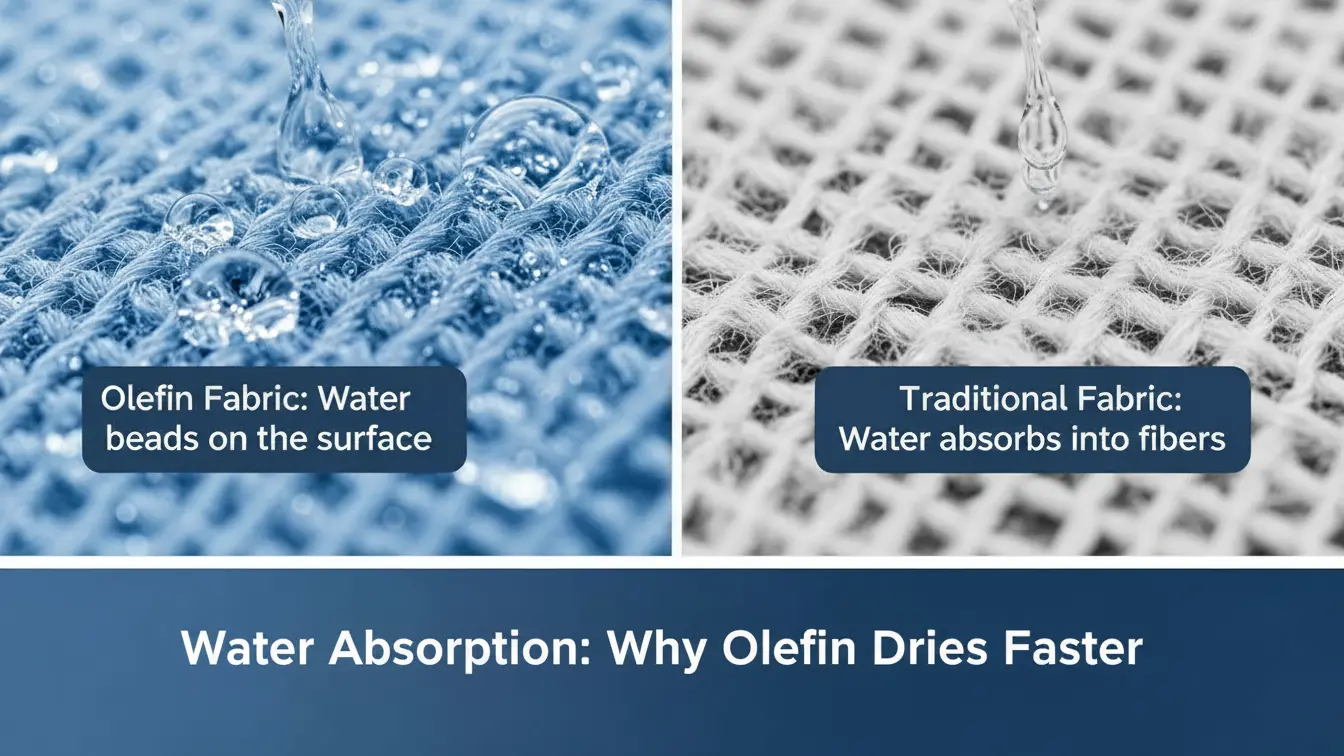
Olefin is inherently hydrophobic, featuring a water absorption rate of less than 0.1%. Because the fibers do not absorb moisture, water beads and rolls off the surface, allowing the fabric to dry rapidly and remain resistant to mold and mildew in humid resort settings.
The Hydrophobic Profile: Why Water Beads on Olefin
Olefin fibers exhibit a moisture absorption rate of under 0.1%, making them virtually waterproof compared to absorbent materials like cotton or traditional polyester. The non-porous chemical structure causes water to bead and roll off the surface rather than penetrating the fiber core. This inherent hydrophobicity prevents the “soggy” feel common in outdoor cushions, ensuring fabrics remain lightweight even when exposed to heavy rain or pool splashes.
Rapid moisture wicking limits the environment required for mold and mildew growth, which is critical for humid climates and pool deck applications. Because moisture cannot be retained within the weave of the fiber itself, evaporation occurs significantly faster than in natural or semi-synthetic blends, maintaining a sanitary and dry seating surface for high-frequency resort environments.
ASTM D3575 Validation: Quantifying Performance in Wet Zones
Technical testing via ASTM D3575 (Test Method L) provides quantifiable proof of Olefin’s quick-dry superiority. This industry standard measures absorption after submersion under a 3-m (10-ft) head of water for 48 hours to simulate extreme hydrostatic pressure. Typical Olefin absorption values range from 0.034 to 0.055 kg/m², which is significantly lower than standard commercial-grade outdoor fabrics that often rely on topical coatings rather than inherent fiber properties.
Post-immersion protocols involve high-pressure air streams (30 psi) to remove surface water, confirming that internal fiber integrity remains unaffected by water weight. High-density variants, ranging from 32-kg/m³ to 64-kg/m³, maintain consistent low absorption across varying material thicknesses. This engineering ensures long-term durability and performance in high-traffic waterparks and luxury spas where textiles are subjected to constant moisture and chlorine exposure.
Scale Your Business with Factory-Direct Commercial Umbrellas

Stain Resistance: Why Oils Don’t Stick
Oils fail to stick to poolside fabrics due to low surface-energy fluorochemical finishes like Teflon® and non-porous fiber structures. By engineering surfaces with lower energy than the oils themselves, materials like solution-dyed acrylic and PVC composites cause contaminants to bead on the surface rather than soaking into the fiber matrix.
The Chemistry of Low Surface Energy and Hydrophobic Barriers
The primary mechanism preventing oil penetration in poolside performance textiles is the application of fluorochemical and PTFE-based finishes, such as Teflon® fabric protector. These treatments create a low surface-energy barrier that is significantly lower than the surface tension of most oily substances, including sunscreens and body oils. By engineering this molecular shield, the fabric prevents the “wetting” of the fiber, forcing non-polar contaminants to bead on the surface rather than diffusing into the internal fiber matrix.
In addition to surface treatments, the inherent material properties of 100% solution-dyed acrylic systems offer high levels of stain resistance. These fibers are chemically engineered to be naturally hydrophobic and resistant to the growth of mildew and fading. Because the color and performance characteristics are integrated during the polymer stage before the fiber is extruded, the material can withstand harsh cleaning agents, such as diluted bleach, to remove oily residues without damaging the fabric’s integrity or appearance.
Advanced poolside upholstery often utilizes 100% PVC-faced composites that act as a continuous, non-porous physical barrier. This construction ensures that oils remain entirely on the surface where they can be easily wiped away. The integration of tightly woven structures further limits the physical diffusion of contaminants into the backing material, providing a multi-layered defense system that is essential for maintaining furniture aesthetics in high-traffic hospitality environments.

Standardized Testing for Oil Release and Surface Durability
Technical benchmarks for oil resistance are verified through the AATCC 130 (Oil Stain Release) testing protocol. This industrial standard uses oily soils, such as motor oil and corn oil, to evaluate how effectively a fabric releases contaminants during cleaning. Poolside fabrics are engineered to meet high release efficiency ratings, ensuring that sunscreen and tanning oils do not leave permanent shadows or “rings” on the upholstery after a maintenance cycle.
Surface durability is equally critical, as the protective finishes must remain intact even after repeated use. Many poolside fabrics are rated to exceed 100,000 Wyzenbeek double rubs, a measure of heavy-duty abrasion resistance. This high rating ensures that the mechanical action of cleaning—scrubbing and wiping—does not erode the protective fluorochemical layer. This durability allows the fabric to maintain its oil-repellent properties over years of commercial or residential use.
Dimensional stability and finish longevity are also quantified using the ISO 6330 domestic washing standard. Testing at temperatures ranging from 30°C to 60°C typically shows minimal shrinkage, often between -0.4% and -1.1%. This stability confirms that the fabric will not lose its shape or protective efficacy after laundering. Finally, these performance chemistries are designed to be compatible with flammability standards such as UFAC Class I and NFPA 260, ensuring that oil-repellent properties do not compromise the fire safety requirements of the installation.
Abrasion Resistance: Durability in High-Traffic Zones
Abrasion resistance is measured by Wyzenbeek (ASTM D4157) or Martindale (ASTM D4966) tests. For high-traffic poolside zones, the Association for Contract Textiles (ACT) recommends a minimum of 30,000 double rubs or 40,000 cycles. Materials like Olefin and vinyl-coated polyester mesh are preferred for their superior resistance to pilling and mechanical wear.
Defining Durability: Wyzenbeek and Martindale Benchmarks
Engineering standards for commercial textiles rely on two primary mechanical stress tests to quantify durability: the ASTM D4157 Wyzenbeek and the ASTM D4966 Martindale. The Wyzenbeek method, recognized as the North American gold standard for contract textiles, measures durability via “double rubs” using a #10 cotton duck abradant. Conversely, the Martindale test utilizes an oscillating motion measured in “cycles” at a specific 12 kPa pressure. Both tests are essential for validating how a fabric will perform when subjected to the constant friction of guests moving on and off poolside furniture.
For a textile to be classified for high-traffic or public-space upholstery, the Association for Contract Textiles (ACT) mandates a minimum performance threshold of 30,000 Wyzenbeek double rubs or 40,000 Martindale cycles. These requirements represent a significant increase in durability over standard private-use fabrics, which typically only require 15,000 double rubs or 20,000 cycles. Adhering to these commercial-grade benchmarks is vital for facility managers to prevent premature yarn breakage and objectionable wear in hospitality environments.
Material Performance in High-Stress Poolside Applications
Material selection is the most critical factor in achieving long-term abrasion resistance in wet, high-friction zones. Solution-dyed Olefin is frequently specified for poolside cushions because it exhibits higher abrasion resistance and significantly lower pilling than traditional acrylic or polyester blends. For load-bearing sling seating, vinyl-coated polyester meshes, such as Phifertex®, are engineered for extreme durability. These materials offer not only high rub counts but also exceptional tear strengths between 100–125 lb (45.4–56.7 kg), ensuring they can support repeated dynamic loading without structural failure.
When specifying textiles, it is important to recognize the “over-spec” limit where higher numbers do not equate to better real-world performance. The ACT indicates that abrasion ratings exceeding 100,000 double rubs are generally not meaningful, as the primary failure mode usually shifts from physical wear to UV degradation or chemical damage from pool chlorine. Even specialized apparel, such as high-performance boardshorts, targets a Martindale benchmark of at least 10,000 cycles to withstand the friction of pool decks and slides, reinforcing the need for rigorous abrasion standards across all poolside textiles.
Environmental Impact: Low-Waste Manufacturing
Low-waste manufacturing utilizes the Zero Waste Hierarchy to eliminate production discards at the source. By implementing lean principles and ISO 14001 standards, manufacturers achieve up to a 30% reduction in material waste and repurpose 80% of scrap, significantly lowering the 7.6 billion tons of industrial waste generated annually.
The Zero Waste Hierarchy in Fabric Production
Modern poolside fabric production relies on the Zero Waste International Alliance (ZWIA) hierarchy, a framework that prioritizes the highest and best use of materials to minimize environmental footprints. By shifting focus toward the use of prime materials and designing for repairability, manufacturers can significantly reduce the frequency of product replacement. This strategic alignment ensures that material reuse and refurbishment take precedence over energy recovery and landfilling, which are relegated to the lowest levels of the hierarchy.
To implement these principles effectively, engineers utilize Life Cycle Assessment (LCA) to identify and mitigate waste hotspots throughout the manufacturing journey. This data-driven approach allows for source-level process redesigns that address the root causes of industrial discards. By eliminating waste at the point of origin, facilities contribute to a reduction in the 7.6 billion tons of industrial waste generated globally each year, protecting biodiversity and preventing pollution without relying on chemical fuel conversion or incineration.
Efficiency Metrics and ISO 14001 Standards
Lean manufacturing and Just-in-Time (JIT) production serve as the technical foundation for achieving material efficiency. By optimizing value stream mapping, manufacturers can realize a 30% decrease in material waste while simultaneously lowering operational costs by 10-15%. Circular economy loops further enhance these results, enabling the reprocessing of up to 80% of industrial scrap—such as injection molding plastics and scrap metals—back into the production cycle rather than discarding them as byproduct.
Standardization through ISO 14001 certification ensures that these waste reduction and energy efficiency measures are consistently maintained. Facilities compliant with these standards often integrate LED lighting and solar energy systems, resulting in a 15% reduction in total power consumption. Furthermore, industrial recycling programs that divert plastic and metal from the waste stream can slash landfill disposal fees by over 50%, demonstrating that resource management is as economically viable as it is environmentally responsible.
Texsilk Brand Profile: The European Standard
Texsilk is a 100% European-made solution-dyed Olefin fabric produced near Barcelona. It sets the industry standard for poolside performance with OEKO-TEX Class 1 safety certification, UV UPF80+ protection, and exceptional resistance to chlorine (5/5 rating) and high-traffic abrasion (20,000 cycles).
Vertical European Manufacturing and Solution-Dyed Composition
Texsilk is defined by its 100% European production pedigree, manufactured in a vertically integrated facility near Barcelona, Spain. This vertical integration allows for complete control over the manufacturing process, from the selection of raw pigments to the final textile finishing. This localized production ensures 100% traceability and strict adherence to European Union environmental and labor standards, providing a level of transparency and quality assurance that is often missing in globally sourced alternatives.
The core of Texsilk’s performance lies in its solution-dyed Polypropylene (Olefin) composition. By locking pigments into the fiber core during the extrusion process, rather than applying dye to the surface, the fabric achieves superior fade resistance. This material foundation also ensures exceptional dimensional stability; according to UNE EN 25077 testing, the fabric exhibits a minimal dimensional change of only -0.4% during washing, maintaining its structural integrity and fit over long-term outdoor exposure.

Certified Performance: Safety, UV Protection, and Mechanical Resilience
Texsilk sets the benchmark for safety and protection with rigorous third-party certifications. It is OEKO-TEX Standard 100 Class 1 certified, the most stringent classification which ensures the fabric is non-toxic and safe even for direct contact with infant skin. For outdoor longevity, it carries the UV Standard 801 UPF80+ rating, effectively blocking more than 97% of harmful UV radiation. This protection extends to the fabric’s chemistry, as it achieves a perfect 5/5 rating for swimming pool water fastness (UNE EN ISO 105-E03) and a 5/5 spray test rating for water repellency, making it immune to chlorine degradation.
The mechanical durability of Texsilk is engineered for high-traffic environments and commercial applications. Laboratory results demonstrate high-performance metrics including a breaking strength of 740 N (weft) and a tear resistance of 73.9 N. With an abrasion resistance of 20,000 cycles and a pilling resistance rating of 5/5, Texsilk is built to withstand the physical rigors of poolside use, such as constant friction and exposure to abrasive elements, without losing its aesthetic or functional properties.
Best Use Cases: Pools, Waterparks, and Spas
Poolside environments require fabrics engineered for extreme chlorine resistance, UV stability, and near-zero water absorption. Key materials like solution-dyed acrylics and HDPE shade cloths meet CFFA marine standards and withstand frequent 10% bleach disinfection protocols, ensuring they survive the combined assault of salt, chemicals, and intense sun.
| Material Type | Technical Specifications | Primary Application |
|---|---|---|
| Solution-Dyed Acrylic/Polyester | 382 g/m²; 10% Bleach Cleanable; BS EN ISO 105-B04 Rating: 8 | Commercial Pool Upholstery & Spa Lounges |
| HDPE Shade Fabric | 363 lbf Burst Strength (ASTM D3787); 10-Year Life | Waterpark Canopies & Tension Structures |
| PVC-Coated Polyester Sling | 100% PVC Coating; High Drainage; Mildew Resistant | Waterpark Chaise Lounges & Seating |
| Expanded PTFE Thread | 1200–2400 Denier; Chlorine & Saltwater Immune | Structural Seaming for Aquatic Canopies |
Hospitality and Commercial Aquatic Environments
Commercial pool decks and hospitality settings demand textiles specifically labeled for poolside use, typically featuring a weight of approximately 382 g/m² and a thickness of 1.26 mm. These materials are engineered to withstand the rigors of high-frequency disinfection without experiencing fiber degradation or structural failure. In specialized zones such as spa relaxation areas or indoor aquatic centers, upholstery must be compatible with aggressive cleaning protocols, specifically 90% water and 10% bleach solutions, to effectively eliminate bacteria derived from skin oils and sunscreens.
For high-traffic resort environments, performance is measured against stringent international standards. Fabrics are selected based on superior wet and dry rubbing fastness (EN ISO 105-X12) and artificial weathering ratings as high as 8 (BS EN ISO 105-B04), ensuring that material colors remain vibrant even in intense splash zones. In waterparks, chaise lounges frequently employ 100% PVC-coated polyester sling fabrics, such as Phifertex, which are designed to maximize drainage and inhibit the growth of mildew in perpetually humid conditions.
Technical Performance Standards for Wet Zones
Large-format tensioned structures within waterparks rely on UV-stabilized HDPE fabrics to provide consistent shade and protection. These materials must demonstrate significant mechanical resilience, including a burst strength of approximately 363 lbf according to ASTM D3787 standards, and are expected to maintain a 10-year service life within chlorinated mist environments. To ensure the longevity of these structures, seams are joined using 100% expanded PTFE thread (ranging from 1200 to 2400 denier), which is chemically inert and remains unaffected by exposure to salt water or non-hydrocarbon cleaning agents.
Marine-grade specifications serve as the benchmark for poolside upholstery and liners. Materials used in splash zones must adhere to CFFA-MARINE/VINYL-201D or CFFA-MARINE/PU-101C minimum performance requirements to guarantee resistance to chemical exposure and mechanical wear. Furthermore, tensioned canopies engineered for these zones are built to endure extreme temperature fluctuations, maintaining their structural integrity across a range from -77 °F to +167 °F while under constant ultraviolet load.
Final Thoughts
Olefin, specifically in its high-performance Texsilk form, emerges as the definitive choice for high-traffic aquatic environments. By combining a chemically inert polypropylene backbone with a solution-dyeing process that locks color deep within the fiber, it transcends the limitations of traditional outdoor textiles. It is not just resistant to the harsh reality of poolside life—it is engineered to thrive within it, offering a unique intersection of 5/5 chlorine fastness, near-zero moisture absorption, and rigorous European safety certifications. Whether facing the concentrated bleach required for sanitation or the mechanical friction of daily resort use, this material provides a durability-to-value ratio that is difficult for even premium acrylics to match.
For facility managers, designers, and homeowners, choosing Olefin means investing in a textile that minimizes maintenance while maximizing longevity. Its ability to dry rapidly and resist mold growth ensures a hygienic, guest-ready surface, while its low-waste manufacturing footprint and OEKO-TEX Class 1 certification align with modern sustainability and safety goals. In an era where commercial-grade performance is expected in every outdoor space, Texsilk stands as the technical champion—a fabric that doesn’t just survive sun, salt, and chlorine, but maintains its structural and aesthetic integrity year after year in the most demanding conditions.
Frequently Asked Questions
Is Olefin fabric good for patio umbrellas?
Yes. Olefin is widely used as a durable, budget-friendly fabric for patio umbrellas, offering high UV fade resistance and mildew resistance. While it typically carries a shorter warranty (approximately 1 year) than premium acrylics, it provides excellent performance for 3–5 seasons in residential and poolside settings.
Can I use bleach on Olefin fabric?
Yes. Olefin (polypropylene) is highly resistant to chemicals and is compatible with bleach (sodium hypochlorite). It maintains a ‘Satisfactory’ (S) rating for chlorine exposure at temperatures up to 140°F (60°C), allowing for aggressive sanitation without damaging the fiber.
Is Olefin or Acrylic better for pool umbrellas?
For maximum longevity and 5-year warranties, solution-dyed acrylic is the premium standard. However, high-quality solution-dyed Olefin is the better value-engineered choice for pool decks where frequent bleach cleaning is required; it offers 700–1500 UV hours of fade resistance at a significantly lower price point.
Does chlorine damage umbrella fabric?
Chlorine does not damage fabrics specifically engineered for poolside use, such as solution-dyed Olefin (Texsilk) or acrylic. These materials are chemically inert to pool splash-over and chlorine-based cleaners, whereas standard polyester fabrics may degrade or lose structural integrity with prolonged exposure.



 English
  Spanish
  French
  German
  Portuguese