

Poor tube compatibility is a primary driver of customer returns and negative reviews in the patio umbrella category. A mismatched pole and base stem leads to wobbling, which customers perceive as a product defect. This simple specification error complicates inventory management for retailers and increases the landed cost per unit through unnecessary reverse logistics.
This technical brief outlines the key base specifications needed to support a diverse product line. We analyze the engineering behind dual-locking knobs, stainless steel stems, and the use of reducer rings to ensure a secure fit for both standard 38mm and heavy-duty 48mm poles. The goal is to help buyers source universal bases that reduce SKU complexity.
Standard Pole Diameters: 1.5″ (38mm) vs. 2.0″ (48mm)
The 1.5” (38mm) pole is standard for most center-pole market umbrellas. The larger 2.0” (48mm) diameter is reserved for heavy-duty cantilever or large specialty umbrellas needing more strength.
| Specification | 1.5″ (38mm) Diameter | 2.0″ (48mm) Diameter |
|---|---|---|
| Primary Use | Standard residential and light commercial | Heavy-duty and specialty applications |
| Umbrella Style | Center-pole market and patio umbrellas | Cantilever (hanging), large double-sided models |
| Our Product Line | PTMU-001 Market Umbrella | PTZHU-003 Hanging, PTMU-014 Double-Sided |
Matching Diameter to Umbrella Type
The choice between a 38mm and 48mm pole comes down to the umbrella’s size, weight, and design. A thicker pole provides the structural support needed for larger canopies and offset designs, while the standard size is perfect for most common patio setups.
- 1.5″ (38mm) Poles: This is the industry standard for center-pole market and patio umbrellas. It fits nearly all standard patio tables and bases, making it the right choice for high-volume models like our PTMU-001.
- 2.0″ (48mm) Poles: This larger diameter provides the necessary strength for heavier and larger canopies. It’s essential for offset hanging umbrellas (cantilevers) and extra-large models that carry more weight and face greater wind load.

Pole Specifications in Our Product Line
We engineer our umbrellas with the correct pole diameter to ensure stability and performance, optimizing each model for its intended market segment.
- Our best-selling PTMU-001 market umbrella features a 38mm aluminum pole, a design proven for retail settings and optimized for maximum container loading.
- For buyers needing greater coverage, the PTZHU-003 hanging umbrella and the PTMU-014 double-sided umbrella are both built with a robust 48mm pole to handle the larger canopy size.

The Reducer Ring: How to Fit Both Sizes
A reducer ring is a simple plastic insert that narrows an umbrella base opening, allowing a 38mm pole to fit securely in a hole designed for a 48mm pole.
How a Reducer Ring Bridges the Gap
A reducer ring is a tough plastic insert that drops into the stem of an umbrella base or the hole in a patio table. Its only job is to solve the problem of a pole being too narrow for the opening. Without it, the umbrella pole shifts and wobbles, especially in the wind.
The insert accomplishes three things:
- It narrows the diameter of the opening for a snug, secure fit.
- It fills the empty space, eliminating movement and preventing the pole from rattling.
- It protects the pole’s powder-coated finish from getting scratched during setup and use.
Making a Base Compatible with 38mm and 48mm Poles
Many umbrella bases are built with a stem wide enough to fit 48mm poles. This larger diameter is common on specialty models like our PTMU-014 Double-Sided umbrella or certain cantilever styles that require a thicker, stronger pole for support.
The reducer ring makes that exact same base compatible with the industry-standard 38mm poles. These are found on the best-selling center pole market umbrellas, including our high-volume PTMU-001 model.
This dual compatibility is a key inventory advantage. A buyer can stock one universal base that supports different umbrella types across their product range, from standard market models to larger, specialized units.
Get Durable, Custom Umbrellas Direct from Factory

Double-Locking Knobs: Preventing Wobble
A double-locking system uses two knobs to apply opposing pressure, centering the pole and eliminating gaps. This creates a much firmer, more stable fit than single-knob bases.
The Principle of Opposing Tension
A single tightening knob is a point of failure. It can only push the umbrella pole against one side of the base tube. This leaves a gap on the opposite side, allowing the pole to rock back and forth, especially in the wind. Adding a second knob applies balanced, opposing force. The two pressure points work together to center the pole perfectly within the tube, locking it down and preventing any tilt or movement.
A Secure Fit for Different Pole Sizes
This system provides a practical advantage by accommodating the most common commercial pole diameters, like 1.5″ (38mm) and 2.0″ (48mm), without needing flimsy plastic reducer rings. Those rings can crack or get lost, but a dual-knob system creates a direct metal-on-pole grip. The result is a rigid, reliable setup that performs better in windy conditions—a non-negotiable requirement for commercial venues like hotels and restaurants.

Stem Height: Why Higher is Better for Support
A taller stem grips the umbrella pole higher up, reducing the leverage wind can exert. This minimizes wobble and creates a much more stable foundation.
The Principle of Leverage in Umbrella Stability
It comes down to simple physics. A taller base stem raises the point of contact on the umbrella pole. This change effectively shortens the lever that wind can push against, giving it less mechanical advantage. The result is a significant reduction in side-to-side wobble at the base, keeping the entire umbrella more upright and secure, especially during gusty conditions.
Enhancing Grip with Double-Locking Knobs
To maximize this stability, many high-support bases use two locking knobs instead of the standard single knob. This design applies firm pressure at two separate points along the umbrella pole. By doing this, it completely prevents the pole from shifting, twisting, or rotating within the stem, locking it into a fixed position.
Material: Stainless Steel Stem vs. Iron (Rust Risk)
Stainless steel has built-in rust resistance from its chromium content. We protect our standard iron stems from corrosion with a durable, factory-applied powder-coated finish.
How Chromium Gives Stainless Steel Its Advantage
Stainless steel contains a high percentage of chromium. When exposed to air, the chromium reacts with oxygen to form a thin, invisible film of chromium oxide on the surface. This passive layer acts as a protective barrier, preventing moisture from reaching the underlying metal and stopping rust before it can start.
Our Protective Powder-Coating on Steel Stems
Our standard steel umbrella stems receive an Anthracite or Black powder-coated finish for robust rust resistance. This process seals the iron from the elements, providing a durable and cost-effective solution for preventing corrosion in typical outdoor settings.
Under-Table Clearance: Short Stems
A short base stem is crucial for fitting under a table’s support beams. If clearance is an issue, offset cantilever umbrellas eliminate the center pole and the problem entirely.
Why Standard Stems Conflict with Table Structures
Many outdoor dining tables are built with a cross-beam or central support structure directly underneath the umbrella hole. A standard base with a long vertical stem will collide with these supports. This prevents the umbrella from seating flush and securely, leading to instability and wobbling.
The Offset Design Solution: No Stem Needed
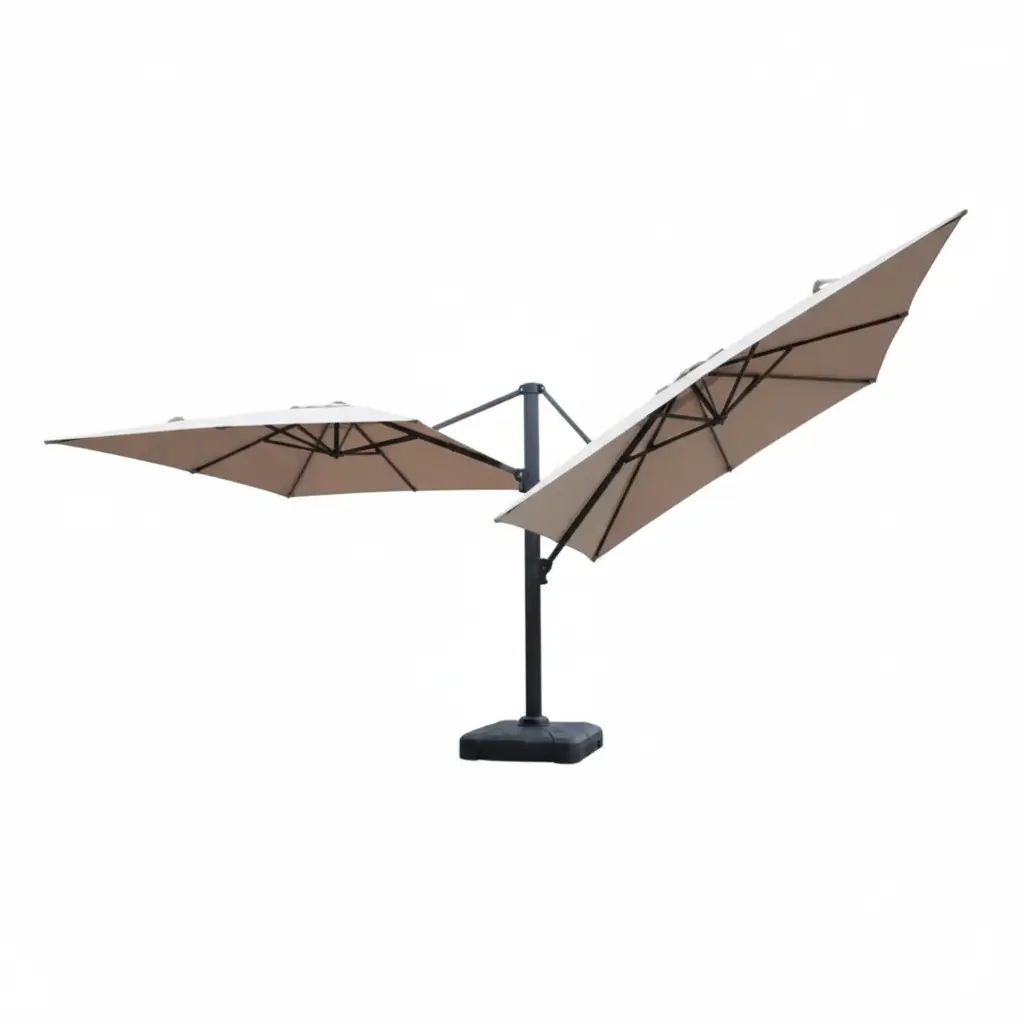
For tables with obstructive under-structures, the best solution is to remove the center pole from the equation. Cantilever umbrellas use an offset design that places the base and main pole off to the side, solving the clearance problem while also maximizing legroom for guests.
- ‘Banana’ Series (PTZHU-003): An entry-level hanging design perfect for residential patios where table clearance is a common issue.
- ‘Roma’ Series (PTZHU-020): A heavy-duty cantilever solution that completely bypasses the table, ideal for commercial and premium settings.
Identifying “Through-Table” Bases
A through-table base is a compact stand that fits under a table. It anchors the pole, but the table itself provides most of the stability against tipping.
Low-Profile Design for Under-Table Clearance
These bases are intentionally flat and compact. The design maximizes legroom under the table so customers aren’t kicking a bulky stand. It’s a simple, functional approach that prioritizes user comfort over unnecessary weight.
They rely on the table’s structure for lateral stability. Since the table’s center hole keeps the pole upright, the base doesn’t need the massive footprint of a freestanding model. Its primary job is to secure the bottom of the pole, preventing it from lifting or sliding.
Center Pole vs. Cantilever Umbrella Compatibility
Through-table bases are built for one purpose: to support center-pole umbrellas. This includes standard models like our PTMU-series market umbrellas, where the pole passes directly through the table and into the base below.
This setup is completely different from cantilever or offset models. Umbrellas like our PTZHU ‘Banana’ and ‘Roma’ series use their own heavy-duty cross bases for support. Their poles are positioned off to the side, so they don’t pass through a table at all.

Troubleshooting: Wobbly Umbrellas
A wobbly umbrella usually means an underweight base, a loose pole connection, or uneven ground. Add sufficient weight to the base and tighten all locking knobs.
Identifying Common Causes of Instability
Before you can fix the problem, you need to know the source. A wobble almost always comes down to one of three failures in the foundation of the setup.
- Inadequate Base Weight: The provided cross base isn’t secured with enough weight. This makes the entire unit top-heavy and unstable, even in a light breeze.
- Loose Pole Connection: The locking knobs that hold the umbrella pole inside the base stem are not fully tightened. This allows the pole to shift and rock back and forth.
- Uneven Ground Surface: The base sits on soft, sloped, or uneven ground. It can’t sit flat, which compromises the entire structure’s stability from the ground up.
Securing the Base and Pole for a Firm Fit
Specific actions are required depending on the umbrella model. The connection between the pole and the base is the most critical point of failure to address.
- For cantilever models like our PTZHU-003 ‘Banana’ series, the included cross base is not enough on its own. Always anchor it with heavy pavers or a dedicated sand/water-filled weight.
- Check that the pole fits snugly in the base tube. For a center pole model like the PTMU-001 with its 38mm pole, tighten the securing knobs until they press firmly against the aluminum. There should be no play.
- Confirm the ground is level and hard before assembly. The heavy-duty frame on our PTZHU-020 ‘Roma’ series needs maximum surface contact to provide proper support and prevent tipping.
Frequently Asked Questions
What size base tube do I need for my patio umbrella?
The base tube diameter should closely match your umbrella pole, typically with no more than a ¼-inch gap for a snug fit. The most common pole size is 1.5 inches. It is also important to ensure the base weight is sufficient for your umbrella’s size—a common guideline is 10 pounds of base weight for every foot of umbrella diameter.
How can I stop my umbrella from spinning in its base?
A spinning umbrella is often caused by a loose connection or an oversized hole. The first step is to tighten the securing bolt on the base. For a more effective solution, a rubber cone wedge can be placed on the pole to fill the gap in a table, creating friction that prevents both spinning and rattling.
Will a 1.5-inch umbrella pole fit in a 2-inch base?
A 1.5-inch pole will be loose in a base designed only for a 2-inch pole. But, most modern umbrella bases are built with adjustable holders or tightening knobs that can accommodate a range of pole sizes, including both 1.5 and 2 inches. Check the product specifications to confirm the base supports multiple sizes.
Why is my patio umbrella wobbly and how do I fix it?
Wobbling is usually caused by loose hardware or a base that is too light for the umbrella. First, check and tighten all bolts and screws. If the issue persists, the base likely needs more weight. For umbrellas used through a table, a cone wedge can add significant stability.
Final Thoughts
While generic bases lower your initial FOB cost, they are a direct line to customer returns from wobble and rust. Our standard of dual-locking knobs and powder-coated steel stems protects your brand’s reputation. Reliable hardware is what separates a one-time purchase from a loyal dealer network.
Verify our engineering for yourself. We recommend requesting a sample base to test the fit and finish with your existing umbrella stock. Contact our team to get the technical spec sheets or discuss OEM requirements for your next container.




 English
  Spanish
  French
  German
  Portuguese