


Restaurant space planning is an engineering challenge where layout directly dictates revenue potential. Industry data confirms that effective floor plans must adhere to a strict **40/60 back-to-front house split** to balance preparation efficiency with earning capacity. Failing to meet capacity targets—specifically the allocated **11–20 square feet per guest**—compromises your **Sales Per Square Foot (SPSF)** and creates immediate workflow bottlenecks.
This article provides the empirical framework for maximizing your restaurant’s **Net Selling Area**. We analyze density standards across **Fine Dining** and **Fast Food** service models, comparing the ROI of high-density **Booths** versus adaptable **Freestanding Tables**. Furthermore, we explore advanced auditing methods, including the use of **LiDaR sensors** and **SPSF formulas**, to identify dead zones and validate your build-out investment.
The Importance of Restaurant Space Planning
Effective layouts adhere to a 40/60 back-to-front house split and allocate 11–20 square feet per guest to maximize turnover and workflow efficiency.
Balancing Operational Flow and Revenue Potential
Restaurant space planning is an engineering challenge, not an aesthetic one. Menu complexity dictates the initial layout; a complex menu demands expanded workstations and specific equipment, which immediately increases the back-of-house footprint. To prevent bottlenecks, you must integrate flow diagrams and scaled equipment layouts before finalizing utility scheduling.
Capacity planning relies on hard data rather than guesswork. You determine revenue potential by analyzing chair spacing, seat turnover rates, and peak meal volumes. For instance, a schematic plan must support specific throughput targets—such as 700 total daily meals split across breakfast, lunch, and dinner—without compromising anthropometric clearances required for staff movement or Disability Act compliance.
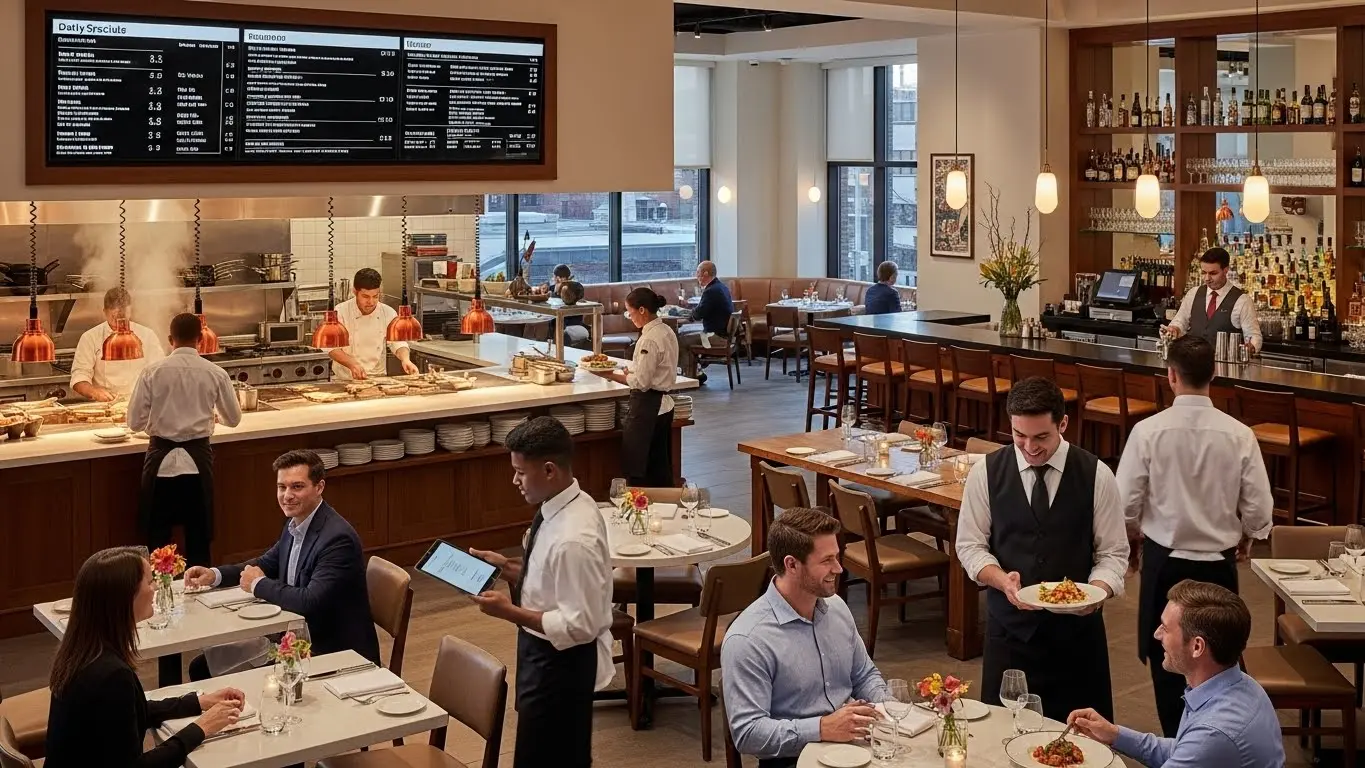
Standard Allocation Ratios and Square Footage Metrics
The industry standard allocates 40% of total space to the kitchen and storage, leaving 60% for the dining area. This split balances preparation efficiency with revenue-generating capacity. Detailed square footage assignments depend heavily on the service model and safety requirements.
- Fine Dining: 18–20 sq ft per guest.
- Full-Service Dining: 12–15 sq ft per guest.
- Fast Food: 11–14 sq ft per guest.
- Equipment Ergonomics: Minimum 22″ x 13″ counter space next to ovens for unloading full-sized pans.
Validating your space-per-dollar investment requires precise coverage calculations. For a 100-seat restaurant serving 1,000 meals daily, data suggests allocating 1,400 sq ft for dining and 1,300 sq ft for the kitchen. As volume increases to 175 seats and 1,800 meals, those requirements scale to 2,625 sq ft for dining and 2,000 sq ft for the kitchen.
Calculating Revenue Per Square Foot
Revenue per square foot benchmarks layout efficiency by dividing total sales by net selling area, explicitly excluding non-revenue spaces like storage and offices.
| Metric Component | Technical Definition | Application |
|---|---|---|
| Gross Sales | Total revenue generated over a fixed period (month, quarter, year). | The numerator in the efficiency equation. |
| Net Selling Area | Active floor space only. Excludes back-of-house, storage, and offices. | The denominator. Using “Gross Leasable Area” here dilutes the data. |
| SPSF Output | The standardized dollar value generated per unit of space. | Determines if a layout validates the rent or build-out cost. |
The Core Formula: Gross Sales vs. Net Selling Area
The standard engineering-style definition for Sales Per Square Foot (SPSF) is total sales revenue divided by the selling area. The accuracy of this metric depends entirely on how you define the “area.” You must use Net Selling Area rather than Gross Leasable Area (GLA). Including back-of-house, storage, offices, or non-revenue corridors skews the results and hides the true selling power of your floor plate.
- The Formula: SPSF = Total Sales Revenue ÷ Net Selling Area (ft²).
- Retail Example: $500,000 annual sales ÷ 2,000 ft² selling space = $250/ft².
- Multi-Store Example: $15,000,000 revenue ÷ 150,000 ft² (across 10 locations) = $100/ft² average.
Strategic Application: Benchmarking Layout Efficiency
Landlords and retailers use this metric to judge how efficiently a specific floor plan converts space into cash. In commercial real estate, analysts calculate Tenant Sales PSF to compare revenue density against Rent Per Square Foot. This ratio identifies location profitability and signals whether a footprint should be expanded, downsized, or re-tenanted.
For space planners, this metric transforms abstract design choices into quantifiable investment trade-offs. Instead of asking “which layout saves more space,” you evaluate alternate floor plans by projecting total sales for each concept and dividing by the active selling footage. This allows you to stack different concepts side-by-side to see which layout yields higher revenue per dollar of build-out cost.

Booths vs. Tables: Which Saves More Space?
Booths maximize density by utilizing perimeter walls and corners, whereas freestanding tables require extra floor area for chair circulation and access gaps.
| Comparison Metric | Booths | Tables |
|---|---|---|
| Space Efficiency | High (Uses walls & corners) | Moderate (Requires circulation gaps) |
| Trade Show Standard | Island: 20×20 ft or 20×30 ft | Tabletop: 6-foot linear |
| Privacy Level | High (Enclosed zones) | Low (Noise bleed/Open) |
| Flexibility | Fixed | High (Reconfigurable) |
Perimeter Efficiency and Seating Density
Booths utilize vertical and corner real estate, effectively eliminating the “dead zones” typically found behind pull-out chairs. Fixed installations allow for continuous seating along walls, which significantly reduces the interstitial gaps required for circulation around freestanding tables. Corner booths specifically convert awkward architectural spaces into high-density zones that enhance perceived capacity.

Dimensional Standards and Flexibility Trade-offs
Trade show configurations highlight the distinct scale difference between these setups. Booths generally command larger, high-visibility footprints, while tables serve compact, portable requirements.
- Island Booths: Typically occupy 20×20 feet or 20×30 feet for 360-degree access.
- Tabletop Displays: Often limited to compact 6-foot linear spaces.
Tables prioritize adaptability, allowing reconfiguration for events or large parties, but they suffer from noise bleed and reduced privacy in open layouts. Booths offer superior longevity and durability for high-traffic zones, balancing their higher upfront cost against the need for frequent table rearrangements.
Factory-Direct Commercial Patio Umbrellas

Strategies for Optimizing Traffic Flow
Optimize flow by segregating high-activity zones and applying the 30-meter rule for collaboration. Validate layouts using IoT sensors and heatmaps rather than relying on empirical guesswork.
Zone-Based Zoning and Proximity Rules
Implement zone-based layouts that strictly separate high-traffic collaboration areas from quiet focus zones. This physical division prevents cross-flow disruptions that kill productivity. For team placement, apply the **30-meter rule**. Research indicates that collaboration and natural interaction peak within a 30-meter radius and decline rapidly beyond that distance.
Adopt flexible zoning strategies rather than static setups. **77% of businesses** now prioritize adaptable layouts over merely shrinking office footprints. This approach allows for modular adjustments to traffic pathways as operational needs shift, ensuring long-term efficiency without requiring major construction.
Data-Driven Modeling and Sensor Integration
Stop guessing where people walk. Deploy **IoT sensors**, specifically **LiDaR strips** and blurred vision cameras, to capture real-time occupancy and congestion data without compromising privacy. These tools generate heatmaps that expose bottlenecks and “dead zones” invisible to the naked eye.
When auditing floor plans, analyze pathways against **3-5 year growth projections**. Current usage metrics often fail to account for future density. Your audit must factor in specific expansion requirements:
- Headcount: Projected staff density and department scaling.
- Technology Capacity: Infrastructure limits for new workstations.
- Storage Needs: Space requirements for physical assets and archives.
- Meeting Room Utilization: Frequency and occupancy rates for gathering spaces.
Common Floor Plan Mistakes
Floor plan errors stem from incomplete 2D drawings that miss vertical volume and technical systems, leading to costly construction clashes and poor livability.
Inaccurate Scaling and Missing Dimensions
Visual scale mismatches often deceive stakeholders. A room drawn to appear spacious frequently proves cramped in physical reality because the draft lacks precise proportions. Professional standards demand consistent scaling across all drawings to prevent these misjudgments. You must use metric measurements (width × length) as the primary data point, placing imperial units in brackets only for reference.
Verticality is a critical blind spot in standard 2D plans. Drafts often fail to explicitly mark ceiling heights, which is fatal in properties with lofts or basements. Sloping ceilings in these areas drastically reduce the actual usable volume, yet the floor plan suggests full capacity. Always use arrowheads against walls to define boundaries and annotate restricted headroom clearly.
Technical Oversights in Systems and Circulation
Functionality breaks down when utility planning is an afterthought. A frequent error involves suboptimal plumbing and electrical routing, such as designing long pipe runs between kitchens and utility areas. This oversight increases modification costs and complicates the build. You need to verify systems layering early, ensuring adequate power outlets and ventilation distances align with actual workflows.
Circulation details define the livability of the space. Neglecting door swings, stair travel direction, or furniture fit results in physical clashes once construction finishes. Missing orientation data is another common technical failure. You must include specific technical markers to validate the layout’s viability:
- North Arrow: Required for planning natural light, heating, and ventilation orientation.
- External Areas: Explicit boundaries for gardens, balconies, and parking.
- Fixtures & Fittings: Exact positions for kitchen and bathroom units, including window widths.
- Storage & Utility: Dedicated service spaces often omitted from initial drafts.
Final Thoughts
Revenue density relies on cold math, not aesthetic preference. Prioritizing open space over calculated efficiency will destroy your Sales Per Square Foot ratio.
Audit your Net Selling Area today against the 60/40 split standard. If you fall short, swap low-density tables for perimeter booths to immediately increase capacity.
Frequently Asked Questions
Can you put a cantilever umbrella over a dining table?
Yes, cantilever umbrellas work well for dining configurations because they remove the center pole obstruction. For optimal coverage, the canopy must extend 2 feet beyond the table edge on all sides. For example, a 9-11 ft canopy is the correct specification for standard 38-48 inch tables.
Do market umbrellas strictly require a hole in the table?
While properly weighted freestanding bases can support them, the industry standard for market umbrellas in dining setups is “through-table” installation. Most commercial outdoor tables feature a 1.75-2.0 inch center hole designed to stabilize standard 1.5-2 inch umbrella poles.
Which umbrella configuration provides the most shade?
Coverage scales with canopy diameter; a standard 10 ft umbrella covers approximately 78.5 sq ft. For maximum efficiency, multi-canopy cantilever systems (such as a 4-head mast) provide up to 400 sq ft of shade from a single structural footprint.
How should multiple umbrellas be arranged for maximum shade?
Commercial layouts typically space umbrellas 6-8 feet apart (center-to-center) to create continuous shade while minimizing clutter. Planners must ensure at least 4 feet of circulation space between setups and maintain 7 feet of vertical head clearance.




 English
  Spanish
  French
  German
  Portuguese