


Offering Spare Parts is a critical defense against warranty claims that erode margins on high-volume promotional umbrellas. A single rib failure from a sudden breeze can force a full unit replacement, turning a profitable sale into a net loss and damaging client relationships.
This analysis identifies the essential components for frames with a standard Grade 3 wind resistance. We detail the factory-direct process for ordering model-specific parts, clarifying MOQ and payment terms to protect your investment and extend product life.
What Should Be Inside Your Umbrella “Emergency Repair Kit”?
A practical emergency kit needs waterproof fabric patches for canopy tears and a set of rib connectors and rivets to handle common frame damage from wind or wear.
Core Components for Fabric and Frame Repair
Any field repair kit focuses on the most frequent points of failure. For patio umbrellas, that means the fabric and the frame’s moving parts. Having a few key items ready can prevent a minor issue from turning into a complete loss.
- Waterproof Patches: Self-adhesive patches designed to instantly seal tears or snags in the canopy fabric, preventing further damage.
- Rib Connectors & Rivets: Steel fasteners are essential for re-securing frame arms that have disconnected from the hub or broken under stress.
- Buttons & Fasteners: Simple replacement parts for worn-out hardware that can compromise the umbrella’s function.
Why Patches and Connectors Are Critical for Promotional Grade Umbrellas
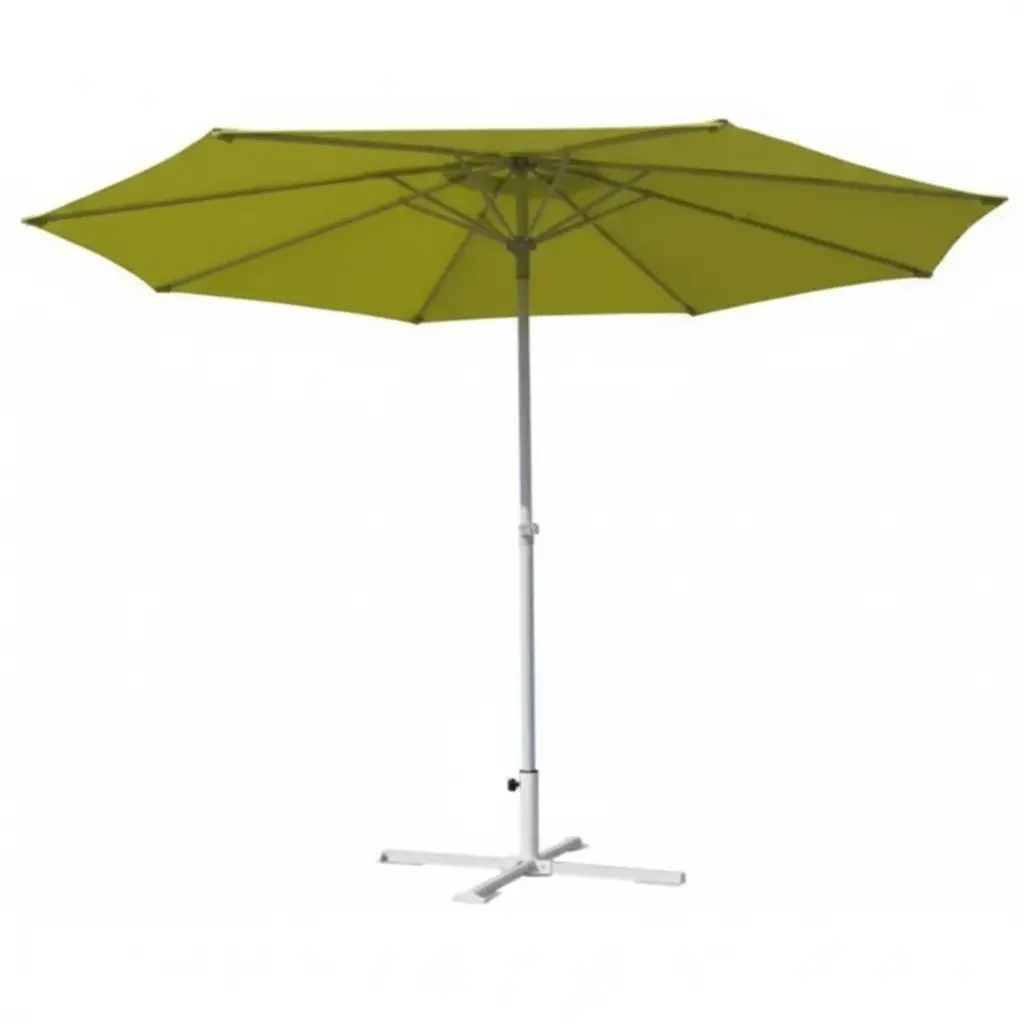
Our promotional grade umbrellas are built for seasonal value, not storms. The frame has a standard wind resistance rated at Grade 3 or less. This means the ribs are the most likely failure point in a sudden breeze. Having rib connectors on hand is non-negotiable for quick field repairs that extend the product’s usable life.
The canopy fabric is another key area. We use a cost-effective 160g/m² polyester that looks great but can be susceptible to snags. A simple waterproof patch turns a potentially discarded umbrella into one that can finish the season, protecting your client’s investment and brand visibility.
What Is the “2% Rule” for Calculating Free Spare Parts?
The “2% rule” is for maintenance budgeting, not free parts. For promotional umbrellas, a practical, pre-negotiated quantity of common parts is the industry standard.
Clients often ask about a “2% rule” for getting free spare parts. This is a common misunderstanding. The rule actually applies to financial planning for industrial maintenance, not calculating parts for a specific order of consumer goods. Let’s break down the difference between the budgeting guideline and the practical method used for high-volume promotional products.
| The “2% Rule” (A Maintenance Budgeting Guideline) | The Practical Method (For Promotional Umbrellas) |
|---|---|
What It IsA financial planning tool. It suggests budgeting 2% to 5% of a facility’s total Replacement Asset Value (RAV) for annual maintenance costs. Another version recommends budgeting 2% of the initial inventory cost for spare parts in the second year of an asset’s life. | What It IsA practical, pre-negotiated agreement. Instead of a percentage formula, a fixed quantity of the most common failure parts is included based on the total order volume. This is standard practice for our ‘Promotional Grade’ and ‘Seasonal Value’ umbrellas. |
Best ApplicationLong-term, high-value industrial equipment and facilities where ongoing maintenance is critical to prevent costly downtime. | Best ApplicationHigh-volume, cost-effective products like ours that have a defined seasonal lifespan. This method is more efficient and realistic for entry-level goods. |
The OutcomeAn annual financial budget allocated for future, unscheduled repairs and upkeep. | The OutcomeA physical set of spare parts (like ribs or plastic finials) included with the bulk shipment to handle immediate, common issues. |
Boost Profits with Factory-Direct Commercial Umbrellas

Which Spare Parts Are Critical to Keep in Stock? (Ribs, Hubs, and Finials)
Stock ribs, hubs, and finials for promotional-grade umbrellas. These are the most common failure points from wind, drops, or mishandling, making repairs fast and cost-effective.
For entry-level, promotional umbrellas, you don’t need a massive inventory of every possible part. Focusing on the three most common points of failure—ribs, hubs, and finials—is the most efficient way to handle repairs. These components take the most abuse from weather and user error. Stocking them allows for quick fixes that keep customers happy without the expense of replacing a whole unit.
Identifying Common Failure Points from Use and Weather
These umbrellas are designed for seasonal use and have clear performance limits. The ribs are the first to go when exposed to wind stronger than the recommended Grade 3 limit of 12-19 km/h. They bend or snap under the stress. The hub, which is the mechanism that slides up and down the pole, will crack if someone tries to force it open or slam it shut. And the finial, the decorative piece at the very top, is just plastic—it easily breaks if the umbrella is dropped on a hard surface or stored carelessly.
Matching Spare Parts to Frame Specifications
You can’t just order any generic part. The replacement must match the original frame’s material and treatment to maintain its integrity. For our steel-framed models like the PTMU-010, the replacement parts need the same Phosphating and Powder Coating treatment. Without it, you lose the rust resistance that the original product offered.
It’s the same story for aluminum frames. For a model like the PTMU-001, you must order aluminum-specific parts. This ensures the unit stays lightweight and naturally rust-proof, which are its key selling features. Mixing materials can lead to problems down the line and undermines the product’s quality.

Best Practices: How Should You Store and Label Your Spare Parts Inventory?
Organize storage by part frequency and size, using precise location codes with barcodes on every bin. This system ensures fast retrieval, accurate tracking, and minimal operational downtime.
Organizing Storage by Part Criticality and Size
A functional warehouse isn’t just a big room with shelves; it’s organized for efficiency. Put your high-demand or critical spare parts in the most accessible spots—lower shelves near the front of the storage area. This simple step cuts down on time wasted searching. Safety is just as important. Place heavy components on sturdy, low shelves to reduce the risk of injury and the need for heavy lifting equipment. Smaller items like bolts, screws, and fasteners should be organized into clearly labeled bins to prevent loss and speed up picking.
Using Location Codes and Barcodes for Fast Retrieval
Vague locations kill efficiency. Instead of just noting a part is in “Aisle 3,” assign each SKU an exact location code that specifies the aisle, shelf, and bin number. This turns a general area into a precise address that anyone can find instantly. To make it even faster, apply QR codes or barcodes directly to the bins and shelves. Scanning a code is much quicker and more accurate than manual entry. This automates inventory updates in your system, drastically reduces search time, and eliminates guesswork when a technician needs a part right now.
How Can You Order Extra Parts Using the Factory Direct Price List?
Provide detailed specs and quantities, negotiate MOQs and bulk pricing, then confirm with a formal PO and a 30% T/T deposit to lock in factory direct costs.
To get the best price on spare parts, you have to operate like a professional buyer. This means being clear about what you need and understanding how factories like ours structure deals. A sloppy inquiry gets a slow response, or worse, an inflated quote. The process is straightforward if you follow the standard steps.
Defining Your Requirements and Negotiating Terms
The first step is sending a clear request for quotation (RFQ) that we can actually work with. Vague inquiries create delays and pricing errors. You need to provide precise details upfront to get an accurate quote and negotiate from a position of strength.
- Document Exact Specifications: We need to know the part’s material, critical dimensions, and the total quantity you plan to order. Without this, we can’t calculate material costs or production time.
- Inquire About Bulk Discounts: Factories operate on volume. Always ask about tiered pricing. The price per unit will drop significantly as your order volume increases.
- Clarify the Minimum Order Quantity (MOQ): Every part has an MOQ for production. You need to know this number to see if it aligns with your inventory needs and budget. We can’t fire up a production line for just a handful of pieces.

Finalizing Your Order with Our Standard Payment Terms
Once we agree on price and quantity, finalizing the order follows our standard factory procedure. These terms are non-negotiable for new B2B clients and ensure your production slot is secured in our schedule.
- Payment Method: Our standard method is T/T (Telegraphic Transfer). We require a 30% deposit to confirm the order and begin sourcing raw materials.
- Balance Payment: The remaining 70% balance is due upon our sending you the copy of the Bill of Lading (B/L), just before the container is released at your port.
- Sample Verification: We always recommend verifying quality with a sample first. Samples are charged at 2x the agreed unit price to cover handling and air freight prep. This sample cost is fully refunded on your subsequent bulk order.
Are Your Replacement Parts Universal or Model-Specific?
Core parts like poles and ribs are model-specific for umbrellas like the PTMU-001 or PTZHU-003. This guarantees a perfect fit and avoids performance issues for our budget-friendly umbrellas.
General-Purpose Parts vs. Guaranteed-Fit Parts
Universal parts are designed to fit a wide range of models from different manufacturers. They’re often cheaper and easier to find, but the fit is a compromise. You might get a part that works, but it rarely aligns perfectly without some modification, which creates a weak point.
Model-specific parts are engineered to our exact factory specifications for a particular product. There’s no guesswork. They provide a flawless fit, maintain the product’s structural integrity, and ensure reliable operation, which is critical for outdoor equipment.
Why Our Core Umbrella Components Are Model-Specific
The core structural components of our umbrellas are not interchangeable. Each model is optimized for cost and container loading, so the dimensions are precise. For example, the pole for our PTMU-001 market umbrella is 38mm aluminum, while the pole for our high-volume PTMU-010 is a 34mm steel pole. They simply will not fit each other’s bases or hubs.
This applies to other key parts, too. The ribs, hubs, and finials are engineered to the specific geometry and load requirements of each umbrella line. The mechanics of a center-pole Market umbrella (PTMU series) are completely different from an offset Banana umbrella (PTZHU series). Using incorrect parts leads to failure and customer complaints.

How Fast Can We Ship Emergency Parts via DHL or FedEx?
For US domestic emergencies, FedEx is fastest. For international parts from our Linhai factory, DHL Express is the go-to for next-business-day delivery to major hubs.
When a machine is down, getting a replacement part isn’t just urgent—it’s critical. The right shipping choice depends entirely on where the part is coming from: our US warehouse or directly from the factory floor in China.
For US Domestic Shipments: FedEx Priority Options
If the emergency part you need is stocked in our US warehouse, FedEx provides the most aggressive timelines. The standard for urgent cross-country needs is FedEx Priority Overnight, which targets next-business-day morning delivery for most of the United States.
For extreme situations where hours matter, FedEx SameDay service can be used for point-to-point delivery within the same region, getting a part from our warehouse to your facility as quickly as possible.
For International Shipments from China: DHL Express Worldwide
When a critical component has to ship directly from our factory in Linhai, DHL is our carrier of choice. Their DHL Express Worldwide service is built for speed, aiming for an end-of-day delivery on the next possible business day to major hubs in North America, Europe, and Asia.
DHL also maintains a very high on-time performance record on these key international routes. For critical parts where reliability is just as important as speed, they are the trusted option for getting components from our production line to you without delay.
Frequently Asked Questions
What are the most common parts that break on a patio umbrella?
The ribs are the components most susceptible to damage, particularly from wind gusts that stress the metal joints. The internal string or cord within crank mechanisms also frequently wears out or breaks from use. Fabric tears are another common issue that can worsen over time if not repaired.
What information do I need to provide to order the correct parts?
To ensure accuracy, please provide the product model number (e.g., PTMU-001 or PTZHU-003), a clear description of the part, and photos of the component you need to replace. This helps our team identify the exact item from our inventory.
What are the payment and sampling terms for parts?
Our standard payment terms require a 30% deposit to start the order, with the remaining 70% balance due against the copy of the Bill of Lading (B/L). Part samples are charged at double the unit price, and this cost is refunded when you place a bulk order. Sample freight is collected.
What is the warranty on your standard polyester fabric?
Our standard polyester fabric (160g/m² or 180g/m²) is a promotional-grade material intended for seasonal value and comes with a 1-month warranty. For applications requiring longer color life, we recommend upgrading to our Yarn-Dyed fabric, which carries a 3-6 month warranty.
Final Thoughts
Generic parts might seem cheaper, but a mismatched rib or hub leads directly to customer complaints and erodes your brand’s credibility. Our model-specific components guarantee a perfect fit, maintaining the umbrella’s original integrity and protecting your reputation. This is how you turn a simple field repair into a value-add for your clients.
Stop guessing and start stocking the right components. Request a sample kit of our most common parts—ribs, hubs, and finials—to verify the quality and fit firsthand. Let’s discuss including a pre-packaged spares kit with your next container to streamline your after-sales service.



 English
  Spanish
  French
  German
  Portuguese